Q: What does the pope eat during the season of Lent?
A: Holy mackerel!
source: http://www.jokes4us.com/sportsjokes/fishingjokes.html
Have a FINtastic week! R <+>{
All about Fish Vetting – Dr Richmond Loh
Q: What does the pope eat during the season of Lent?
A: Holy mackerel!
source: http://www.jokes4us.com/sportsjokes/fishingjokes.html
Have a FINtastic week! R <+>{
We are expanding our veterinary services to include Canberra in the ACT.

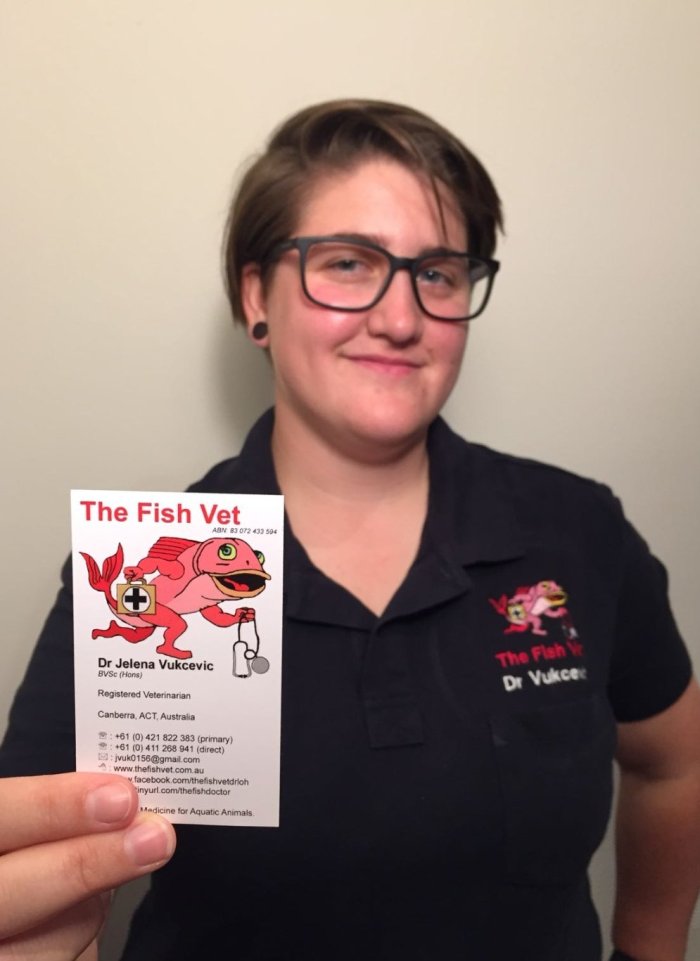
Dr Vukcevic is a small animal and exotics veterinarian based in Canberra. Since graduation, she has held positions in small animal and exotics practices in Canberra. She has a keen interest in aquatic animal medicine and currently divides her time between working as a veterinarian at a university institution, a zoological institution and small animal/ exotic practice, where she manages and provides veterinary advice/ treatment to a variety of both aquatic and non-aquatic species in various settings.
Whether you have a pet fish, aquarium, pond or zoo, we are here to help.
Servicing Canberra, Sydney, Melbourne and Perth.
Q: Why did the fish cross the road?
A: To prove he wasn’t chicken.
Have a FINtastic week! R <+>{
Presentation by Dr Jessie Sanders (a Certified Aquatic Veterinarian) can be viewed here –
https://youtu.be/dAVvWuVepqo
While they acknowledge that CyHV-3 can have a devastating effect on farmed carp populations, the broader number of variables at play in the wild, including carp biology, the virus’ pathogenesis and the ecology of local rivers, mean a release of koi herpesvirus would not likely result in the desired outcome...
This symposium held in Sydney during Jan/Feb 2018 was well-attended, with over 70 registrants from every state in Australia, and attracted international participants from USA and New Zealand. And about 50 of these stayed on to attend the Wetlab workshop.

It had a combination of great speakers sharing their relevant and practical knowledge unreservedly. Dr Lucie Nedved and her team, with thanks to the Tecniplast (platinum sponsor), other sponsors and the UNSW – made this all possible.
The following paragraphs are some interesting and important gems of knowledge I manage to capture…
Fish sentience, cognition and behaviour. By A/Prof Culum Brown.
Prof. Brown lamented, “Despite many scientific publications and books, the understanding that fish have cognitive ability and pain perception hasn’t penetrated into the general society.” Maybe we need to get these in the forum that is more available for general consumption.
He gave many examples of behaviours that demonstrate cognitive abilities of fishes, ranging for the use of tools, to altering of the environment (e.g. cichlids nest building), complex social structures, social learning, intra-species and inter-species co-operation, and even fish with personalities and how they enjoy back-rubs!
He recommended housing for fishes to have spatial complexity (e.g. environmental enrichment), allow for social complexity, and a varied diet.

Pain perception in fish. By Prof Craig Johnson.
Prof. Johnson started by introducing New Zealand’s definition of what constitutes an “animal” under their animal welfare act. It includes all mammals, birds, reptiles, amphibia, fishes, and some invertebrates (octopus, squid, crab, lobster, crayfish). It also includes any mammalian foetus, or pre-hatched avian or reptile young in the last half of its period of gestation/development, and any marsupial pouch-young.

The key concept is that most animals have a degree of nervous complexity, and so they are assumed to have the ability to suffer. He provided a lot of examples of experiments showing response to analgesic, avoidance, learning, and trade-off with other activities. When an animal is in pain, they may not communicate it to us in a way we understand. It is more important that they can communicate their pain to con-specifics, rather than to humans.
He explained that “nociception” is only the detection of a stimuli (mechanical or chemical), and that “pain” is nociception plus emotional/feeling. So, for an animal to feel pain, they need all the following:
Whereas, nociception only satisfies points 1, 4 and 6.
Aquarium experiments on wild fishes – are they relevant. By Prof David Booth.
He asked the question, are we controlling variables too much in a laboratory setting? After all, animals live in a multivariate society. Traits that make wild fish more suitable for captive experiments include those with a low home range, small species and sedentary fish. Increasing the feeding frequency helped reduce stress in the captive fish.

Animal Welfare Officer challenges in aquatic research. By Dr Lewis Vaughan.
Researchers at the university running trials using fish of species that are eaten by people. There are few medicines registered for use in food fish. Those available for the aquarium industry are for ornamental fish treatment only, and are not labelled with their active ingredients. A more thorough search for their Materials Safety Data Sheet (MSDS) states that many are “very toxic to aquatic organisms, may cause long-term adverse effects in the aquatic environment.”
Both malachite green and formalin are carcinogens (can cause cancer), and malachite green has been banned for use in food fish. Thus these medicines are not suitable for fish that could possibly enter the food chain.

Exotic aquatic pathogens from the importation of ornamental fish and the biosecurity risk to Australia. By A/Prof. Joy Becker.
There are 34 non-native freshwater species that have established populations in Australia. Approximately half of these are believed to originate from the ornamental fish trade. Dr Becker claims ornamental fish could pose a source for exotic diseases; notably Atypical Aeromonas salmonicida was first detected in a Victorian goldfish farm in 1974, cyprinid herpesvirus 2 (goldfish herpesvirus) with the first outbreak occurring in a small breeding facility in Perth (WA) in 2003, and dwarf gourami iridovirus (Megalocytivirus) with a significant outbreak at a Murray cod farm in Victoria in 2003. Dr Becker calls to re-evaluate current import practices.

Impact of pathogens on zebrafish research. By Dr Marcus Crim.
Zebrafish are susceptible to naturally-occurring infectious diseases that can invalidate studies.
Thus diseases can be more than a major problem for animals in laboratories:
Overt diseases with or without mortalities are easy enough to detect in adult fishes, and researchers must take these into account when interpreting their data. However, it is the subclinical diseases that could prove to be the great undoing of any research project.
But how about diseases in fish embryos (most research is conducted on fish <5 days post-fertilisation)? How can disease be an issue for the researcher?
The zebrafish innate immune system develops early:
Ways in which disease can invalidate studies even on embryos include:
Epigenetic effects?
My conclusion is that at the beginning, and at the completion of the experiment, a subsample of the animal population should be sent for diagnostics, to allow researchers to determine if their health/disease status is a confounding factor in how they interpret their data.
Freshwater fish diseases (Parts I and II). By Dr Richmond Loh.
It is important to categorise disease based on type of aetiology, since this influences the choice of therapy/management: bacteria, fungi, microsporidia, apicomplexan, algal, myxosprean, external ciliated protozoa, external flagellated protozoa, opportunistic ectoparasites, invasive ciliated protozoa, internal flagellated protozoa, nematodes, trematodes, arthropods, nutritional, environmental, physical, neoplasia, etc.

Dr Loh presented multiple examples in each category, showing the range of lesions that may be observed, and that the clinical signs are rarely pathognomonic. A “googlenosis” is no substitute for a proper diagnosis by a trained aquatic veterinarian.
Setting up a Sentinel Program and innovations in health monitoring. By Dr Marcus Crim.

Health Monitoring in Laboratory Animals has come a long way:
The intensity of health monitoring can occur at various levels; facility, room, population, tank or individuals.
Histopathology remains the most important too to investigate reasons for disease. Molecular techniques are good for disease exclusion, and can be done on already dead fish or environmental samples. Samples most suitable for molecular testing for certain pathogens varies (faeces are suitable for Pseudocapillaria and mycobacteria, biofilm for Mycobacteria, and fish for Pseudoloma and Pseudocapillaria). Sentinel fish health monitoring is commonly used in large facilities.
There was discussion about whether fish that are more susceptible to disease be used as sentinels. Immunocompromised individuals would likely increase sensitivity for disease detection, however, there is a risk they may amplify diseases and cause problems in RAS. Thus it is only suitable for flow-through systems, where the infectious material will not be recirculated in the population, but be flushed away (into a biosecure sump that can be disinfected prior to discard). Old/retired fish are useful to check for chronic diseases.
Tecniplast presentation. By Mr Marco Brocca.
They are among the world leaders in zebrafish systems, and is the most established in Australia. They have created a “dish-washer” that can clean and sterilise aquariums. With fish welfare in mind, they have created aquaria with a gravel print design for their tank bases.

Managing Aquatics in a Research Environment. By Ms Diana Baumann.

Ms Baumann shared her experiences managing a huge animal facility that includes a range of aquatic and terrestrial animals; but the focus of this talk was on the emerging aquatic models. Some interesting ones are the Medaka; a Japanese fish that has gone to space several times… and the first vertebrate to mate in space! The Blind Cave Fish that can potentially help us with a cure for diabetes. The axolotls for organ regeneration (us humans can only regrow skin and some muscle, but these critters can regrow entire limbs and more!). Ms Bauman also shared some practical tips to make managing animal facilities easier such as using plastic where appropriate, instead of steel that could rust; bracing aquarium racks to the wall in case of earthquakes; all setups with two pumps that are switched over monthly to avoid sudden failures; have a store of spare parts; the benefits of alarm systems; labelling water pipework with direction of flow; SOPs with lots of pictures and labels; channel floor drains rather than a hole; and having a backup generator installed that’s safe from water damage.
Monitoring the welfare of zebrafish. By Dr Lucie Nedved.
Dr Nedved detailed many factors that can impact on the welfare of laboratory zebrafish. Some new nuggets of information I learnt included:
Clinical signs of stress displayed by zebrafish:

Method of recovery blood collection from zebrafish and diabetes research. By Ms Elena Angelides.
Zebrafish can regenerate their spinal cord in 30-days, and their heart in 45-days; and regeneration is more rapid at 22-24°C rather than at 28°C. They have found Regulatory T cells (Treg cells) up-regulate Foxp3 (a protein that binds to specific regions of DNA and helps control the activity of genes that are involved in regulating the immune system), which peaks 7 days post-injury.
Wetlab Workshop. By Dr Richmond Loh.
In my keynote lectures, I presented diseases and then talked about the pathology they elicit. In this practical, I presented it in a different way. I showed clinical signs of disease, and how the same clinical sign can be due to a suite of different agents. In effect, creating a differential diagnosis list.

I then showed videos from my DVD, of what we may expect to find under a microscope. Participants got to practice taking and preparing samples, and a quick anatomical lesson with a necropsy.
And attendees took home a booklet with loads of practical information, such as a size chart showing the parasites in relation to others, non-lethal and post-mortem sampling guide for laboratory testing, and other resources available (texts, courses, qualifications, associations).
Concluding remarks
While previous conferences has been rather informal, this one would be on par with global standards.
It was an excellent conference and I learnt so much from every one of the presenters.
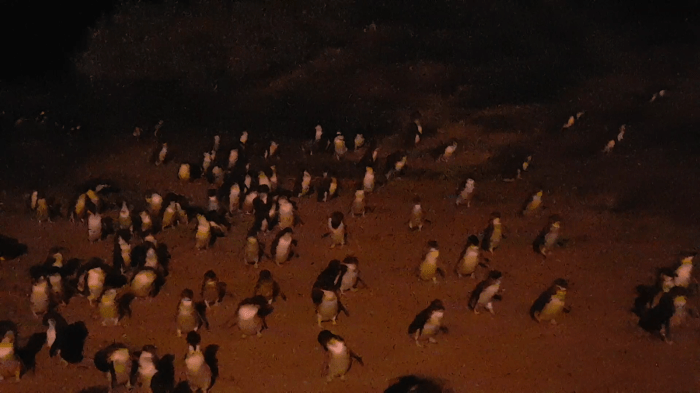
And here’s a random happy snap from one of the conference outings.

Q: what does a shell fish do if he has a sore foot ?
A: Limpet!
With thanks to Alan.
Have a FINtastic week! R <+>{
Belgian, English and Australian scientists are calling on the Australian authorities to review their decision to introduce the carp herpes virus… believe that this measure will be ineffective but that it also represents a risk to ecosystems.
Read more here – https://www.sciencedaily.com/releases/2018/02/180222145048.htm