Notice the circular marks on the heads of these Atlantic Salmon? Percussive stunning has been used during slaughter as a more humane method of euthanasia.

Salmon can get too fat?
Date: 21 October 2011 22:52:48 AWST
To: Thefishvet
Subject: Dr Richmond Loh sent you this article from Fishupdate.com.
This is an automated email sent by a visitor to our site.
Salmon can get too fat
http://www.fishupdate.com/news/fullstory.php/aid/16400Salmon that are not fed enough marine-based feed may be at risk of suffering from “lifestyle diseases” like heart problems, according to new NIFES research.
“The salmon store body fat in the wrong places,” says NIFES research scientist Bente E. Torstensen.
NIFES has led the first feeding trials in which farmed salmon were fed an almost exclusively vegetarian diet. The results, which have just been published in the British Journal of Nutrition, suggest that such a diet seem to be lacking essential nutrients for large growing salmon.
Plant food for fish
Farmed salmon are traditionally fed a marine-based diet in the form of fish-oil and fish-meal. In place of this, NIFES scientists formulated a diet in which 70 percent of the fish-oil was replaced by vegetable oil and 80 percent of the fish-meal with plant protein, and fed it to Atlantic salmon for 12 months.The feeding trial showed that salmon do not do well as vegetarians.
“The salmon stored more fat in their blood, liver and around internal organs. It is normal for salmon to have a lot of fat in their bodies, but not just there. Salmon basically have lean livers,” says Torstensen.
So salmon, which are naturally fatty fish, seem to be capable of developing obesity.
“We have seen the same phenomenon as we find in humans who are in the process of developing metabolic syndrome. The salmon become fat in the wrong places, and this can cause metabolic imbalance and have negative health effects.”
Metabolic syndrome is a collective term for various conditions that can lead to type 2 diabetes and cardiovascular disease, among other ailments.
In other words, one could imagine that Atlantic salmon could develop heart disease if they have too much raw material derived from plants in their diet without re-evaluating their essential nutrient requirement levels.
Finding the limit
The trials form part of the European Union’s AquaMax project, in which NIFES and 32 other institutions in 14 countries have been studying fish meal and fish oil replacement for farmed fish, and their effects on the health of both the fish and consumers.The rapid growth of the fish-farming industry means that in the future, feeding salmon a marine-based diet will not be a sustainable strategy. In 2030, about half of the world’s production of seafood will come from aquaculture.
“With these results, we can conclude that too much vegetable food can have negative effects for the salmon, but just where the limits lie is something we still need to find out,” says Torstensen.
Nor do the scientists know at present whether bigger stores of fat around internal organs will have the same negative effects on health in salmon as in human beings.
“That is something that we hope to find out in our next experiments,” says Torstensen.
Fish Parasitology Lecture
Just finished giving a lecture to veterinary students at Murdoch University.
Different dietary carbohydrates for early spiny lobster juvenile
Aquaculture Nutrition Volume 17, Number 6 (December 2011) 
The effect of dietary carbohydrates on the growth response, digestive gland glycogen and digestive enzyme activities of early spiny lobster juveniles, Jasus edwardsii
Authors: C.J. SIMON1,2,3, A. JEFFS 3 Author Affiliations:
| 1: | Tasmanian Aquaculture and Fisheries Institute, University of Tasmania, Nubeena Crescent, Taroona, Tas., Australia |
| 2: | National Institute of Water and Atmospheric Research, Kilbirnie, Wellington, New Zealand |
| 3: | Leigh Marine Laboratory, University of Auckland, Warkworth, New Zealand |
Source: Aquaculture Nutrition, Volume 17, Number 6 (December 2011) Page Numbers: 613 – 626 Available Full Text:
| Full Text: | Subscription Required to view full text |
| Format: | |
| Size: | unknown |
| Location: | Publisher’s Site |
| Authentication: | EBSCOhost EJS |
Abstract: The effect of various carbohydrate sources (glucose, sucrose, agar, wheat, tapioca, maize, potato and dextrin), and inclusion levels of gelatinized maize starch (0, 70, 170, 270 g kg-1), incorporated in semi-purified diets on the performance [growth, survival, food consumption (FC), enzyme activity and glycogen content of the digestive gland (DG)] of spiny lobster juveniles was investigated in a 12-week culture experiment. There was no difference in specific FC among diets (1.1% BW day-1), but lobsters fed with fresh mussel grew significantly faster (specific growth rate = 1.8% BW day-1) than on the formulated diets (0.9–1.1% BW day-1). None of the carbohydrate supplements tested produced a significant improvement in growth or survival over a basal control diet. However, the diet containing 270 g kg-1native wheat starch resulted in the highest moulting (mean = 2.1 moults per lobster), glycogen (3.3 mg g-1) and free glucose (1.1 mg g-1) concentrations among lobsters fed with the formulated diets, suggesting a superior utilization of this source of carbohydrate. The greater glycogen (8.0 mg g-1tissue) and free glucose (2.0 mg g-1tissue) concentrations, as well as higher specific activity of a-amylase (2.3 versus <0.7 U mg-1for other diets), found in the DG of lobsters fed with fresh mussel indicated a metabolism strongly directed to the utilization of glycogen.
Citation: C.J. SIMON, A. JEFFS . The effect of dietary carbohydrates on the growth response, digestive gland glycogen and digestive enzyme activities of early spiny lobster juveniles, Jasus edwardsii. Aquaculture Nutrition, Volume 17, Number 6 (December 2011), pp. 613-626,
URL: http://ejournals.ebsco.com/direct.asp?ArticleID=4303841CAB0A6C633545
Humane euthanasia of fish when going fishing.
If fish that are to be euthanased are for immediate consumption (e.g. from a fishing trip), they can either use Aqui-S anaesthetic (active ingredient iso-eugenol is a derivative of clove oil which is registered for you in several fish species), or use percussive stunning (some examples of implements sold in fishing shops shown below) followed by bleeding out and/or ikijime (pithing the brain).
Leaving fish in buckets to die slowly or putting them into an ice slurry is considered inhumane.

WAVMA taking steps towards certifying fish veterinarians – asking fellow vets to provide input
From: Palic, Dusan [B M S]
Sent: Tuesday, September 27, 2011 12:16 PM
Subject: WAVMA Members-L: Aquatic Veterinary Practitioner certification survey
Dear WAVMA Members;
As you are aware, the World Aquatic Veterinary Medical Association Practitioner Credentialing Committee is moving forward to develop the WAVMA Certified Aquatic Veterinary Practitioner (Cert-AqVP) Program. We see this as helping recognize those that have attained the most fundamental, core, “day-one,” or basic knowledge, skills, education and experience (KSEs) necessary to practice aquatic veterinary medicine. We see the CertAqVP program as a bridge between general veterinary practitioner and Board Certified or similar specialist programs, or as supplement to current veterinary education. As we develop different parts of the Program we will keep members informed and will constantly seek your input and suggestions.
We thank those members that have previously provided input. We also encourage others to approach the credentialing committee if they would like to have more information or to contribute their opinion and ideas.
We now seek your input by completing a brief online survey that will take less than 5 minutes to complete. Your input will help provide additional guidance that will unsure the Cert-AqVP Program is a service to the greatest number of people.
Simply click on http://www.surveymonkey.com/s/WAVMA_Cert-AqVP_Survey2 to complete the survey.
PLEASE NOTE: the survey will close October 30, 2011.
We thank you for your input.
Dušan Palić
Practitioner Credentialing Committee Chair
Who supplies fish for aquaponics?
With the weather warming up, this is the time of the year to consider harvesting your rainbow trout and replacing your stock with barramundi.
However, for those who are unable to provide multiple feeds per day to get fishes to plate size within the <6 month time frames, they may like to consider silver perch.
But where do you get your fishes from? Some contacts are provided below:
- Bob Henley 08 9407 5339 in Wanneroo.
- Bruce Ginbey 0438 947 576 at TAFE Fremantle.
- Broome TAFE 08 9192 9141.
- Trevor Blanco 0402 925 337 in Gingin.
- Ferguson Spring 0428 921 369
—
Now on: Twitter – Blog – Facebook – Linkedin – Flickr
—
Yours sincerely,Dr Richmond Loh
BSc BVMS MPhil (Vet Path) MANZCVSc (Aquatics & Pathobiology) DipPM
BSc BVMS MPhil (Vet Path) MANZCVSc (Aquatics & Pathobiology) DipPM
Veterinarian / Adjunct Lecturer Murdoch University / Secretary Aquatic Animal Health Chapter ANZCVS
The Fish Vet, Perth, Western Australia. Mobile Veterinary Service for fish and other aquatic creatures.
http://www.thefishvet.com.au
Ph: +61 (0)421 822 383
http://www.thefishvet.com.au
Ph: +61 (0)421 822 383
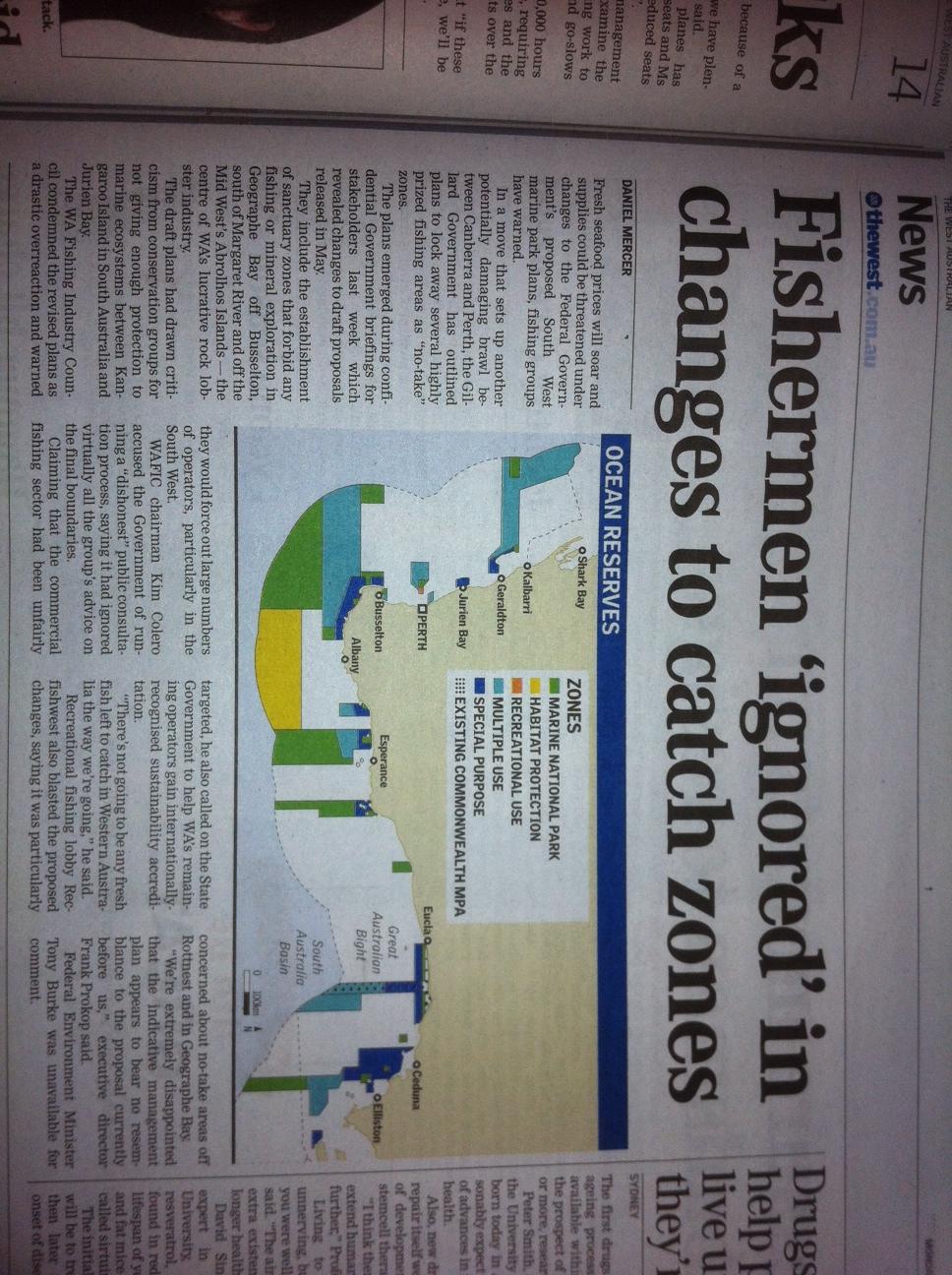
Changes to catch zones
From today’s West Australian newspaper.
Protein and energy requirements of farmed South African abalone at optimal vs elevated water temperatures
Aquaculture Research Volume 42, Number 11 (October 2011)
The protein and energy requirements of farmed South African abalone Haliotis midaeL. cultured at optimal and elevated water temperatures
Authors: Alistair J Green 1, Clifford L W Jones 1, Peter J Britz 1 Author Affiliations:
| 1: | Department of Ichthyology & Fisheries Science, Rhodes University, Grahamstown, South Africa |
Source: Aquaculture Research, Volume 42, Number 11 (October 2011) Page Numbers: 1653 – 1663 Available Full Text:
| Full Text: | Subscription Required to view full text |
| Format: | |
| Size: | unknown |
| Location: | Publisher’s Site |
| Authentication: | EBSCOhost EJS |
Abstract: Formulated abalone feeds used by the culture industry are believed to be unsuitable for use at elevated water temperatures (>20 °C). The aim of this study was to develop a feed that could safely be fed to abalone cultured at elevated water temperatures by optimizing dietary protein/energy levels. Abalone (54.90 ± 0.08 mm; 28.99 ± 0.16 g) were cultured at either 18, 22 or 24 °C, and fed diets containing graded levels of protein (18–26%) and energy (11.6–16.2 MJ kg-1). Abalone growth was temperature dependent, declining from 4.33 g month-1at 18 °C to 0.77 g month-1at 24 °C. Shell length and weight gain were independent of dietary protein, provided that the digestible energy content of the diet was not lower than 13.5 MJ kg-1. Dietary energy levels below 13.5MJ kg-1resulted in significant reductions in shell growth, weight gain and increased mortality from 5% to 27%. Feed consumption of the 22% and 26% protein diets with 11.6 MJ kg-1was significantly higher (0.53 ± 0.04 and 0.55 ± 0.04% bd. wt. day-1respectively) compared with abalone fed the 16.2 MJ kg-1diets at the same protein levels (combined mean of 0.45 ± 0.04% bd. wt. day-1) indicating that consumption was linked to energy requirement. The growth and mortality results suggest that abalone cultured at these temperatures have a dietary digestible energy requirement of at least 13.5 MJ kg-1.
Citation: Alistair J Green, Clifford L W Jones, Peter J Britz . The protein and energy requirements of farmed South African abalone Haliotis midaeL. cultured at optimal and elevated water temperatures. Aquaculture Research, Volume 42, Number 11 (October 2011), pp. 1653-1663,
URL: http://ejournals.ebsco.com/direct.asp?ArticleID=4250943513070B381FCF
Probiotics for shrimp
Aquaculture Nutrition Volume 17, Number 6 (December 2011)
Probiotic bacteria effects on growth and bacterial composition of black tiger shrimp (Penaeus monodon)
Authors: T. BOONTHAI 1, V. VUTHIPHANDCHAI 2, S. NIMRAT 3 Author Affiliations:
| 1: | Faculty of Science, Department of Microbiology, Burapha University, Chon Buri, Thailand |
| 2: | Faculty of Science, Department of Aquatic Science, Burapha University, Chon Buri, Thailand |
| 3: | Faculty of Science, Department of Microbiology and Environmental Science Program, Burapha University, Chon Buri, Thailand |
Source: Aquaculture Nutrition, Volume 17, Number 6 (December 2011) Page Numbers: 634 – 644 Available Full Text:
| Full Text: | Subscription Required to view full text |
| Format: | |
| Size: | unknown |
| Location: | Publisher’s Site |
| Authentication: | EBSCOhost EJS |
Abstract: The effects of Bacillusprobiotic forms on growth performance and microbiota were examined in black tiger shrimp (Penaeus monodon). Shrimp were fed for 120 days with one of three diets; a control diet alone or supplemented with either probiotics consisting of live-sprayed Bacillus(LS) or freeze-dried Bacillus(FD). Culturable bacteria counts in the hepatopancreas, intestine and culture water of the three treatments were relatively constant during the experiment. Bacillusnumbers in the hepatopancreas and intestines of probiotic-treated groups increased significantly (P <0.05) after 30 treatment days and remained relatively constant afterwards while no appreciable changes occurred in the control. Shrimp supplemented with LS and FD contained significantly lower concentrations of Vibrio(P <0.05) in the hepatopancreas, intestine and culture water, compared to those in the control group. Shrimp treated with LS and FD probiotic bacteria showed a significant improvement (P <0.05) in specific growth rate (SGR) and feed efficiency (FE), compared to those of control group. Probiotic bacteria have the potential to enhance shrimp culture by reducing Vibrioand improving growth performance.
Citation: T. BOONTHAI, V. VUTHIPHANDCHAI, S. NIMRAT . Probiotic bacteria effects on growth and bacterial composition of black tiger shrimp (Penaeus monodon). Aquaculture Nutrition, Volume 17, Number 6 (December 2011), pp. 634-644,
URL: http://ejournals.ebsco.com/direct.asp?ArticleID=4A298C21FFC9A7B1274F