Keep Koi Herpesvirus out!
With the holidays well underway and people jet setting around, some fish enthusiasts may become tempted to bring fish home illegally. Please refrain from doing this. Of greatest concern because of its ability to spread widely and quickly is a disease of koi. Koi herpesvirus disease affects all varieties of common carp Cyprinus carpio, including varieties such as mirror, leather, koi, and ghost koi. Mortalities are usually 100% and there is no treatment. Clinical signs include listlessness or erratic behaviour, loss of balance, loss of mucus (resulting in dry, rough patches, sloughing of mucus), and sunken eyes. Gills are most frequently affected displaying patchy areas of necrosis (dead tissue), often with secondary infection of bacteria and fungi.
Grass carp are tough as nails when coping with temperature fluctuations!
Grass carp are tough as nails when coping with temperature fluctuations!
| Aquaculture | |||||||||||||||||
| Volume 323, Number 1 (December 2011) | |||||||||||||||||
 |
Respiratory response of grass carp (Ctenopharyngodon idellus) to temperature changes | ||||||||||||||||
| Authors: | Zhigang Zhao, Shuanglin Dong, Fang Wang, Xiangli Tian, Qinfeng Gao | ||||||||||||||||
| Author Affiliations: |
|
||||||||||||||||
| Source: | Aquaculture, Volume 323, Number 1 (December 2011) | ||||||||||||||||
| Page Numbers: | 128 – 133 | ||||||||||||||||
| Available Full Text: |
|
||||||||||||||||
| Abstract: | Respiratory parameters of grass carp were studied in conditions of temperature changes, 30°C–25°C–20°C–15°C–10°C–15°C–20°C–25°C–30°C (acclimation temperature 30°C for Group I) and 10°C–15°C–20°C–25°C–30°C–25°C–20°C–15°C–10°C (acclimation temperature 10°C for Group II). The results showed that the respiratory frequency (fR), oxygen consumption rate (VO2), respiratory stroke volume (VS.R), gill ventilation (VG) and water convection requirement (VG/VO2) of fish were directly dependent on the acute temperature in two acclimation groups. The oxygen extraction efficiency (EO2) of fish remained almost constant in both Group I and Group II while temperature changes between 10°C and 30°C. The fR, VO2, VGand EO2of the fish in Group II were significantly higher than those in Group I at 15°C, 20°C, 25°C and 30°C (P<0.05), but the VS.Rin Group II were significantly lower than those in Group I at 10°C, 15°C and 30°C (P<0.05). There were no significant differences in the VG/VO2between Group I and Group II at 15°C, 20°C, 25°C and 30°C (P0.05). The Q10values for fR, VO2and VGof fish decreased or increased gradually with the increases or declines of temperature. The Q10values for fR, VO2and VGwere 1.75–2.47, 2.39–2.64 and 3.21–3.48 at 10–30°C of temperature interval, respectively. Grass carp showed partial metabolic compensation to temperature. These results indicate an ecological advantage for this migratory species. The study results also suggest that grass carp has shown good suitability for aquaculture due to its regulatory ability in acute temperature changes. | ||||||||||||||||
| Citation: | Zhigang Zhao, Shuanglin Dong, Fang Wang, Xiangli Tian, Qinfeng Gao . Respiratory response of grass carp (Ctenopharyngodon idellus) to temperature changes. Aquaculture, Volume 323, Number 1 (December 2011), pp. 128-133, | ||||||||||||||||
| URL: | http://ejournals.ebsco.com/direct.asp?ArticleID=4A88B752167457CB93A8 | ||||||||||||||||
How do you decrease biofouling in shellfish?
Some very clever scientists have come up with very practical, non-chemical means of decreasing shell deformities and biofouling in bivalve culture. Check out the article below.
—
Now on: Twitter – Blog – Facebook – Linkedin
—
Yours sincerely,Dr Richmond Loh
BSc BVMS MPhil (Vet Path) MANZCVS (Aquatics & Pathobiology) DipPM
BSc BVMS MPhil (Vet Path) MANZCVS (Aquatics & Pathobiology) DipPM
Veterinarian / Adjunct Lecturer Murdoch University / Secretary Aquatic Animal Health Chapter ANZCVS
The Fish Vet, Perth, Western Australia. Mobile Veterinary Service for fish and other aquatic creatures.
http://www.thefishvet.com.au
Ph: +61 (0)421 822 383
http://www.thefishvet.com.au
Ph: +61 (0)421 822 383
Aquaculture Volume 325, Number 9 (January 2012) Using stocking density modifications and novel growth medium to control shell deformities and biofouling in suspended culture of bivalves Authors: A. Dunham, R.D. Marshall Author Affiliations:
| no affiliations available |
Source: Aquaculture, Volume 325, Number 9 (January 2012) Page Numbers: 234 – 241 Available Full Text:
| Full Text: | Subscription Required to view full text |
| Format: | |
| Size: | Unknown |
| Location: | Publisher’s Site |
| Authentication: | Publisher’s Site |
Abstract: Bivalve aquaculture currently utilizes two main farming practices: intertidal (beach) and deep-water (suspended) culture. Although suspended culture offers a number of advantages during both nursery and grow-out phases, two commonly encountered issues – shell deformities and biofouling – lead to reduced seed and final product quality in some species and preclude other species from being cultured in suspension. None of the existing strategies for controlling these issues is efficient and fully reliable. In this study we tested the efficiency of two new methods for controlling biofouling and shell deformities in suspended culture of bivalves using basket cockle Clinocardium nuttalliias a model species. The first method involved a short-term increase in bivalve stocking density during peak plankton concentrations and biofouling settlement periods. The second method comprised adding artificial growth medium (expanded clay aggregate) to culture enclosures. Both high-density and growth medium treatments significantly reduced the incidence of C. nuttalliishell deformities compared to the control treatment (by 86 and 72%, respectively). This finding suggests that clam shell deformities in suspended culture primarily develop due to the lack of structural support normally offered by the substratum. Both treatments also significantly reduced barnacle fouling rate (by 67 and 83%, respectively). Additionally, growth medium treatment led to a significant reduction in tube worm fouling, as well as combined fouling rate and intensity, but it was less effective in controlling sponge fouling. Overall, both high-density and growth medium treatments showed promise in reducing the incidence of shell deformities and the amount of biofouling on C. nuttalliiin suspended culture. These treatments are inexpensive, environmentally-friendly, readily available to shellfish growers, and may be further refined and adapted for a variety of cultured bivalve species. They have the potential to improve the efficiency of suspended grow-out systems and extend the option of suspended culture to bivalve species currently grown on the beach only. Citation: A. Dunham, R.D. Marshall . Using stocking density modifications and novel growth medium to control shell deformities and biofouling in suspended culture of bivalves. Aquaculture, Volume 325, Number 9 (January 2012), pp. 234-241, URL: http://ejournals.ebsco.com/direct.asp?ArticleID=49548B86958E34D17565
Free aquatic epidemiology workshop – Melbourne
From: Evan Sergeant <evan>
Date: Tue, Dec 20, 2011 at 7:17 AM
Subject: FRDC workshop on epidemiology and disease outbreak investigation
Dear all,
Just a reminder that the above workshop will be held at Attwood Motel and Convention Centre at Attwood, near Melbourne Airport on 13-15 March 2012. More details are attached or available from our website http://training.ausvet.com.au/index.php?n=Main.Welcome.
Thank you to all those who have already registered. If you are thinking of coming and haven’t registered please get your registration form in promptly
Wishing you all a very happy and safe Christmas
regards
evan
EpiDiseaseOutbreakInvest WorkshopMar12.pdf
FRDC outbreak investigation registration form.pdf
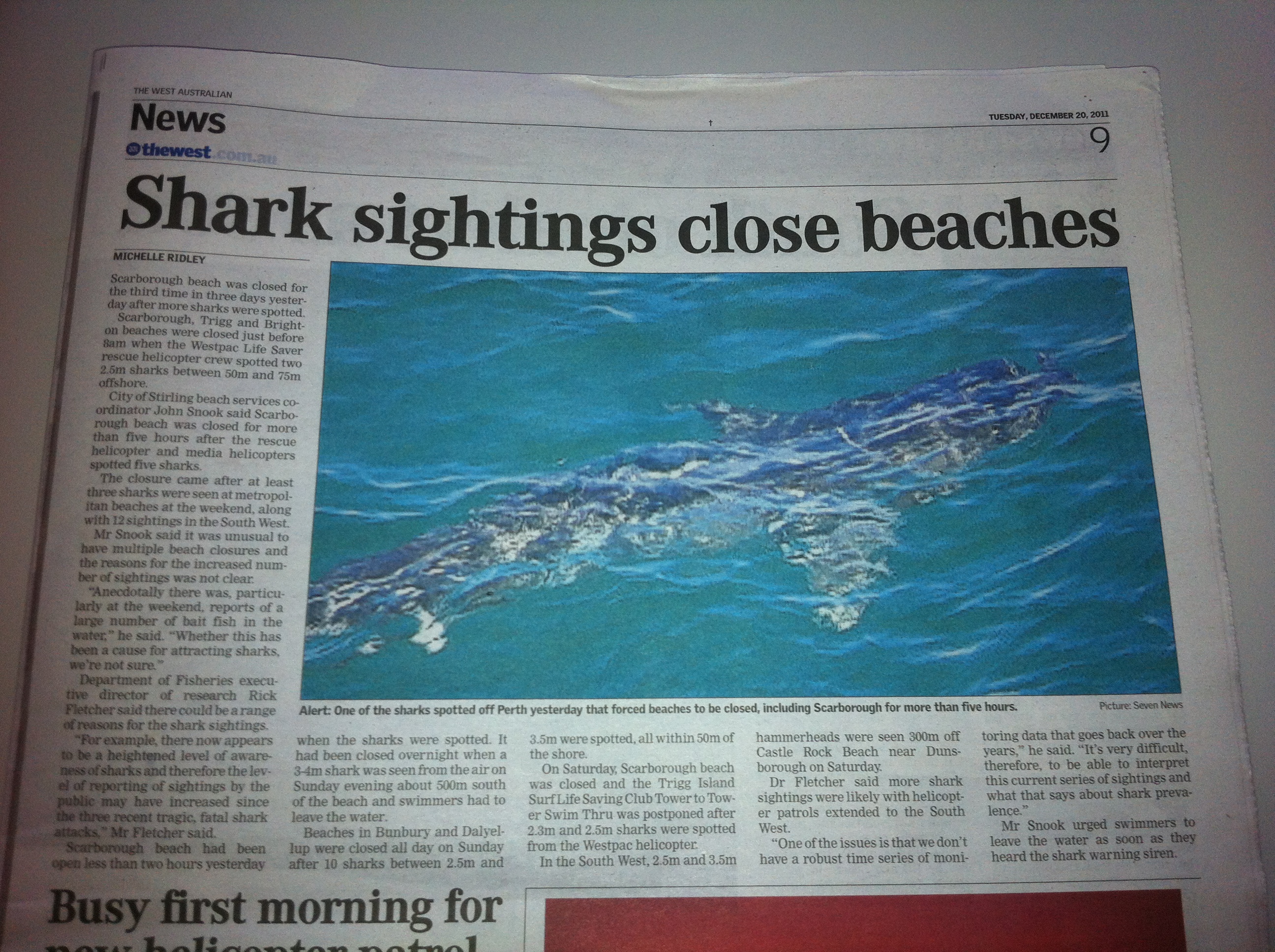
Shark sightings close beaches
Australia: ‘Sea of Dead Fish’ at Buffalo Creek Blamed on Too Much Rain?
toxic algae outbreak
On 19/12/2011, at 6:40, noreply> wrote:
AquaticHealth.net Disease News Update >> Dermo spreading through Texas [ProMed]
Link to source content: http://floridaindependent.com/60885/algae-outbreak-shuts-down-texas-oyster-industry.
Your input is important: Please verify and add any relevant commentary to this report. Also, is the information in the report summarised somewhere in the Wiki?
Report Content:
RED TIDE, SHELLFISH – USA (02): (TEXAS) OYSTER
**********************************************
A ProMED-mail post
ProMED-mail is a program of the
International Society for Infectious Diseases
Date: Wed 14 Dec 2011
Source: The Florida Independent, USA Today report [edited]
A widespread toxic algae outbreak has shut down oyster season across the Texas coast and caused health problems for many nearby residents.
Fueled by Texas’ ongoing drought, the algae — known as _Karenia brevis_ — [one of the causative agents for red tide. – Mod.TG] thrive in warm, salty water and have spread through the bays and islands along Texas’ 350-mile coast [560 km], says Meridith Byrd, a marine biologist for the Texas Parks and Wildlife Department. The algae could cause nausea, vomiting, and diarrhea in humans and are harmful to fish but not fatal to people, she says.
State health officials took the rare step of closing the entire coast for oyster harvesting — all 17 586 acres [7117 ha] of oyster beds — before the season opened 1 Nov 2011. The state has shut down the entire coast before, most recently in 2000, according to state health officials. But the size of the current bloom coupled with the state’s ongoing drought and lack of rain could make it one of the biggest and most destructive in history, Byrd says. The bloom so far has killed
4.5 million fish, she says.
In Florida, algae blooms have caused health problems for residents and, in towns that rely on water to fuel their business, have hurt the bottom line.
The Texas bloom appears different from those in Florida and is likely caused by red tide that, due to the drought, is creeping ever-closer to oyster beds near the shore.
A parasite known as “dermo”, which has fast been spreading through Texas coastal waters, is also becoming a major threat to the industry.
And it isn’t just the shellfish industry that’s hurting. One hardware store owner told USA Today that the closures are costing his business at least USD 4000 a month. Restaurants, fueling stations, and fishing equipment suppliers have also been negatively impacted.
The Texas bloom is only the latest in a string of events negatively affecting the state’s USD 30 million oyster industry. In 2005, Hurricane Katrina devastated the Gulf Coast area, and remains t he costliest natural disaster the country has ever seen. Last year’s [2010] gulf oil spill only made matters worse — especially for the fishing industry, which is still grappling with consumer’s concerns over the safety of Gulf of Mexico seafood.
[Byline: Virginia Chamlee]
Are your biosecurity strategies sufficient?
Those involved in the aquaculture or any other farming industry knows that diseases can spread by a number of means. Those with good biosecurity practices would have a few protocols in place to handle routine activities and to react to exotic diseases. This paper challenges us to be vigilant and to ask ourselves, “Is what we’re already doing adequate?”
| Journal of Fish Diseases | |||||||||||||||||
| Volume 35, Number 1 (January 2012) | |||||||||||||||||
| |
Studies on the effect of temperature and pH on the inactivation of fish viral and bacterial pathogens | ||||||||||||||||
| Authors: | P F Dixon 1, D A Smail 2, M Algoët 1, T S Hastings 3, A Bayley 1, H Byrne 2, M Dodge 1, A Garden 2, C Joiner 1, E Roberts 1, D Verner-Jeffreys 1, F Thompson 2 | ||||||||||||||||
| Author Affiliations: |
|
||||||||||||||||
| Source: | Journal of Fish Diseases, Volume 35, Number 1 (January 2012) | ||||||||||||||||
| Page Numbers: | 51 – 64 | ||||||||||||||||
| Available Full Text: |
|
||||||||||||||||
| Abstract: | Disposal of fish by-products in the European Community must comply with Regulation (EC) No 1069/2009 which categorizes animal by-products according to risk, and specifies methods of disposal of by-products according to that risk. There is provision under the regulation for composting or ensiling to be used for by-products from aquatic animals. Biosecurity considerations require knowledge of the parameters of time and temperature, or time and pH, required to inactivate any fish pathogens that may be present. To provide those data, we undertook laboratory studies on the inactivation of a number of fish pathogenic viruses and bacteria at 60 °C, pH 4.0 and pH 12.0 as a preliminary to conducting subsequent trials with the most resistant viruses and bacteria in fish tissues. The most resistant bacterium to 60 °C, pH 4.0 as well as pH 12.0 was Lactococcus garvieae. Its concentration was reduced to the level of sensitivity of the test after 24–48 h exposure to 60 °C, but it survived for at least 7 days at pH 4.0 and 14 days at pH 12.0. The most resistant virus to 60 °C was infectious pancreatic necrosis virus, and to pH 12.0 was infectious salmon anaemia virus. The majority of the viruses tested survived exposure to pH 4.0 for up to 28 days. The results suggest that the process of acid ensiling alone is not an effective method for the inactivation of many viral and bacterial pathogens, and fish by-products would need further treatment by a method approved under the regulation following ensiling, whereas alkaline or heat treatment are likely to provide an increased degree of biosecurity for on-farm processing of mortalities. | ||||||||||||||||
| Citation: | P F Dixon, D A Smail, M Algoët, T S Hastings, A Bayley, H Byrne, M Dodge, A Garden, C Joiner, E Roberts, D Verner-Jeffreys, F Thompson . Studies on the effect of temperature and pH on the inactivation of fish viral and bacterial pathogens. Journal of Fish Diseases, Volume 35, Number 1 (January 2012), pp. 51-64, | ||||||||||||||||
| URL: | http://ejournals.ebsco.com/direct.asp?ArticleID=4D3B8916E198DEFDE83E | ||||||||||||||||
Antibiotic resistance caused by aquaculture?
Antibiotic resistance might be caused by aquaculture
November 22, 2011 Boston, MA –
Researchers from Tufts University School of Medicine agree on the controversial, non-therapeutic use of antibiotics in food animals and fish farming as a cause of antibiotic resistance. They report that the evidence shows a need for stricter regulation of the practice. “The US lags behind its European counterparts in establishing a ban on the use of antibiotics for growth promotion. For years it was believed that giving low-dose antibiotics via feed to promote growth in cows, swine, chickens and the use of antibiotics in fish farming had no negative consequences. Today, there is overwhelming evidence that non-therapeutic use of antibiotics contributes to antibiotic resistance, even if we do not understand all the mechanisms in the genetic transmission chain,” said Levy, MD, professor of molecular biology and microbiology and director of the Centre for Adaptation Genetics and Drug Resistance at Tufts. Antibiotics have been used for the last 70 years to fight bacterial infections such as streptococcus, meningitis, tuberculosis and urinary tract infections. The misuse and overuse of antibiotics have played a part in antibiotic resistance. Today, antibiotics are less effective when used to save lives. Levy and co-author Bonnie Marshall summarize their findings after reviewing numerous studies:• According to estimates, antibiotics are eight times more likely to be used for non-therapeutic purposes than for treating a sick animal.• Current practices set the stage for the rapid spread of antibiotic-resistant bacteria.• The long-term administration of antibiotics in animal feed creates an optimal environment for antibiotic resistance genes to multiply.• Treated animals become “factories” for the production and distribution of antibiotic-resistant bacteria such as Salmonella and Methicillin-resistant Staphylococcus aureus (MRSA).• Even if farmers turn to antibiotics that are not commonly used to treat people, these drugs – given over long periods of time – can also promote resistance.• Several studies demonstrated that antibiotic-resistant bacteria can easily spread from animals to people in close contact with animals, such as veterinarians, slaughterhouse workers, farmers, and the families of farmers.• As much as 90 per cent of antibiotics given to livestock are excreted into the environment. Resistance spreads directly by contact and indirectly through the food chain, water, air, and manured and sludge-fertilized soils.• The broad use of antibiotics in fish food in farm fishing, particularly overseas, leads to leaching where it can be washed to other sites, exposing wild fish to trace amounts of antibiotics.• The consequences of antibiotic resistance are great. According to the Centres for Disease Control and Prevention, antibiotic-resistant infections cause longer and more expensive hospital stays and greater risk of death.• Bans on the use of non-therapeutic antibiotics are effective in diminishing antibiotic resistance. Bans in European countries have seen less antibiotic resistance. It is common sense to avoid overcrowding food animals to improve hygiene and reduce the practice of routinely giving antibiotics to promote growth. “While the use of non-therapeutic antibiotics remains contentious, the evidence is strong enough to merit precaution. Antibiotics save lives. When infections become resistant to primary antibiotics, and alternative antibiotics must be used, health care costs increase. As more infections become more resistant to more antibiotics, we run the risk of losing more of our arsenal of antibiotics, resulting in needless deaths. It’s important to consider what we stand to gain versus what we stand to lose,” concludes Levy.
Source: http://tinyurl.com/7385dn5 [See http://tinyurl.com/7gn7xdu for Bonnie M. Marshall, BM & SB Levy (2011). Food Animals and Antimicrobials: Impacts on Human Health. Clin. Microbiol. Rev., 24:718-733. ADS-Mod.]
What to do with salty poo?
‘Recycling’ wastes from most farm animals, including freshwater fish farms is easy. Chicken wastes may need to be composted. Fish wastes from tour garden pond filter can be applied directly to plants. But what about wastes from marine or brackish aquaculture? The salt in it prohibits direct application to plants. This paper attempts to address this issue by finding another use for salty aquaculture wastes.
| Aquaculture | |||||||||||||||||
| Volume 323, Number 1 (December 2011) | |||||||||||||||||
| |
Utilization of waste from a marine recirculating fish culture system as a feed source for the polychaete worm, Nereis virens | ||||||||||||||||
| Authors: | Nicholas Brown, Stephen Eddy, Stefanie Plaud | ||||||||||||||||
| Author Affiliations: |
|
||||||||||||||||
| Source: | Aquaculture, Volume 323, Number 1 (December 2011) | ||||||||||||||||
| Page Numbers: | 177 – 183 | ||||||||||||||||
| Available Full Text: |
|
||||||||||||||||
| Abstract: | Two experiments were conducted to test the effect of feeding the polychaete worm Nereis virens with solid wastes collected from a marine recirculating system. In experiment 1, worms with an initial mean weight of 0.37g were fed for 80days with a commercial worm diet (CD), halibut fecal waste (FW), uneaten halibut feed pellets (PW) or a 1:1 mixture of fecal waste and feed pellet waste (MW). The resulting biomass and average weight of harvested worms was significantly higher in the PW group than in the other 3 groups (ANOVA, p<0.05). Total fat levels in the worms from the MW and PW groups were higher than the CD group. | ||||||||||||||||
| Citation: | Nicholas Brown, Stephen Eddy, Stefanie Plaud . Utilization of waste from a marine recirculating fish culture system as a feed source for the polychaete worm, Nereis virens. Aquaculture, Volume 323, Number 1 (December 2011), pp. 177-183, | ||||||||||||||||
| URL: | http://ejournals.ebsco.com/direct.asp?ArticleID=414D860744ED0E336AB3 | ||||||||||||||||