I was watching River Monsters and discovered another use for the swimbladder – it is used as a filter in beer production!
Feed fish onions?
We’ve heard of garlic being good for fish’s immune system with an antiparasitic effect. This recent study suggests onions are just as healthy!
| Journal of the World Aquaculture Society | |||||||||||||||||
| Volume 43, Number 1 (February 2012) | |||||||||||||||||
 |
Onion Powder in the Diet of the Olive Flounder, Paralichthys olivaceus: Effects on the Growth, Body Composition, and Lysozyme Activity | ||||||||||||||||
| Authors: | Sung Hwoan Cho 1, Sang-Min Lee 2 | ||||||||||||||||
| Author Affiliations: |
|
||||||||||||||||
| Source: | Journal of the World Aquaculture Society, Volume 43, Number 1 (February 2012) | ||||||||||||||||
| Page Numbers: | 30 – 38 | ||||||||||||||||
| Available Full Text: |
|
||||||||||||||||
| Abstract: | This study tested the onion powder (OP) supplementation in the diet of the olive flounder on the growth, body composition, and lysozyme activity. Thirty-five fish averaging 5.1 g were randomly stocked into 18 individual 180-L flow-through tanks. A commercially available OP was used as a dietary additive. Six experimental diets were prepared to contain OP at the concentrations of 0, 0.5, 1, 2, 3, and 5% for diets OP-0, OP-0.5, OP-1, OP-2, OP-3, and OP-5, respectively. After the 8-wk feeding trial, 20 fish from each tank were infected with Edwardsiella tardaand mortality was monitored for the following 96 h. No distinctive improvement in survival, weight gain, or feed efficiency of fish was observed at the end of the 8-wk feeding trial. Lysozyme activity in fish fed the OP-0.5 diet was higher than that of fish fed the OP-0, OP-1, OP-2, OP-3, and OP-5 diets. The cumulative mortality of fish fed the OP-0.5, OP-1, OP-2, OP-3, and OP-5 diets was lower than that of fish fed the OP-0 diet at 72 h after E. tardainfection. Dietary inclusion of 0.5% OP was effective at improving lysozyme activity of fish, and OP seemed to be an effective immunostimulant to lower mortality upon E. tardainfection. | ||||||||||||||||
| Citation: | Sung Hwoan Cho, Sang-Min Lee . Onion Powder in the Diet of the Olive Flounder, Paralichthys olivaceus: Effects on the Growth, Body Composition, and Lysozyme Activity.Journal of the World Aquaculture Society, Volume 43, Number 1 (February 2012), pp. 30-38, | ||||||||||||||||
| URL: | http://ejournals.ebsco.com/direct.asp?ArticleID=486B8A7C35C506F24E6A | ||||||||||||||||
How to move large fishes?
I just had a client ring me in distress but unfortunately, it was too late.
This owner had to move a large fish and it irreversibly damaged itself in the process.
If your fish is not tame and used to handling, it is advisable to sedate it first regardless of how far you need to move it. This is good for the fish and good for the handlers for several reasons:
- Fish will not stress,
- Fish will not injure itself by colliding into sides or fracturing its back,
- Avoids tank breakage and glass splinters,
- Avoid splashing water everywhere (electrical danger),
- Minimising danger to the handler.
Check out the video on this link where we had to move a sizeable Murray Cod.
http://www.abc.net.au/creaturefeatures/murraycod.htm
—
Now on: Twitter – Blog – Facebook – Linkedin
—
Yours sincerely,Dr Richmond Loh
BSc BVMS MPhil (Vet Path) MANZCVS (Aquatics & Pathobiology) DipPM
BSc BVMS MPhil (Vet Path) MANZCVS (Aquatics & Pathobiology) DipPM
Veterinarian / Adjunct Lecturer Murdoch University / Secretary Aquatic Animal Health Chapter ANZCVS
The Fish Vet, Perth, Western Australia. Mobile Veterinary Service for fish and other aquatic creatures.
http://www.thefishvet.com.au
Ph: +61 (0)421 822 383
http://www.thefishvet.com.au
Ph: +61 (0)421 822 383
Algae treatments for ponds and aquaria.
I came across some of my early notes and thought this might be of use, especially now that it is summer.
NOTES:
• *Remove as much algae as possible by hand (using a fine net or siphon) before and after treatment to prevent the decaying algae from adversely affecting water quality and thereby, fish health. Removal will reduce the nutrient load in the tank.
• *Water changes should always be conducted in conjunction with a gravel clean (utilising a gravel siphon).
• *Chemicals should never be the sole treatment. It should be used only after or in conjunction with management strategies as outlined above.
Suspended green algae
Appearance
• Green water
Cause
• Over fertilising water (PO4+3, NO3-, Fe).
• excess fertiliser, overfed, overstocking (too many fish), insufficient cleaning, insufficient water exchange.
• Too much lighting (artificial or natural).
• Poor water flow.
• Water source with high PO4+3 and or NO3-.
Treatment
• Several large (30-50%) water changes (with gravel clean), remove algae manually, restrict feeding.
• Reduce photoperiod / provide shade.
• Grow more aquatic plants to compete for nutrients and light.
• Provide water movement (aerate/power head/fountain).
• Reduce fish stocking density.
• UV clarifier.
• Ozonate water.
• Use flocculants and then filter out debris.
• Barley straw (added such at aerobic decomposition and allow for colonisation by flora that will consume the algae).
• Barley straw extract.
• Algicide – TetraPond AlgoRem.
• *Ion-exchange resins.
Blue-green algae
Appearance
• Bright green, often aggregates on the surface in the static parts of the pond and tend to collect at the edges.
Cause
• Poor water quality (excess nutrients).
• Wrong lighting.
Treatment
• Large (30-50%) water changes every 2-3d (with gravel clean).
• Use only white light.
• Chemicals – ZMF Algo-stop fix.
Blanket weed & Duck weed
Appearance
• Minute twin leaved plants with well-developed roots.
Cause
• Pest weed introduction from contaminated source water.
Treatment
• Algicide – TetraPond AlgoFin.
Brownish algae
Appearance
• Thin and carpet-like.
Cause
• High silicate level in the tap water.
Treatment
• Increase frequency of water change (with gravel clean).
• Lower stocking density.
• Use only pure white bulbs.
• Use alternative water source.
• Use rainwater (ensure it is collected safely to avoid zinc or aluminium toxicity).
Brown algae
Appearance
• Look like rust on leaves, glass, rocks.
Cause
• New aquarium with very hard water.
Treatment
• Should disappear over time.
• Decrease water hardness using distilled water or rain water.
• Use reverse osmosis water.
Red algae (Rhodophyta)
Appearance
• Black colour that changes to red when put in alcohol.
• *Prefer harder more alkali water.
Cause
• New aquarium.
• Poor plant growth (Cause sand substrate, insufficient nutrients).
• Wrong lighting (too much blue spectrum).
• Add blue food dye to water to absorb/reflect the light.
• Using yellow bulbs (bad for plants, indirectly good for this algae).
Treatment
• There are no chemical treatments available because the structure of the red algae is very similar to water plants.
• Manually remove affected leaves from water plants.
• Encourage growth of water plants to reduce red algae by using fertilisers (TetraPlant fertilisers: Crypto tablets & FloraPride).
• Reduce water hardness and pH.
• Use pure white lighting only.
• Chemicals – Tetra Algizit (beware, stunts plant growth).
Grass-like algae (1)
Appearance
• Green and grassy.
• Grow on all surfaces.
Cause
• Nutrient rich water.
• Too much lighting.
Treatment
• Manual removal by scrubbing surfaces affected.
• Partial water (30-50%) changes.
Grass-like algae (2)
Appearance
• Greeny-black.
• Grow on all surfaces.
• *difficult to eradicate.
Cause
• Nutrient rich water.
• Too much lighting.
Treatment
• Use only pure white daylight bulbs.
• Decrease water hardness.
• Decrease pH.
• Chemicals – Algizit.
Grass-like algae (3)
Appearance
• Brownish looking.
Cause
• Indicator of poor water quality.
• Wrong lighting.
Treatment
• 30% water change every 2 weeks.
• Decrease stocking density.
• Reduce feeding.
• Use only daylight bulbs.
• Add plants to compete.
• Chemicals – Algizit or AlgoStop.
Brush algae
Appearance
• Plant-like, brown/black, grows on all aquarium surfaces.
• *Difficult to eradicate.
Cause
• High iron levels.
• Wrong lighting.
• High pH.
Treatment
• Several part water changes (with gravel clean).
• Use only pure white light bulbs.
• Don’t fertilise with iron.
• Keep pH below 7.
• Use Tetra Algizit.
Black algae
• *These algae grow best at pH > 7.
• *not usually possible to eradicate this algae, but you can reduce it to a minimum.
Treatment
• Reduce KH.
• Reduce pH <7.
Black moss / Black beard
Appearance
• Grows on all surfaces.
Notes
• Very stubborn and difficult to eradicate.
• This algae does not thrive in soft acid water.
Cause
• Poor water quality.
Treatment
• Several large water changes (with gravel clean) to remove fertiliser.
• Reduce KH and pH.
• Manual removal.
• Tetra Algizit (liquidises algae, but may stunt plant growth).
Cloudy water
Appearance
• Whitish-green cloudy water.
Treatment
• Partial water changes (with gravel clean).
• Use only pure white light bulbs.
• UV-clarifier.
Diatoms
Notes
• Fish do not consume diatoms.
• Some diatoms may be toxic.
Cause
• High silicate level.
• Lighting.
• Inadequate water current.
• Excess nutrients in water.
Doctors vs Veterinarians
Can you imagine going to see the doctor for your tap or chair? Apparently you can! Check out these candid shots.


And today I saw a “carpet doctor” driving around as well!
Can you imagine bringing your sick koi to see the doctor? No you wouldn’t. Fish are animals and as such, veterinarians are the only ones who are trained to diagnose and to treat animal ailments. A common slogan around the vet school is, “Real doctors treat more than one species!”
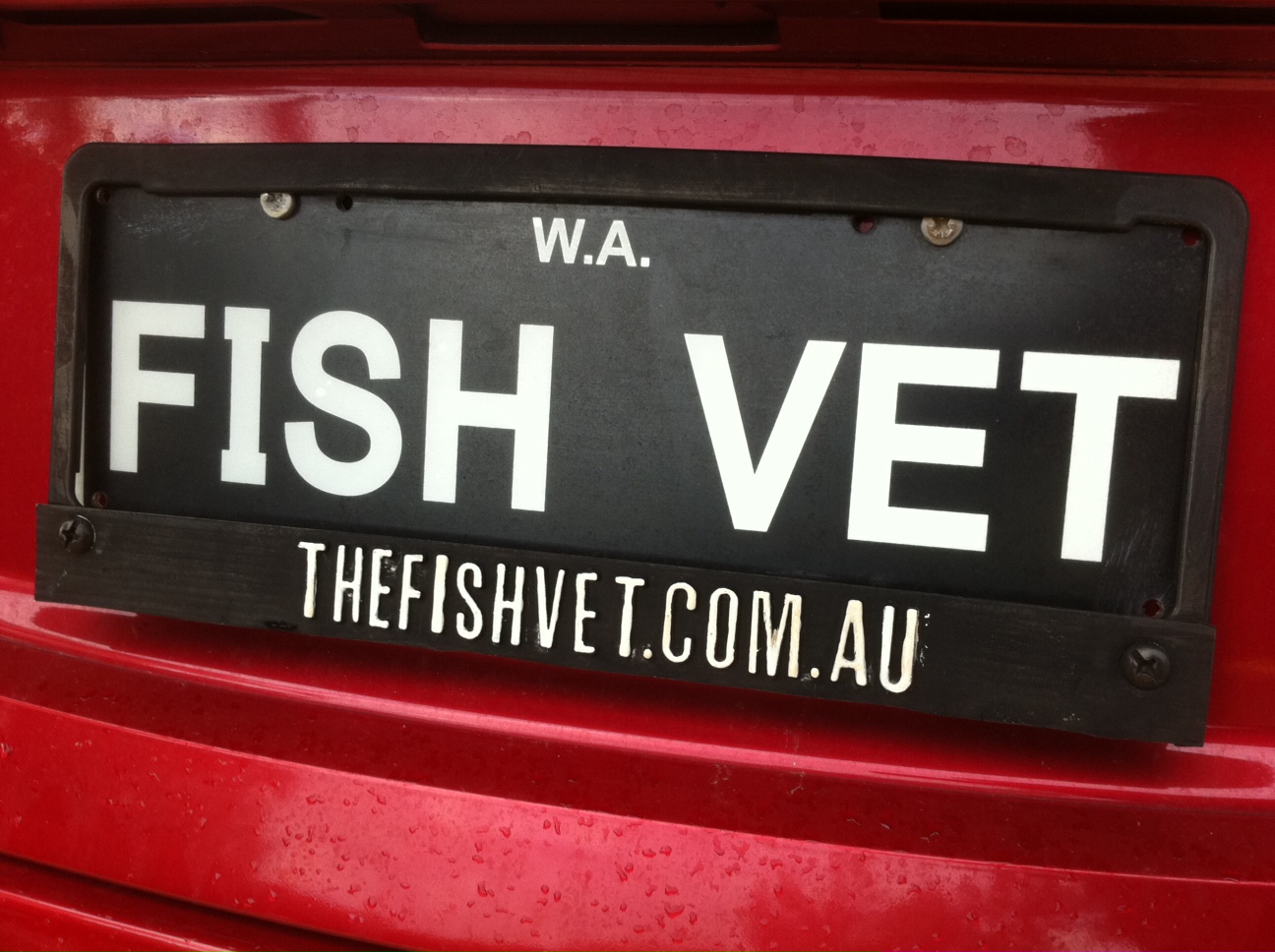
Check out this neat clip:
http://www.youtube.com/watch?v=8uZ5IsCoPAg
—
Now on: Twitter – Facebook – Linkedin
—
Yours sincerely,Dr Richmond Loh
BSc BVMS MPhil (Vet Path) MANZCVS (Aquatics & Pathobiology) DipPM
BSc BVMS MPhil (Vet Path) MANZCVS (Aquatics & Pathobiology) DipPM
Veterinarian / Adjunct Lecturer Murdoch University / Secretary Aquatic Animal Health Chapter ANZCVS
The Fish Vet, Perth, Western Australia. Mobile Veterinary Service for fish and other aquatic creatures.
http://www.thefishvet.com.au
Ph: +61 (0)421 822 383
http://www.thefishvet.com.au
Ph: +61 (0)421 822 383
How do you introduce new fish to a tank?
Check out this video:
http://www.youtube.com/watch?v=4h6CsbejiXI
Here Dr Loh is introducing silver perch to a circular tank.
The unopened bag was first floated on the surface for 5-10 minutes to equalise any temperature differences so as not to cause temperature shock. It is important to leave the bag unopened at this stage (see explanation at this link –
https://thefishvet.wordpress.com/2012/02/06/bagged-fish-water-quality-changes/).
Then the bag is opened and new tank water is added to the fish bag to double its volume. This will dilute any wastes that had built up in the bagged water and will allow fish to acclimatise to the new water conditions. An air stone may be added to aerate the water if there is a high stocking density in the bag.
After another 5-10 minutes, fish can be released into the new tank.
Bagged fish – water quality changes.
Ever wondered what happens to the water quality of bagged fish? This is a question I ask my students when I teach them about water quality at Murdoch University.
Fish will continue to respire, consuming oxygen and producing carbon dioxide. They will continue to excrete ammonia as well. So what happens?
Dissolved oxygen will be diminished (and this is the reason why oxygen, rather than air, is used to inflate the bag for long journeys).
The carbon dioxide produced by the fish will and increase, and this will cause the water to become more acidic (think about the acidity of carbonated drinks like “Coke”). But this is not such a bad thing. Why? Read on…
Ammonia is excreted by the fish and will accumulate in the bag of water over time. It could rise to levels as high as 10ppm! But why don’t fish suffer from ammonia toxicity? Ammonia is more toxic when the water is more alkaline (it is the unionised form of ammonia that is toxic to fish – see extract from my recently published book: FishVetEssen_p46-47_Ammonia). But if we remember from the previous paragraph, the water pH declines due to the dissolved carbon dioxide and this is what keeps fish from dying. And this is why it us important not to open your bag of new fish while floating it in your aquarium when acclimatising the water temperature.
This is truly water chemistry in action!
A recent paper talks about such reactions but the scientists were concerned about decreasing pH when transporting marine fish. This is good and all, but I wonder if they take into consideration what effect the increasing ammonia levels would have on the fish if the water’s pH is not allowed to decrease.
| Aquaculture | |||||||||||||||||
| Volume 333, Number 7 (February 2012) | |||||||||||||||||
| |
Changes in pH during transport of juvenile cod Gadus morhuaL. and stabilisation using buffering agents | ||||||||||||||||
| Authors: | J.W. Treasurer | ||||||||||||||||
| Author Affiliations: |
|
||||||||||||||||
| Source: | Aquaculture, Volume 333, Number 7 (February 2012) | ||||||||||||||||
| Page Numbers: | 92 – 99 | ||||||||||||||||
| Available Full Text: |
|
||||||||||||||||
| Abstract: | Salmonids have been transported from hatchery to ongrowing units for many years, but little information is available on optimal conditions for the transport of marine finfish species. This study examined the changes in pH that occur under various simulated transport conditions of stocking density and fish size, and thereby recommends protocols for live marine fish transportation. The pH of the transport water declined rapidly due to the respiration of carbon dioxide. Various buffers (sodium bicarbonate, TRIS, Magnaspheres) were compared and maintained pH close to normal seawater levels. The decline in pH was greater with small (18g) rather than larger (32g) fish, at identical loading biomass in tanks, indicating that fish size should be considered when planning transport. Although unionised ammonia level increased with increasing stocking density (10 to 30kgm-3) the pH did not decline significantly. The use of air aeration as well as oxygenation reduced CO2levels indicating that aeration stripped the CO2from the water. Non invasive measurements of free cortisol release into the tank water by juvenile cod indicated primary stress response to handling events. This study demonstrates that cod juveniles will be exposed to fluctuating pH in transport tanks, and buffering of the pH and stripping of CO2by aeration to reduce fluctuations is recommended. | ||||||||||||||||
| Citation: | J.W. Treasurer . Changes in pH during transport of juvenile cod Gadus morhuaL. and stabilisation using buffering agents. Aquaculture, Volume 333, Number 7 (February 2012), pp. 92-99, | ||||||||||||||||
| URL: | http://ejournals.ebsco.com/direct.asp?ArticleID=4722AD404EF8FCC51D3A | ||||||||||||||||
—
Now on: Twitter – Blog – Facebook – Linkedin
—
Yours sincerely,Dr Richmond Loh
BSc BVMS MPhil (Vet Path) MANZCVS (Aquatics & Pathobiology) DipPM
BSc BVMS MPhil (Vet Path) MANZCVS (Aquatics & Pathobiology) DipPM
Veterinarian / Adjunct Lecturer Murdoch University / Secretary Aquatic Animal Health Chapter ANZCVS
The Fish Vet, Perth, Western Australia. Mobile Veterinary Service for fish and other aquatic creatures.
http://www.thefishvet.com.au
Ph: +61 (0)421 822 383
http://www.thefishvet.com.au
Ph: +61 (0)421 822 383
Some crabby jokes to cure Monday-itis.
Why did the crab cross the road?
To get to the other tide.
What is the crab’s favourite movie?
Claws!
Why did the crab blush?
Because the sea “weed”.
Fish memory – how can we trick them into our nets?
There’s a common fallacy that fish have a 3 second memory. But I hope we’ve graduated from that a long time ago.
The article below illustrates how scientists are using the fish’s memory and ability to learn to recapture them. This article also shows that the learned fish can teach others as well (“The total number of carp captured exceeded the number of stocked carp”).
I wonder if the reason why we no longer catch fish as easily when fishing is not because there are fewer fish in the sea, but we have clever fish in the sea (from anglers who catch and release)!
They don’t call groups of fish, “schools of fish” for no reason!
| Create Alert Add to Favorites Mark | |||||||||||||||||
| Aquaculture | |||||||||||||||||
| Volume 333, Number 7 (February 2012) | |||||||||||||||||
| |
Ranching acoustically conditioned fish using an automatic fishing machine | ||||||||||||||||
| Authors: | Boaz Zion, Ilan Karplus, Assaf Barki | ||||||||||||||||
| Author Affiliations: |
|
||||||||||||||||
| Source: | Aquaculture, Volume 333, Number 7 (February 2012) | ||||||||||||||||
| Page Numbers: | 136 – 141 | ||||||||||||||||
| Available Full Text: |
|
||||||||||||||||
| Abstract: | Fish ranching using acoustic conditioning and an automatic fishing machine was tested in a reservoir as an intermediate stage between laboratory studies and future application of sea-ranching technology in the open sea. A self-operated floating fishing machine was used. Fish were conditioned to associate an acoustic signal with food and then were released into the reservoir. Reinforcement of the conditioned response by periodic training was used to maintain the trained behavior. Fish were captured by calling them to the fishing machine using the acoustic signal and automatically closing a net around them. In one experiment, fish responses to the presence of the fishing machine, the acoustic signal and the food were tested. In another experiment, 65% and 13% of stocked common carp (Cyprinus carpio) and tilapia (Oreochromishybrid) were recaptured, respectively, together with con- and hetero-specifics of the reservoir. The total number of carp captured exceeded the number of stocked carp (154%) in nine capture events over 3months. The experiments highlight the importance of choosing a competitive species for sea-ranching applications to be successful. | ||||||||||||||||
| Citation: | Boaz Zion, Ilan Karplus, Assaf Barki . Ranching acoustically conditioned fish using an automatic fishing machine. Aquaculture, Volume 333, Number 7 (February 2012), pp. 136-141, | ||||||||||||||||
| URL: | http://ejournals.ebsco.com/direct.asp?ArticleID=4FBD9C524E776EAEC184 | ||||||||||||||||
Fish kill or no fish kill? That is the question.
This article shows that you shouldn’t jump to conclusions too quickly: