Can pregnant women start eating raw fish (sashimi, sushi, smoked salmon)?

Just read this from AquaVetMed. There’s something they can put onto the meat to eat up the bad bugs…


———- Forwarded message ———-
From: Dr. David Scarfe <DScarfe@avma.org>
Date: Sun, Apr 8, 2012 at 10:45 PM
Subject: AquaVetMed: Bacteriophage Use for Listeria Removal (EFSA Opinion)
To:

The European Food Safety Authority (EFSA) Panel on Biological Hazards approves the use of a bacteriophage to reduce L. monocytogenes surface contamination of raw fish

April 8, 2012


Parma, Italy – Scientific Opinion on the evaluation of the safety and efficacy of ListexTM P100 for the removal of Listeria monocytogenes surface contamination of raw fish (EFSA Journal 2012;10(3):2615-2657).

Abstract

Studies evaluating the safety and efficacy of Listex™ P100 to reduce Listeria monocytogenes contamination on raw fish were assessed. The material should not present human toxicological problems because the bacteriophage P100, used as active principle, is not regarded as harmful to consumers nor to organisms other than Listeria spp., and because the fabrication parameters do not include anything obvious that might compromise safety.


Data of studies considered indicate that Listex™ P100 is listericidal on inoculated catfish and salmon samples, but do not allow definitive conclusions on efficacy in reducing L. monocytogenes counts on raw fish nor on its impact on L. monocytogenes contamination levels in finished product. It was not possible to estimate the potential listeriosis risk reduction by treating raw fish with Listex™ P100. The data were not adequate to allow firm conclusions on persistence or activity of P100 in stored fish. The proposed use of Listex™ P100 is unlikely to result in emergence of reduced susceptibility to biocides and/or resistance to key therapeutic antimicrobials: however, this conclusion may need verification.


No information was provided on survival of P100 in processing wastewater or the environment, or on the potential accumulation of naturally P100 resistant L. monocytogenes variants. Pilot and industrial scale studies should consider parameters affecting decontaminating efficacy, and should verify that application on raw fish has an impact on reduction of L. monocytogenes contamination on the final product. The persistence or activity of P100 as well as potential changes in L. monocytogenes counts should be evaluated during fish storage. Tests to investigate potential development of resistance or reduced susceptibility to biocides and key therapeutic antimicrobials, following use of Listex™ P100, are recommended. The continuous effectiveness of Listex™ P100 against L. monocytogenes and the potential for selection and dominance of strains naturally-resistant to P100 should be monitored.


The full EFSA opinion is accessible at www.efsa.europa.eu/en/efsajournal/pub/2615.htm.


___________________________

AquaVetMed e-News provides information to veterinary and veterinary-allied subscribers concerning aquatic animal medicine, health, welfare, public health and seafood safety, obtained from a variety of sources (largely AquaVetMed subscribers). While provided by the American Veterinary Medical Association’s, Aquatic Veterinary Medicine Committee and are for public distribution, they do not necessarily reflect the opinion of the AVMA or the veterinary profession. See the AVMA Terms of Use (http://tinyurl.com/29h2rf) for further information.


If e-News information is used elsewhere please acknowledge AquaVetMed as the source. Encourage individuals to subscribe rather than distribute through list serves.


Messages may contain attachments that will have been scanned for known viruses.


Subscription and Contributions: Interested veterinarians and veterinary-allied professionals can subscribe, unsubscribe, or contribute pertinent news or information, by sending a message with “For AquaVetMed -” and the topic in the subject line, to dscarfe@avma.org.


Note: Undelivered e-mails will not be resent; Subscribers will be deleted from the list after repeated undelivered or bounced messages and will have to re-subscribe.


Visit our website: www.avma.org


________________________________


—
Follow me on: Twitter – Blog – Facebook – Linkedin – YouTube

—
Yours sincerely,

Dr Richmond Loh
BSc BVMS MPhil (Vet Path) MANZCVS (Aquatics & Pathobiology) DipPM

Veterinarian / Adjunct Lecturer Murdoch University / Secretary Aquatic Animal Health Chapter ANZCVS
The Fish Vet, Perth, Western Australia. Mobile Veterinary Service for fish and other aquatic creatures.
http://www.thefishvet.com.au
Ph: +61 (0)421 822 383
Ornamental fish questions & answers

The "Self-Assessment Colour Review of Ornamental Fish" was one of the most useful study tools I used when preparing for the Membership Examinations of the Australian and New Zealand College of Veterinary Scientists.

Some examples of questions and answers from this book can be viewed here: http://en.wikivet.net/Category:Ornamental_Fish_Q%26A

The information has been made available through the "Opening Veterinary Access to Literature (OVAL) project" which involves the repackaging of currently restricted-view veterinary educational resources into an open format, which will then be made freely accessible to an international audience of veterinary online learners.

—
Follow me on: Twitter – Blog – Facebook – Linkedin – YouTube —
Yours sincerely,

Dr Richmond Loh
BSc BVMS MPhil (Vet Path) MANZCVS (Aquatics & Pathobiology) DipPMVeterinarian / Adjunct Lecturer Murdoch University / Secretary Aquatic Animal Health Chapter ANZCVS
The Fish Vet, Perth, Western Australia. Mobile Veterinary Service for fish and other aquatic creatures.
http://www.thefishvet.com.au
Ph: +61 (0)421 822 383

Looking for more books? Check out this site.

Is there a general treatment for fish?

I often get asked this question….
Just as in humans and all other living creatures, there is no "general" medicine apart from providing a good environment and nutrition. Different diseases would require different management/treatments.

Network Of Veterinary ICt in Education (NOVICE)

The Network Of Veterinary ICt in Education (NOVICE) is a professional network that enables its members to exchange knowledge and expertise throughout Europe and beyond.

If you’re a veterinarian, veterinary student, ICT educationalist or veterinary educationalist, then join NOVICE now and start discussing the issues that are important to you.

If you would like to read more before joining, click the button that applies to you:

Veterinarian

Veterinary Student

ICT Educationalist

Veterinary Educationalist

It is free to join, but you must be a veterinarian, veterinary student, ICT educationalist or veterinary educationalist to become a member of the NOVICE network.

Once you have become a member, you will be able to use group discussion boards, blogs and wikis to discuss veterinary topics with like-minded people. The NOVICE project seeks to explore and extend the use of Web 2.0 tools in veterinary education and lifelong learning.

Where in the world can you find a fish veterinarian?

Several hundred aquatic veterinarians are listed in the online Aquatic Veterinary Directory (

www.AquaVetMed.info) that clients and colleagues

use to locate aquatic veterinarians.

Fish bites back!

Shared by Bill Philips – not quite the normal fish spa.http://www.couriermail.com.au/news/queensland/killer-tadpole-nearly-took-toes/story-e6freoof-1226320708304

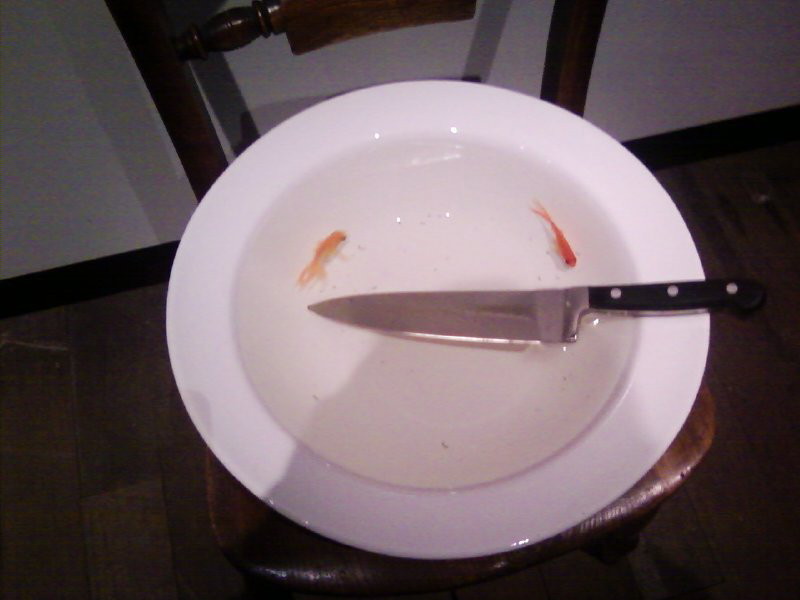
Goldfish in bowl with knife. Is this art?

What are your thoughts?

This is currently on display at the

Museum of New and Old Art – MONA, in Hobart, Tasmania.

Aquaculture Biosecurity & @Risk

———- Forwarded message ———-
From: Dr. David Scarfe <DScarfe@avma.org>
Date: Wed, Apr 4, 2012 at 7:13 PM
Subject: AquaVetMed: Aquaculture Biosecurity & @Risk
To:

Reducing risk of disease in aquatic animals with Palisade’s risk analysis software

March 4, 2012


London, UK (Press Release) – @RISK enables informed decision-making without costs of extensive testing. Palisade’s risk analysis software @RISK is being used by aquatic veterinary surgeons to demonstrate the practice of biosecurity to aquatic farmers. The method helps to reduce the potential for disease in animals without incurring the significant costs of extensive testing.


Biosecurity measures, which aim to prevent, control and ideally eradicate disease in aquatic animals, are regarded as essential to maintain the aquaculture sector. However, encouraging the adoption of these practices is often difficult due to the farmers’ levels of education, training, responsibility and perceived economic benefits. Veterinary surgeons developed an @RISK model to calculate the realistic risk of aquatic disease to farmers. The model simulates thousands of times the results of tests on a limited number of animals to present an accurate picture without testing the entire stock, which is prohibitive due to its cost. The capacity of @RISK to present the calculations in graphs that are easy to understand also makes it straightforward for vets to show farmers disease risk probabilities. With this information readily available, the cost/benefit of disease prevention can be calculated, and farmers can make informed choices about whether to implement controls.


Dr Chris Walster is a qualified veterinary surgeon with a long-standing interest in aquatic veterinary medicine, and is the secretary to the World Aquatic Veterinary Medical Association (WAVMA). Having seen Palisade’s risk analysis tool, @RISK demonstrated, he started using it to calculate the realistic risk of aquatic disease to farms, with a focus on cases where data inputs were limited. He explains: “@RISK enables farmers to reduce the risk of disease spreading amongst their animals whilst minimising additional costs. For aquatic vets, the key is the graphs that allow us to demonstrate a complex probability problem quickly and simply in a way that is easy to understand and trust. These inform decision-making, thereby helping to boost the world’s aquatic stock whilst safeguarding farmers’ livelihoods. This technique also potentially offers an economical method of assisting in the control of many diseases. Farmers undertake their own tests, with each of these providing incremental inputs so that the macro picture can be developed and acted upon,” concludes Walster.


About WAVMA

WAVMA was formed in 2006 as a not for profit professional association to serve the rapidly expanding discipline of aquatic veterinary medicine throughout the world. For further information, visit the website at http://www.wavma.org.


About Palisade

Palisade Corporation is a software developer that produces decision support tools for professionals in many lines of work. The company was founded in 1984, and at present more than 400,000 people use Palisade’s software in fields that range from finance to oil and mineral exploration, real estate to heavy manufacturing, and pharmaceuticals to aerospace. Its software is used by many Fortune 500 companies, including Shell Oil, Procter & Gamble, ExxonMobil, Chase Manhattan, and by prominent economic and financial consultants.


For more information on @RISK go to www.palisade.com/risk or contact:

Kate Alexander / Nicola Males

Vanilla Public Relations Ltd

E: Nicola@vanillapr.co.uk / kate@vanillapr.co.uk

T: +44 7976 652491


___________________________

AquaVetMed e-News provides information to veterinary and veterinary-allied subscribers concerning aquatic animal medicine, health, welfare, public health and seafood safety, obtained from a variety of sources (largely AquaVetMed subscribers). While provided by the American Veterinary Medical Association’s, Aquatic Veterinary Medicine Committee and are for public distribution, they do not necessarily reflect the opinion of the AVMA or the veterinary profession. See the AVMA Terms of Use (http://tinyurl.com/29h2rf) for further information.


If e-News information is used elsewhere please acknowledge AquaVetMed as the source. Encourage individuals to subscribe rather than distribute through list serves.


Messages may contain attachments that will have been scanned for known viruses.


Subscription and Contributions: Interested veterinarians and veterinary-allied professionals can subscribe, unsubscribe, or contribute pertinent news or information, by sending a message with “For AquaVetMed -” and the topic in the subject line, to dscarfe@avma.org.


Note: Undelivered e-mails will not be resent; Subscribers will be deleted from the list after repeated undelivered or bounced messages and will have to re-subscribe.


Visit our website: www.avma.org


________________________________


—
Follow me on: Twitter – Blog – Facebook – Linkedin – YouTube

—
Yours sincerely,

Dr Richmond Loh
BSc BVMS MPhil (Vet Path) MANZCVS (Aquatics & Pathobiology) DipPM

Veterinarian / Adjunct Lecturer Murdoch University / Secretary Aquatic Animal Health Chapter ANZCVS
The Fish Vet, Perth, Western Australia. Mobile Veterinary Service for fish and other aquatic creatures.
http://www.thefishvet.com.au
Ph: +61 (0)421 822 383

Fish on Friday Fuss. What’s it all about?

During the weeks leading up to Easter, you may have noticed a lot of advertisements calling people to buy fish for Friday. What’s it all about?

For the Christian community, abstinence from terrestrial meats became a tradition because in the old days, terrestrial meats (like beef, chicken and lamb) were considered a luxury food. Christians were supposed to fast and to eat simply. Fish on the other hand was considered a poor people’s food as it was cheap and abundant.

Today, the tradition continues even though you’ll be lucky to find fish that’s cheaper than terrestrial meats.