Sea food at New Port, Rhode Island

After a day of whale watching, some of us escaped the cafeteria food to enjoy some local fresh seafood at Newport. It was an enjoyable meal shared with fellow students at Aquavet.

From left to right, Dr Rob Ossiboff (Cornell Pathology Resident), Ms Kelsey Shroeder, Ms Heidi Fink and Ms Deanna Sin (all part way through their veterinary studies).

20120603-211435.jpg

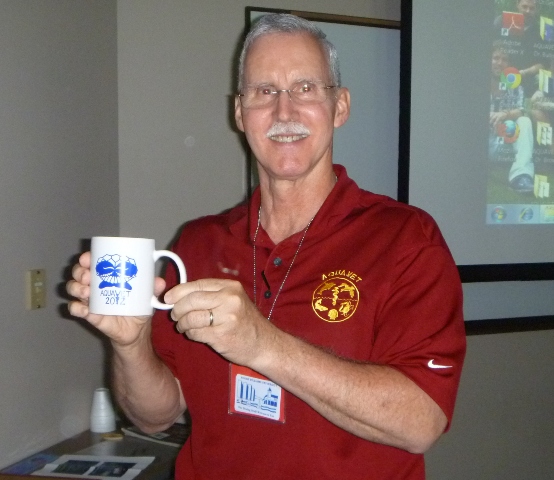
Logo for Aquavet 2012

Each year, the students at Aquavet put in a submission for a T-shirt logo so that we may have something to remember our experience by. Unfortunately mine didn’t make the cut 😦

But, it’s going to be made into mugs ;P

Check out how many different animals you can see in the logo I designed!

20120602-234622.jpg

What are parasites? How can you visualise them better on microscopy?

Day 7, Dr Sarah Poynton from the John Hopkins Medical Institute, presents at Aquavet 2.

Parasitos” = to eat at another’s table.

Parasites are organisms that they are nutritionally dependent on their host.

They’re not always primary pathogens.

Did you know that Microsporidia are now considered to be more closely related to fungi?

And that Myxosporea are now considered to be more closely related to metazoa?

Some of these bugs are difficult to visualise under normal HE stained histological sections. So what are some useful histological stains that can be used to help with visualising the very small parasites?

  • Gram
  • ZN
  • Giemsa
  • PAS
  • Protargol (similar to GMS, a silver stain)
  • DAPI
  • Feulgen

Other techniques include

  • Normarski (differential interference contrast).
  • Wet preparations (to visualise movement)

Dr Loh’s trip to attend AquaVet has been made possible through the – “People development program: 2011 Aquatic Animal Health Training Scheme which is supported by funding from the FRDC on behalf of the Australian Government”.

Follow me on: TwitterBlogFacebookLinkedinYouTube


Yours sincerely,

Dr Richmond Loh
BSc, BVMS, MPhil (Vet Path), MANZCVS (Aquatics), MANZCVS (Pathobiology), DipPM.
Veterinarian | Adjunct Senior Lecturer Murdoch University | WAVMA Communications Committee Member |
Secretary Aquatic Animal Health Chapter – Australian and New Zealand College of Veterinary Scientists (ANZCVS)

The Fish Vet, Perth, Western Australia. Mobile Veterinary Service for fish and other aquatic creatures.
http://www.thefishvet.com.au
Ph: +61 (0)421 822 383

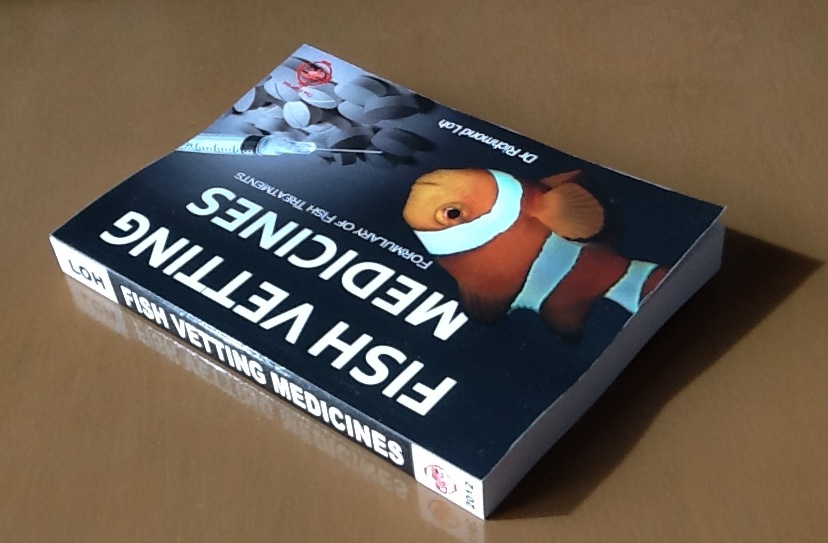
Looking for more books? Check out this site.

Why study fish?

Apart from the reason that they’re so interesting, there are countless reasons. The material below is a summary taken from Dr Jeff Wolf’s presentations over the last two days at the Aquavet II course.
We study fish for the:
Improvement of aquatic animal health
-Sport and commercial fisheries
-Aquaculture, ornamental fish trade
Animal models of human diseases
-Naturally occurring or genetically created
-Less emphasis lately
Surrogate test species for toxicology
-Less expensive than some mammalian models
-Less resistance from animal welfare advocates
Environmental sentinels
-Carcinogenesis
-Endocrine disruption
But why study fish of all things? Why not study birds?
It’s because the aquatic the aquatic environment is the essentially the “sink” for everything from the human household, to the industry, to farming, everything ends up in the water. Fish act as sentinels for our environmental health and our health.
The picture below is from a lecture provided by Jeffrey C. Wolf, DVM, DACVP from the Experimental Pathology Laboratories (EPL®), Inc. Sterling, VA, USA. He sourced this picture from Mr Ed Orlando.
We need to start thinking of the “One Health Concept” rather than thinking about it as animal health, fish health, human health, environment health. We live in a very interconnected world where for every action, there is a consequence.
Dr Loh’s trip to attend AquaVet has been made possible through the – “People development program: 2011 Aquatic Animal Health Training Scheme which is supported by funding from the FRDC on behalf of the Australian Government”.


Yours sincerely,

Dr Richmond Loh
BSc BVMS MPhil MANZCVS (Aquatics)  MANZCVS (Pathol)
The Fish Vet, Perth, Western Australia.
Veterinary Medicine for fish.
http://www.thefishvet.com.au
Ph: +61 (0)421 822 383
New/Improved Terminology for aquatic veterinary pathology.

New/Improved Terminology

We’ve been learning about toxicopathology in fishes, taught by Dr Jeff Wolf, the last couple of days at Aquavet II and came across some great stuff I’d like to share.

I’ve been working as a fish veterinarian and a veterinary pathologist for the last 10+ years and have come across some new and improved terminology that I believe we should all adopt. It makes better sense than the older terms.


So, here they are:

“PMC” (pigmented macrophage centre) rather than “MMC” (melanomacrophage centre) because contain more than just melanin. Three pigments that have been demonstrated to be present in these PMCs include melanin, haemosiderin and the lipopigments, lipofuscin/ceroid (formed byoxidation of lipid and retaining a yellowish-brown appearance).

We can see pancreatic cells within most fish livers, but we should not call it “hepatopancreas” – this term reserved for invertebrates. Call intrahepatic or mesenteric pancreas. Liver is liver. Pancreas is pancreas.

When describing vacuolation in liver, use terms such as “glycogen-type vacuolation” or “lipid-type vacuolation” because cannot be sure what was inside them.

With “lipid-like vaculation” you can further classify them as “microvesicular lipid-type vacuolation” and “macrovesicular lipid-type vacuolation”.

Hepatic lipidosis” should be reserved for pathological finding (deleterious/injurious to the animal’s health) – e.g. if there is breakdown of hepatocellular wall.

Lepido-“ = “scale”.

Dr Loh’s trip to attend AquaVet has been made possible through the – “People development program: 2011 Aquatic Animal Health Training Scheme which is supported by funding from the FRDC on behalf of the Australian Government”.

Follow me on: Twitter – Blog – Facebook – Linkedin – YouTube

Yours sincerely,Dr Richmond Loh

BSc, BVMS, MPhil (Vet Path), MANZCVS (Aquatics), MANZCVS (Pathobiology), DipPM.
Veterinarian | Adjunct Senior Lecturer Murdoch University | WAVMA Communications Committee Member |
Secretary Aquatic Animal Health Chapter – Australian and New Zealand College of Veterinary Scientists (ANZCVS)
The Fish Vet, Perth, Western Australia. Mobile Veterinary Service for fish and other aquatic creatures.
http://www.thefishvet.com.au
Ph: +61 (0)421 822 383

How can you tell how old a fish is?

Ever wondered how you can age fish? Ask them?

There’s a technique whereby the bone from middle ear is sectioned and the growth rings (much like the tree’s) can give you an indication as to the fish’s age.

“The otolith layers are generally oriented parallel to the outer surface of the otolith and are most densely aligned during periods of slower growth (usually associated with cooler months), thus forming characteristic, concentric opaque rings in otolith cross sections (Blacker 1974). Layers that are less densely spaced during periods of faster growth during warmer months make up the translucent ring. When the formation of successive opaque and translucent rings occur on an annual basis, they are collectively referred to as an annual growth zones….”

Unfortunately, this can only be done in a dead fish.

This technique is also used to age manatees (because asking them doesn’t work, especially if they’ve already passed on).

This information can be downloaded from this link (38Mb).

"A Practical Handbook for Determining the Ages of Gulf of Mexico Fishes".

This link was shared by a fellow classmate (Johnny Shelley) at Aquavet II.