Not only is the toilet here dual flush, but it also utilises reclaimed water.
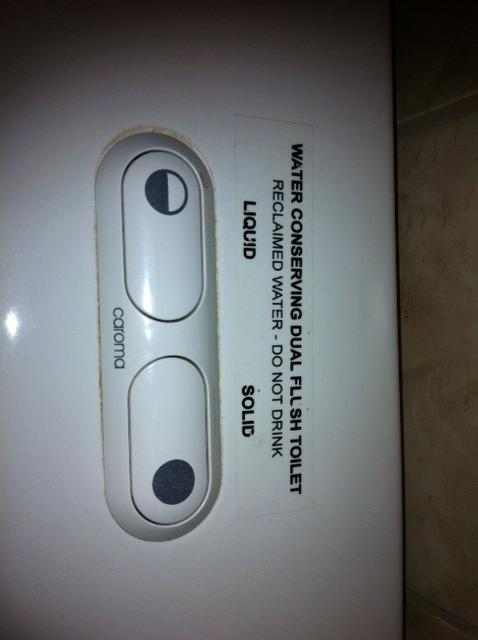
At a Hotel in Arizona.
All about Fish Vetting – Dr Richmond Loh
Not only is the toilet here dual flush, but it also utilises reclaimed water.
At a Hotel in Arizona.
Where do stone fish go for entertainment?
The rock and roll concert.
This article shared by Dr Don Stremme.
Squid strikes woman’s oral cavity with spermatophores
15.jun.12
barfblog
Doug Powell
http://www.barfblog.com/blog/155368/12/06/15/squid-strikes-woman%E2%80%99s-oral-cavity-spermatophores
Park et al. report in the Journal of Paristology regarding a case of oral stings by spermatophores of the squid Todarodes pacificus. A 63-yr-old Korean woman experienced severe pain in her oral cavity immediately after eating a portion of parboiled squid along with its internal organs. She did not swallow the portion, but spat it out immediately. She complained of a pricking and foreign-body sensation in the oral cavity.
Twelve small, white spindle-shaped, bug-like organisms stuck in the mucous membrane of the tongue, cheek, and gingiva were completely removed, along with the affected mucosa. On the basis of their morphology and the presence of the sperm bag, the foreign bodies were identified as squid spermatophores.
Penetration of the oral mucosa by parasite-like sperm bags of squid: A case report in a Korean woman, Journal of Parasitology 98(1):222-223. 2012
Gab-Man Park, Jong-Yun Kim, Jeong-Ho Kim, and Jong-Ki Huh
http://www.bioone.org/doi/abs/10.1645/GE-2827.1
This is one of the signages at the beach in Santa Barbara. Education doesn’t have to be confined to the classroom. Environmentalists, educators and scientists may like to encourage their local councils to install such information posts. Is that a good idea?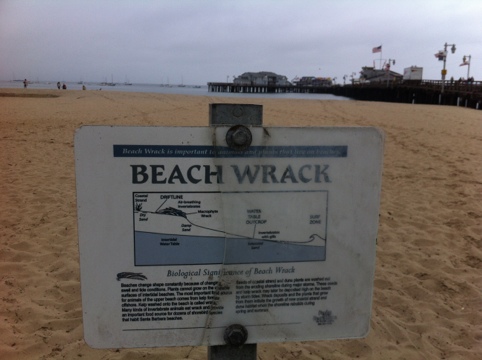
Begin forwarded message:
From: Shelby Sowder <msowder>
Date: 14 June 2012 11:30:45 PDT
To: thefishvet
Subject: Diseases of Warmwater Fish – Early Registration Ends June 25
Reply-To: msowder
Having trouble viewing this email? Click here
EARLY Registration Fee ends June 25, 2012!
Who Should Attend
- Veterinarians
- Fisheries Biologists
- Aquaculturists
- Professional Aquarists
- Graduate students
Travel Information
If traveling by air you should fly into Tampa International Airport and depart from Orlando International Airport.
Van transportation will be provided to and from the host hotels to all course lectures, field trips, and venue changes on August 3 and 10.
Quick Links…
Course Website
Diseases of Warmwater Fish is an intensive two-week class designed to provide instruction in the methodology of diagnosis and treatment of parasitic, bacterial, viral, nutritional, and environmental diseases of warmwater food fish and aquarium species. The course will be held at two University of Florida locations. From July 30-August 3, class is at the Tropical Aquaculture Laboratory in Ruskin (south of Tampa). It moves to the Whitney Laboratory for Marine Bioscience in Marineland (south of St. Augustine) for August 4-9. On August 10, the course concludes at SeaWorld Orlando.
A few spaces remain. Reserve your seat today!
Registration Information
Enrollment in this course is limited to the first 40 participants. Registration will be accepted on a first-come, first-served basis. All figures are presented in US dollars ($).
Early Reduced Registration Fee
(On or before June 25, 2012)$900.00 Regular Registration Fee
(After June 25, 2012)$1,000.00 What does the Registration Fee include?
It provides each participant the educational program, transportation (between host hotel & lecture sites, to field trips and changes of venue on August 3 & 10, Sunday evening (July 29) informal welcome reception, lunch on July 30, dinner on July 31, refreshment breaks Monday-Friday, lab supplies, and course materials.
For More Information: Dr. Ruth Francis-Floyd, Program Organizer
University of Florida | College of Veterinary Medicine
PO Box 100136
Gainesville, FL 32610-0136
PH: 352-294-4197 | Fax: 352-392-8289
rffloydShelby Sowder, Course Coordinator & Registrar
PO Box 110750 | Building 639, Mowry Road
Gainesville, FL 32611-0750 | USA
PH: 352-392-5930 | FAX: 352-392-9734
msowder
Forward email
thefishvet by msowder |
Update Profile/Email Address | Instant removal with SafeUnsubscribe™ | Privacy Policy.UF/IFAS OCI | PO Box 110750 | Bldg. 639 Mowry Road | Gainesville | FL | 32611

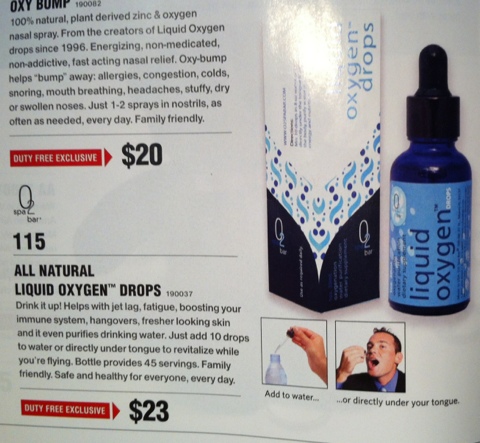
Liquid oxygen.
I saw this on the in-flight magazine. I wonder if he’s just drinking dilute hydrogen peroxide? Well, it certainly can’t be compressed gas!
I know that I can use 3% hydrogen peroxide at a rate of 0.25ml/L in the event we need emergency oxygenation in anoxic conditions as can occur during pump failure or electrical outtage.
To get access to all drug dosages relevant to fish health, get a copy of Fish Vetting Medicines today by following this link – http://thefishvet.com.au/shop/shopping.html
Monterey Bay Aquarium pictures.
Check out my most recent aquarium pictures by clicking on this link.
–
Follow me on: Twitter – Blog – Facebook – Linkedin – YouTube —
Yours sincerely,Dr Richmond Loh
BSc, BVMS, MPhil (Vet Path), MANZCVS (Aquatics), MANZCVS (Pathobiology), DipPM.
Veterinarian | Adjunct Senior Lecturer Murdoch University | WAVMA Communications Committee Member |
Secretary Aquatic Animal Health Chapter – Australian and New Zealand College of Veterinary Scientists (ANZCVS)The Fish Vet, Perth, Western Australia. Mobile Veterinary Service for fish and other aquatic creatures.
http://www.thefishvet.com.au
Ph: +61 (0)421 822 383Mystic Aquarium & NY Aquarium pictures..
They’re on my facebook fanpage – LIKE IT!
http://facebook.com/thefishvetdrloh
There are two folders of my recent visits to public aquaria:
Mystic Aquarium – Connecticut
&
New York AquariumSalmon Fishing in the Yemen.
I watched this during the flight. Very unbelievable. Biologically impossible. And what are they going to eat in the middle of the dessert?
Plus I think they need a veterinarian to do the health checks prior to massive mobilisation of 10,000 fish and its water.