An old but interesting article on fish vets.
At first there was Aquavet…
AquaVet I and II completed, AquaVet III starts Monday 9th July, 2012 for the first time. This will have a marine mammal focus with hands on clinical experience.
Dr Loh will be consulting in Melbourne.
Dr Loh will be at Boronia Aquarium this Saturday, 7th July. Please call Boronia Aquarium to book an appointment.
Please note that the management subsidises Dr Loh’s professional fees significantly for their customers.
Reducing walling in the culture of oceanic larvae may decrease the incidence of malformations.
Other interesting points in this paper as well.
| Aquaculture | |||||||||||||||||
| Volume 357, Number 3 (August 2012) | |||||||||||||||||
 |
The effects of tank colour, live food enrichment and greenwater on the early onset of jaw malformation in striped trumpeter larvae | ||||||||||||||||
| Authors: | Jennifer M. Cobcroft, Alexander Chong Shu-Chien, Meng-Kiat Kuah, Annette Jaya-Ram, Stephen C. Battaglene | ||||||||||||||||
| Author Affiliations: |
|
||||||||||||||||
| Source: | Aquaculture, Volume 357, Number 3 (August 2012) | ||||||||||||||||
| Page Numbers: | 61 – 72 | ||||||||||||||||
| Available Full Text: |
|
||||||||||||||||
| Abstract: | A high incidence of jaw malformation has hindered the production of quality striped trumpeter Latris lineatajuveniles and has been correlated with walling behaviour in Artemia-fed larvae. In this study, striped trumpeter were reared from first feeding to 29days post-hatching (dph) in different coloured tanks (black or white), culture conditions (clear or greenwater) and fed different diets (enriched or non-enriched rotifers and Artemia), to examine behaviour, retinoid receptor gene expression and jaw malformation. The highest incidence and severity of jaw malformations occurred in clearwater and enriched diet treatments and were significantly more common in white (70±15%, mean±SD) than in black tanks (26±15%). In black tanks, jaw malformation was significantly more common in larvae fed enriched diets (18±14%) than in those fed non-enriched diets (8±8%) and in clearwater (19±14%) versus greenwater (7±6%). At the end of the rotifer feeding phase, larvae were significantly larger in black than white tanks, and longer in greenwater than in clearwater. In the Artemiafeeding phase, larval growth was slowest and mortality was highest in non-enriched diet treatments. Larval length and survival were higher in black tanks and in enriched diet treatments, whilst survival was almost twice as high in greenwater (46±18%) than clearwater (26±13%). The average proportion of larvae walling over the duration of the experiment was higher in white than black tanks, and higher in enriched than non-enriched treatments, with lowest walling in greenwater. There was no consistent relationship between feed intake and jaw malformation. However, there was a significant positive correlation between walling and the incidence of jaw malformation at 29dph in larvae fed enriched diets. The expression pattern of three retinoid receptor genes indicated that live feed enrichment and stress could potentially perturb retinoic acid-associated pathways leading to skeletal abnormality. We found that the use of greenwater, black tanks and enriched live feeds is required for good growth, development, survival and final yield of striped trumpeter. The study emphasises the importance of reducing walling in the culture of oceanic larvae and may have direct application in the rearing of other marine fish with similar malformations. | ||||||||||||||||
| Citation: | Jennifer M. Cobcroft, Alexander Chong Shu-Chien, Meng-Kiat Kuah, Annette Jaya-Ram, Stephen C. Battaglene . The effects of tank colour, live food enrichment and greenwater on the early onset of jaw malformation in striped trumpeter larvae. Aquaculture, Volume 357, Number 3 (August 2012), pp. 61-72, <http://ejournals.ebsco.com/direct.asp?ArticleID=488DB95F5DDD57A7C293> | ||||||||||||||||
| URL: | http://ejournals.ebsco.com/direct.asp?ArticleID=488DB95F5DDD57A7C293 | ||||||||||||||||
Fish-friendly fishing gear.
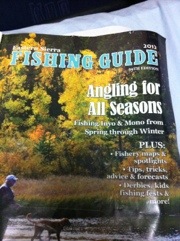
I’m far from an expert fisherman, but I thought I’d share with you a few pointers from a fishing magazine that I picked up when I was in Mammoth, California – 2012 Eastern Sierra Fishing & Vacation Guide. I’ve also added a few more to it.
Barbless hooks allow for ease of removal.
Wide gape hooks prevents hooks from become lodged too deeply.
Use hook removers, pliers or haemostats to remove hooks without causing too much damage.
Tungsten sinkers are lead-free, are more dense and have a smaller profile allows them to sink faster too.
Consider Biodegradable fishing lines and lures.
Fish Tailer Landing Glove is designed to protect the outer slime layer of fish.
Knot-less landing nets protect the slime, skin and scales of fish.
A length of heavy PVC pipe to use for stunning fish you intend to keep.
Alternatively, consider the use of fish anaesthetic such as Aqui-S. In Australia, there is nil withholding period and is registered for use in salmonids, abalone and lobster.
Clean and disinfect clothes and equipment when going from one fishing spot to another.
Aquaculture Drug Approval Coordination Workshop
This is exactly what Australia needs and it’s in it’s 18th year in the US!
18th Annual USFWS Aquaculture Drug Approval Coordination Workshop
Radisson Hotel, La Crosse, Wis.
July 31, 2012
More information:
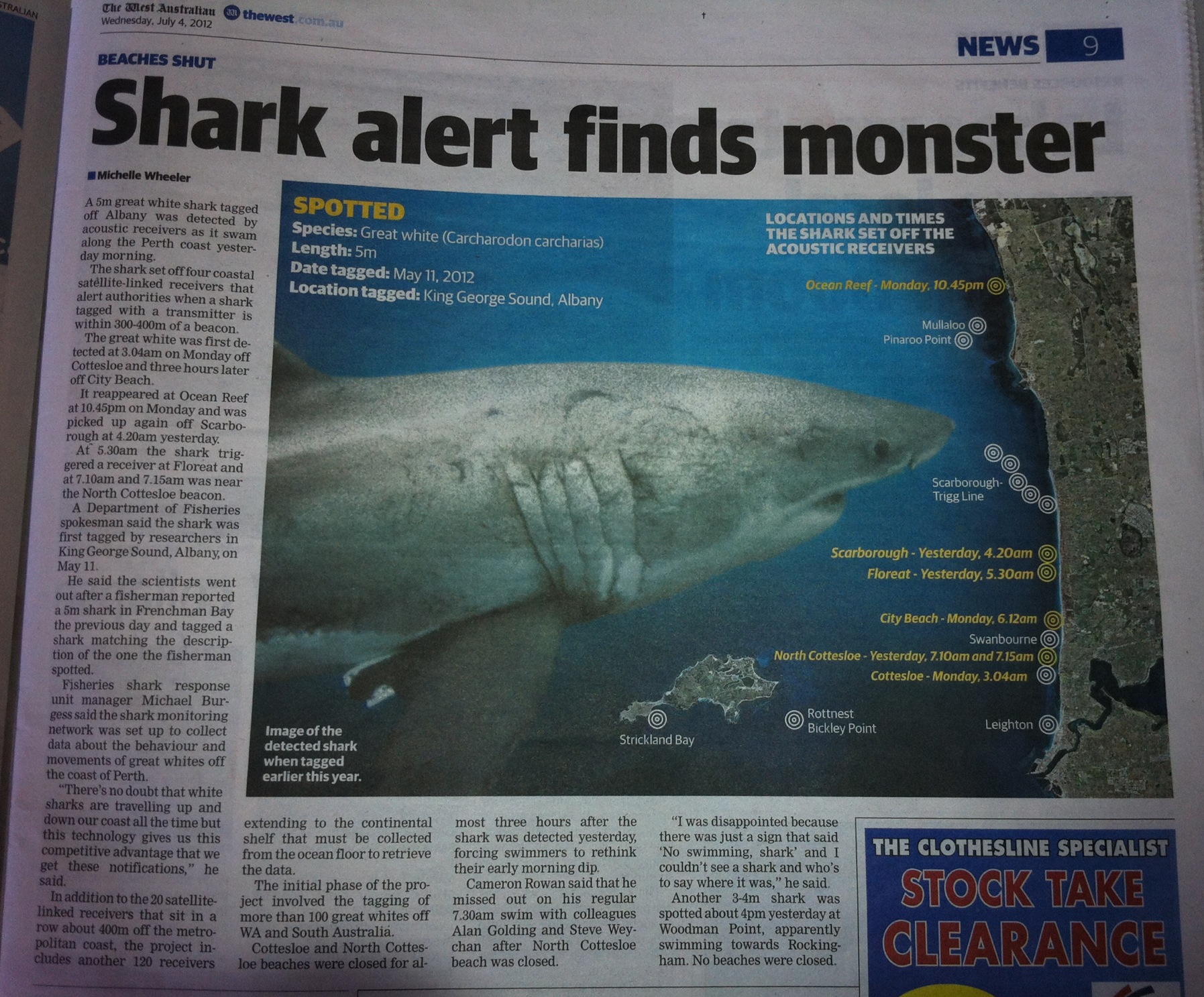
Shark tracker
From today’s West Australian newspaper.
Amphibian and reptile safe practices.
The information is available for download from this link:
http://www.cdc.gov/healthypets/resources/amphibian-reptile-poster-tearoff.pdf
—
Yours sincerely,
Dr Richmond Loh
BSc BVMS MPhil MANZCVS (Aq & Pathol)
The Fish Vet, Perth, Western Australia.
Veterinary Medicine for fish.
http://www.thefishvet.com.au
Ph: +61 (0)421 822 383
Supportive breeding with subsequent stocking is an important long-term conservation tool for sustaining harvestable populations and genetic diversity in wild fish populations.
I understand that the Challenger Institute of Technology was successfully breeding several popular fish species for wild stock enhancement. Their activity have since ceased largely due to the argument that the genetics of the wild stock would be adversely affected. But I think that if it is carefully managed, genetic diversity can still be maintained. Check out this article for more information.
| Aquaculture | |||||||||||||||||
| Volume 357, Number 3 (August 2012) | |||||||||||||||||
| |
Interbreeding of genetically distinct native brown trout (Salmo trutta) populations designates offspring fitness | ||||||||||||||||
| Authors: | Jens Wollebæk, Knut H. Røed, Åge Brabrand, Jan Heggenes | ||||||||||||||||
| Author Affiliations: |
|
||||||||||||||||
| Source: | Aquaculture, Volume 357, Number 3 (August 2012) | ||||||||||||||||
| Page Numbers: | 158 – 168 | ||||||||||||||||
| Available Full Text: |
|
||||||||||||||||
| Abstract: | Supportive breeding with subsequent stocking is an important long-term conservation tool for sustaining harvestable populations and genetic diversity in wild fish populations. In salmonids, this strategy often implies, inadvertently or for logistic reasons, breeding of a mixture of local populations, which may lead to loss of local adaptation and pose risks to receiving populations. In an alpine lake system in Norway (Pålsbu-Tunhovd), we assessed long-term effects of interbreeding three brown trout (Salmo trutta) populations from separate and environmentally contrasting spawning and recruitment habitats. Using a Bayesian genetic assignment algorithm we compared numeric contributions and genetic and demographic characteristics of wild-born and lake-stocked fish within and across populations. Population contribution by the broodstock was disproportional to the number of surviving and reproductively ready stocked brown trout, indicating higher lifetime survival for brown trout descending from a large river dominated by large fish. Life history selection was further indicated by a discrepancy between observed and expected numbers of adult hybrids, i.e., fewer hybrids suggest negative fitness effects of hybridization. Hence, supportive breeding changed gene frequencies, although reduced genetic variation was not documented in mature stocked brown trout. Post stocking, these fish retained the initial length advantage relative to the fastest-growing wild-born population until the age of ten. Stocked brown trout had similar growth rates regardless of genetic origin, whereas wild-born brown trout growth rates differed among recruitment habitats. Our study in this system indicates that genetic origin determined longevity. Genetics may be a less important determinant for growth rates in lake-stocked than in wild-born brown trout. | ||||||||||||||||
| Citation: | Jens Wollebæk, Knut H. Røed, Åge Brabrand, Jan Heggenes . Interbreeding of genetically distinct native brown trout (Salmo trutta) populations designates offspring fitness. Aquaculture, Volume 357, Number 3 (August 2012), pp. 158-168, <http://ejournals.ebsco.com/direct.asp?ArticleID=4178B5BD05DA1236D955> | ||||||||||||||||
| URL: | http://ejournals.ebsco.com/direct.asp?ArticleID=4178B5BD05DA1236D955 | ||||||||||||||||
What caused the oyster mortality event on Tasmania’s East Coast in 2004?
I suspect that the oyster mortality event on Tasmania’s East Coast in 2004 is due to low DO and hyposalinity.
| Aquaculture | ||||||||||||
| Volume 357, Number 3 (August 2012) | ||||||||||||
|
Immune parameter changes of hemocytes in green-lipped mussel Perna viridisexposure to hypoxia and hyposalinity | |||||||||||
| Authors: | Youji Wang, Menghong Hu, S.G. Cheung, P.K.S. Shin, Weiqun Lu, Jiale Li | |||||||||||
| Author Affiliations: |
|
|||||||||||
| Source: | Aquaculture, Volume 357, Number 3 (August 2012) | |||||||||||
| Page Numbers: | 22 – 29 | |||||||||||
| Available Full Text: |
|
|||||||||||
| Abstract: | Marine hypoxia owing to nutrient enrichment of water bodies by anthropogenic activities has become a global problem for several decades. Another marine environmental factor, salinity, plays an important role for marine organisms and fluctuates greatly in estuarine and coastal ecosystem, where hypoxia frequently occurs. The present study evaluated the interactive effects of hypoxia and salinity on immune functions of hemocytes in the green-lipped mussel Perna viridis, which widely distributes in estuarine and coastal waters of the Indo-Pacific region. Mussels were subjected to six combinations of oxygen levels (hypoxia: 1.5mg O2l-1, normoxia: 6.0mg O2l-1) and salinities (15‰, 22‰ and 30‰) for 168h. Mussel hemocytes were sampled after 24h, 48h, 96h and 168h exposure, for analysis of immune functions including hemocyte mortality, phagocytosis, esterase, reactive oxygen species (ROS) production, lysosomal content and total hemocyte counts using flow cytometric methods. Thereafter, all treatments were recovered to normoxic condition (6.0mg O2l-1) and salinity 30‰ for 24h to study the recovery of immune functions from the combined hypoxic and hyposaline stresses. Interactive effects of dissolved oxygen (DO) and salinity on all immune parameters were observed during the experiment. Generally, hemocyte mortality was higher at low salinity than that at high salinity levels; higher hemocyte mortality was also noted when mussels were exposed to hypoxia compared with normoxia. Phagocytosis at low salinities and hypoxia was decreased compared to normal DO and salinity treatment, respectively. The activity of esterase and ROS production at low salinity and hypoxia were reduced, respectively. Lysosomal content and total hemocyte counts were lower at low salinity and hypoxia compared to other treatments, respectively. After 24h recovery, hypoxia and salinity effects were still significant among previous treatments, indicating immune functions of P. viridiscould not recover from combined stresses in a short time. | |||||||||||
| Citation: | Youji Wang, Menghong Hu, S.G. Cheung, P.K.S. Shin, Weiqun Lu, Jiale Li . Immune parameter changes of hemocytes in green-lipped mussel Perna viridisexposure to hypoxia and hyposalinity. Aquaculture, Volume 357, Number 3 (August 2012), pp. 22-29, <http://ejournals.ebsco.com/direct.asp?ArticleID=4C8FB8F8CD619D88FE81> | |||||||||||
| URL: | http://ejournals.ebsco.com/direct.asp?ArticleID=4C8FB8F8CD619D88FE81 | |||||||||||