Is white spot syndrome virus unstoppable in shrimp culture?

Apparently this disease can cripple a nation’s economy that is highly dependent on shrimp farming in as little as a week if the disease is allowed to spread. WSSV has low host specificity and can infect a large number of crustaceans. This paper illustrates several ecological ways of preventing WSSV outbreak.

Aquaculture
Volume 353, Number 11 (June 2012)
Effect of three innovative culture systems on water quality and whitespot syndrome virus (WSSV) viral load in WSSV-fed Penaeus monodoncultured in indoor tanks
Authors: Eleonor A. Tendencia, Roel H. Bosma, Lynbelle Rose Sorio
Author Affiliations:
no affiliations available
Source: Aquaculture, Volume 353, Number 11 (June 2012)
Page Numbers: 169 – 174
Available Full Text:
Full Text: Subscription Required to view full text
Format: PDF
Size: Unknown
Location: Publisher’s Site
Authentication: Publisher’s Site
Abstract: White spot syndrome virus is the most important among the shrimp diseases. It has been devastating the shrimp industry for more than 3 decades. Previous studies reported that greater percentage of yellow colonies on thiosulfate citrate bile salt sucrose agar (yellow vibrios) in the rearing water, abundant supply of natural food such as Chlorella, and the use of the greenwater technology (GW) are some ecological ways of preventing WSSV outbreak. The aim of this study was to investigate the efficiency of the 3 systems against WSSV.
Citation: Eleonor A. Tendencia, Roel H. Bosma, Lynbelle Rose Sorio . Effect of three innovative culture systems on water quality and whitespot syndrome virus (WSSV) viral load in WSSV-fed Penaeus monodoncultured in indoor tanks. Aquaculture, Volume 353, Number 11 (June 2012), pp. 169-174, <http://ejournals.ebsco.com/direct.asp?ArticleID=46FF946AFA99476D73BD&gt;
URL: http://ejournals.ebsco.com/direct.asp?ArticleID=46FF946AFA99476D73BD

Sentinels in quarantine.

Many involved with fish health know well that quarantine is the best policy where “An Ounce of Biosecurity…Worth More Than a Pound of Cure” (phrase borrowed from an up coming conference talk title – http://www.vet.purdue.edu/2012fallconference).

But have you thought about doing something different? One of my colleagues came up with a radically new, brilliant idea that would change the way we do things and save a lot of fish lives!

At the moment, ornamental fish imported into Australia are held in quarantine for 1, 2 or 3 weeks depending on the requirements. Fish in quarantine are not allowed to be treated with any medications so that no signs of disease will be masked.
If significant deaths do occur, the entire population in the affected tanks would have to be destroyed and/or a sample of the fish will need to be tested at the government laboratories. Moreover, the current method cannot detect asymptomatic carriers of diseases.

Because the ornamental fish sector has been highlighted as a threat to Australian biosecurity, there have been moves to tighten the quarantine rules. It has been proposed that 60 or 120 individuals per species batch will have to be sacrificed for destructive testing by local authorities.

This will mean that it will significantly increase the price for fishes and more importantly, unnecessary loss of the lives of thousands of fish. So, what is this radical new method that was suggested by my colleague?

We are aware that environmentalists study sentinel species to give an indication of the health of the environment. Miners in the past used canaries in coal-mines to provide an early indication of pending danger from gas accumulation.

My colleague proposed that we apply this same methodology of using biological indicators to demonstrate disease freedom of imported fish. Here, the quarantine setup will be designed such that water from the quarantine tanks are hooked up to tanks that house several fish species that are susceptible to the diseases we want to keep out (i.e. cohabiting with sentinels). If disease is present, the sentinel fishes would show signs of illness and they can be tested. If there is no disease, then the sentinel fishes will remain in good health and there is no needless destruction of fish. Some of the fish/disease pairings can include Murray cod for gourami iridovirus; fork tailed catfish or barramundi for Edwarsiella ictaluri.

But according to my colleague who proposed the idea, he says that it’s not a novel idea but is standard practice around the world in specific terresterial animal disease monitoring.

There have been several occasions where this method of quarantine would have proven useful for my clients where recently imported fish were carrying a particular strain of pathogen that their resident fish had no immunity to. The imported fish showed no signs of disease during quarantine in a separate pond, but when introduced to the main pond, the resident fish started dying in numbers.

The other brilliant aspect of this proposal is that I believe it will have a much higher rate of acceptance and hence adoption by the industry. Other things I’d add to make this work includes microchipping of the sentinel fishes and faster turnaround time for reporting laboratory results.

Worth a try in ornamental fish? Your thoughts?

http://www.thefishvet.com.au

Fish joke for Monday-itis

Having dinner at a very fancy restaurant, the waiter asked the gentleman that was eating the fish,”How did you find the salmon?”

The puzzled guest looked at the plate and then again at the waiter and replied,”I moved the garnish aside and
voilà I found the fish!”

Fish Vetting Essentials – Reviewed in Vet Record

Check out the latest review for “Fish Vetting Essentials” in Veterinary Record. This is an established and well-regarded scientific journal with a worldwide distribution.

“it really is one of the most practical fish books I have come across and it is absolutely fascinating… given the unique qualities of this book, and its comprehensive yet practical coverage of fish medicine, I would strongly recommend it to anyone keen on seeing fish, whether experienced or just dabbling. And if you’re still not keen on taking the plunge, just find the number of the nearest aquarist and recommend they get a copy.”

More information about the book can be found by clicking on the following link:

Fish Vetting Essentials

Dr Loh has also published a second book.

Fish Vetting Medicines: Formulary of Fish Treatments

You can purchase these books at The Fish Vet’s site.

Please feel free to forward it to others who may be interested.

Thank you.

Book Review – Veterinary Record

Flood/drain versus submerged biofilters. Which is better?

I’ve seen several aquaponics setups that utilise the flood/drain method to water the plants, and hence act as the filtration for the fishes. I had always wondered whether there is enough filtration of the water for the health of the fish especially when the water runs only 4x per day.

This is why my DIY (do-it-yourself) backyard set up is a continuous flow method (nutrient film technique) utilising a submerged biofilter to filter the fishes’ wastes. I thought it’d be better for the fish to be in a proper aquaculture setup and then have the plants as an accessory. See Facebook fanpage link here.

This paper details the work done to come up with the conclusions that:

  1. Removal of organic nitrogen and ammonia was higher in flood/drain biofilters.
  2. Removal of nitrites and nitrates was better in submerged biofilters
  3. The use of combined flood/drain and submerged biofilters may offer the best solution to the treatment of aquaculture waste.

Having said this, I’d like to do some water quality testing of my own for those with the flood/drain design, to look at TAN and nitrite levels.

Aquacultural Engineering
  Volume 50, Number 2 (September 2012)
     Nitrogen removal and changes to microbial communities in model flood/drain and submerged biofilters treating aquaculture wastewater
   Authors: Simon P. Gregory 1, Paul J. Dyson 2, David Fletcher 3, Philip Gatland 4, Robin J. Shields 1
   Author Affiliations:
 1: Centre for Sustainable Aquatic Research, College of Science, Swansea University, Singleton Park, Swansea SA2 8PP, UK
 2: Institute of Life Science, Swansea University, Singleton Park, Swansea SA2 8PP, UK
 3: RAS Aquaculture Research Ltd, Pen Lon, Maes y Llan, Llandwrog, Gwynedd, UK
 4: 31 Spindlewood, Brough, East Elloughton, HU15 1LL, UK
   Source: Aquacultural Engineering, Volume 50, Number 2 (September 2012)
   Page Numbers: 37 – 45
   Available Full Text:
Full Text: Subscription Required to view full text
Format: PDF
Size: Unknown
Location: Publisher’s Site
Authentication: Publisher’s Site
   Abstract: ? Flood/drain biofilters were compared to submerged biofilters for the treatment of marine aquaculture wastewater. ? Analysis of 16s rRNA and amoAgenes by T-RFLP revealed distinct bacterial communities in the submerged and flood/drain biofilters. ? Removal of organic nitrogen and ammonia was higher in flood/drain biofilters. Removal of nitrites and nitrates was better in submerged biofilters. ? The use of combined flood/drain and submerged biofilters may offer the best solution to the treatment of aquaculture waste.
   Citation: Simon P. Gregory, Paul J. Dyson, David Fletcher, Philip Gatland, Robin J. Shields . Nitrogen removal and changes to microbial communities in model flood/drain and submerged biofilters treating aquaculture wastewater. Aquacultural Engineering, Volume 50, Number 2 (September 2012), pp. 37-45, <http://ejournals.ebsco.com/direct.asp?ArticleID=41AF998AA0FB9C7061FB&gt;
   URL: http://ejournals.ebsco.com/direct.asp?ArticleID=41AF998AA0FB9C7061FB

Aquaculture hub

I have just joined AquacultureHub (http://www.aquaculturehub.org).

AquacultureHub is a site for Aquaculturists, teachers, students and everyday people interested in aquaculture.

—
Yours sincerely,

Dr Richmond Loh
BSc BVMS MPhil MANZCVS (Aq & Pathol)
The Fish Vet, Perth, Western Australia.
Veterinary Medicine for fish.
http://www.thefishvet.com.au
Ph: +61 (0)421 822 383

Online educational opportunities – Uni of Florida

Heaps of online and educational opportunities on aquatics can be found on the following web site: http://aquatic.vetmed.ufl.edu/education/

The Spiel:
The University of Florida Aquatic Animal Health program now offers online courses through the UF College of Veterinary Medicine. These courses are designed for undergraduate students interested in this field of study as well as veterinary/graduate students and professionals already immersed in aquatic animal medicine. We invite you to take part in this unique learning experience .

The Fall semester is approaching and Registration is OPEN for our fall course, Aquatic Animal Conservation Issues (http://aquatic.vetmed.ufl.edu/education/courses/distance-learning-courses/aquatic-animal-conservation-issues/). To learn more about our courses and program please visit the links below or contact us.

We look forward to having you with us this Fall!
Best regards,

Iske Larkin, PhD
Education Coordinator

Aquatic Animal Health Program
Department of Large Animal Clinical Sciences
College of Veterinary Medicine
University of Florida

– – – –

Using sari material to filter the water?

This article highlights the importance of removing suspended solids because of the pathogenic bacteria that could be associated with them.

Aquaculture International: Journal of the European Aquaculture Society
Volume 20, Number 4 (August 2012)
A dead-end filtration method to remove particle-associated pathogens in aquaculture systems
Authors: Songzhe Fu 1, Jiazheng Shen 2, Kang Chen 2, Junling Tu 1, Ying Liu 2
Author Affiliations:
1: Nanchang Center for Disease Control and Prevention, No. 833 Lijing Road, Honggutan District, Nanchang, 330038 China
2: Institute of Oceanology, The Chinese Academy of Sciences, Qingdao, 266071 China
Source: Aquaculture International: Journal of the European Aquaculture Society, Volume 20, Number 4 (August 2012)
Page Numbers: 657 – 672
Available Full Text:
Full Text: Subscription Required to view full text
Format: PDF
Size: unknown
Location: Publisher’s Site
Authentication: EBSCOhost EJS
Abstract:
Abstract

To reduce the incidence of bacterial diseases in recirculating aquaculture systems, 27 marine bacterial species were introduced into Instant Ocean maintained at 25°C. Those species were enumerated before and after filtration to evaluate the efficiency of the filtration procedure. The effects of sari filter and nylon filter on the survival of sea bass challenged with Vibrio alginolyticus were also determined. The results of laboratory studies indicated that the ability to remove pathogens was typically 1–3 log orders. Above 90% Vibrio sp., i.e., which were attached to particles, were removed by either 20-µm nylon net or four layers of sari. A 9.53% mortality of sea bass was reported in pilot filtration test using sari material as an end filter, while this percentage increased to 33.35% in control groups. It is concluded that a simple filtration procedure that involves the use of four-layer sari material can reduce the numbers of pathogens attached to particles in aquaculture system. The results of this study provide the basis for pathogen reductions in full-scale facilities.
Citation: Songzhe Fu, Jiazheng Shen, Kang Chen, Junling Tu, Ying Liu . A dead-end filtration method to remove particle-associated pathogens in aquaculture systems. Aquaculture International: Journal of the European Aquaculture Society, Volume 20, Number 4 (August 2012), pp. 657-672, <http://ejournals.ebsco.com/direct.asp?ArticleID=4A15AF4746923D49C3F2&gt;
URL: http://ejournals.ebsco.com/direct.asp?ArticleID=4A15AF4746923D49C3F2

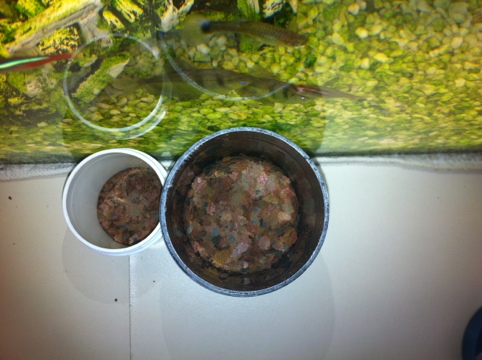
Cheap foods can lead to algal problems.

These two fish foods look similar, but after using the cheaper brand, the owner started seeing algal issues. A simple theory is that the cheaper food is not as digestible and is not as well assimilated by the fish, creating more wastes in the water, favouring algal growth.

20120718-134045.jpg

Human pee versus cow poo.

Need I say more?


Aquaculture International: Journal of the European Aquaculture Society
Volume 20, Number 4 (August 2012)
Comparative evaluation of the fertilizer value of human urine, cow manure and their mix for the production of carp fingerlings in small holding tanks
Authors: B. Jana 1, Sujoy Bag 1, Sukanta Rana 1
Author Affiliations:
1: International Centre of Ecological Engineering, University of Kalyani, Kalyani, 741235 West Bengal, India
Source: Aquaculture International: Journal of the European Aquaculture Society, Volume 20, Number 4 (August 2012)
Page Numbers: 735 – 749
Available Full Text:
Full Text: Subscription Required to view full text
Format: PDF
Size: unknown
Location: Publisher’s Site
Authentication: EBSCOhost EJS
Abstract:
Abstract

Advanced fry of Indian carps and post-larvae of freshwater prawn were reared for 120 days in 18 small holding tanks using each treatment in triplicate as: (a) non-aerated and (b) aerated fresh human urine (0.01%), (c) cow manure (1.8 kg tank-1), mixed treatment with cow manure and human urine under (d) iso-phosphorus and (e) iso-nitrogenous conditions and (f) control. Examination of water quality, primary productivity of phytoplankton, plankton and fish growth from different treatments revealed that the total fish yield was maximum in the cow manure treatment (621.5 g tank-1) followed by the mixed treatments under iso-nitrogenous (428 g tank-1) and iso-phosphorus (333 g tank-1) conditions. Fish yield in different treatments was the direct function of the gross and net primary productivity of phytoplankton which, in turn, were directly related to the concentrations of nitrate and phosphate levels of water as well as their ratios in different treatments employed.
Citation: B. Jana, Sujoy Bag, Sukanta Rana . Comparative evaluation of the fertilizer value of human urine, cow manure and their mix for the production of carp fingerlings in small holding tanks. Aquaculture International: Journal of the European Aquaculture Society, Volume 20, Number 4 (August 2012), pp. 735-749, <http://ejournals.ebsco.com/direct.asp?ArticleID=4F37A463506909C46629&gt;
URL: http://ejournals.ebsco.com/direct.asp?ArticleID=4F37A463506909C46629