What does it mean if fish have “dropsy”?

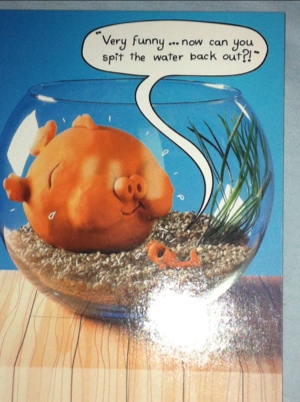
Dropsy is not a disease diagnosis, but is actually a descriptive term for the clinical signs observed in fish. The term has often been misused as being diagnostic for bacterial disease, when all it actually means is an abnormal accumulation of fluid in a body cavity or in the subcutaneous tissues. Another medical term that can be used is anasarca. Grossly, the scales of the fish will protrude from the body (due to subcutaneous oedema), giving them the classic “pine cone” appearance. Fluid may also accumulate in the coelomic cavity, giving them a “pot-belly” appearance. This condition is limited to fishes in a freshwater environment and the reason for this is explained in the following sentence. Fishes that live in freshwater are in a hypo-osmotic environment. And so, if there are any severe external lesions (e.g. large skin ulcers from bacterial infection or severe gill damage from fungal infections), there could be a net influx of fluid into the body. If the kidneys are damaged such that normal excretion of urine is reduced, dropsy can also result. The prognosis is poor and such fish should be euthanased. It is useful to examine the diseased fish immediately post-euthanasia to identify the reason for the disease to prevent it from occurring in its tankmates.

To summarise, the cause of dropsy is not limited to bacterial infection, but it can occur as a result of skin disease, gill disease, renal disease or congestive heart failure which can have a variety of aetiologies.

 

20120810-074429.jpg

Gardening Australia interviews The Fish Vet.

I’ve just got off the phone interview with the journalist. Pet of the month will be goldfish! Keep an eye out for the article!

How can you tell if your fish is being attacked? What to do?

bitten fins will be frayed at the ends. The best way to tell is to observe them from a distance. If this is happening, then it means that the fish are not a good mix. They should be separated (almost like a divorce!). The fish being bullied should be placed in a proper fish tank with cycled filter, rock salt added at 2-5g/L and Melafix added.

A “dick head” fish!

Literally! Fish with genitals on its head!

http://www.newscientist.com/mobile/article/dn22023-zoologger-the-fish-with-its-genitals-on-its-head.html

Why do I get algal problems in my pond despite having low nitrate levels?

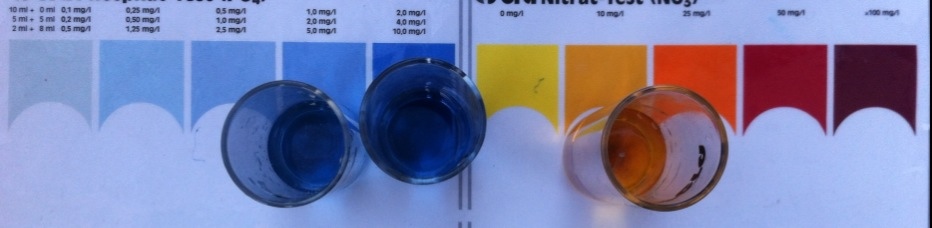
Nitrate levels may be low, but have you checked what the phosphate levels are? Pictured below is an example of what good water quality analysis will show up. The nitrate level (right) is a low 10mg/L, but notice the phosphate level (left) falls between 5-10mg/L (using the highest dilution factor)! Phosphate levels should be maintained below 1mg/L to help reduce algal problems. This is one example where no matter how much chemicals you keep adding to the pond, it won’t have a long term effect.

So where to from here? I would advise the owner to perform several water changes immediately. Then, check what type of foods they are feeding them. Poor quality foods tend to foul the water in this way because the nutrients in the are not as easily assimilated by the fish (see previous post). Providing shade and using natural barley extract can also help. If reaching for chemicals, simazine is one that’s safe to use with fish. More thorough look at algae and treatments can be found in a previous post – see link.

20120809-132817.jpg

Waterproof iPhone covers.

Following on from my last post of drowning digicams, I was referred to a website for good deals on the like. Would you trust this waterproof iPhone case with your phone?

http://shashinki.com/shop/dicapac-wpi10-waterproof-iphone-case-white-iphone-iphone-iphone-iphone-iphone-p-7716.html

Are waterproof cameras really waterproof?

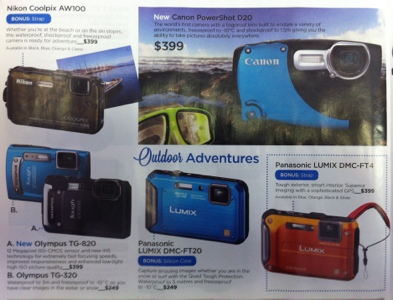
Every aquatic veterinarian needs to have one of these. But for me, I’ve had three of these and am soon onto my fourth! I’ve had two Olympus tough cameras with specs for being waterproof to 10m and it drowned at a max depth of 4m when doing a shark dive at AQWA when examining the fishes in the aquarium. So I moved on to Pansonic’s Lumix a couple of years ago. This one is apparently shock proof to 1.5m, but the casing has given way and I’m afraid that it’s no longer waterproof. I guess I’ve yet to try Canon, Nikon, Sony and Fuji. What are your experiences with them?

20120809-111004.jpg

Can you turn a carnivore into a herbivore?

So far we haven’t been able to do it…

Have a read of this article.

Culture herbivores.

Aquaculture
Volume 353, Number 11 (June 2012)
Effects of plant-based diets on the distal gut microbiome of rainbow trout (Oncorhynchus mykiss)
Authors: Atul R. Desai, Matthew G. Links, Stephanie A. Collins, Graeme S. Mansfield, Murray D. Drew, Andrew G. Van Kessel, Janet E. Hill
Author Affiliations:
no affiliations available
Source: Aquaculture, Volume 353, Number 11 (June 2012)
Page Numbers: 134 – 142
Available Full Text:
Full Text: Subscription Required to view full text
Format: PDF
Size: Unknown
Location: Publisher’s Site
Authentication: Publisher’s Site
Abstract: Replacement of fish meal in aquaculture diets with plant proteins is economically desirable, but the effects of alternative protein sources on the intestinal microbiota and fish health are poorly understood. We examined the intestinal microbiome of 108 rainbow trout (Oncorhynchus mykiss) fed with diets including plant ingredients (peas, soybean, canola) at two processing levels (meal, concentrate), or a fish meal (FM) control diet. Microbial community profiles were determined using pyrosequencing of cpn60 PCR products and 16S rRNA DGGE. Microbial profiles of fish fed the FM diet changed over the course of the study with reduction in species richness and diversity and therefore evaluation of the effects of experimental diets was accomplished through comparison of each diet with its concurrent FM control. Plant ingredient diets were associated with higher Firmicutes:Proteobacteria ratios than controls. Both DGGE and pyrosequencing data showed that microbiomes of fish fed meal-based diets were more distinguishable from the FM control microbiomes than were the microbiomes of fish fed protein concentrate diets. Changes in the FM diet associated profiles could be the result of age-related physiological changes in these fish or a long-term effect of the change in environment from outdoor aquaculture facility to an indoor re-circulating facility. Regardless of the reason, these observations have significant implications for future evaluations of diets and ingredients. We also demonstrated changes in the intestinal microbiome that may contribute to negative health outcomes when diets contain plant meal proteins. These changes in microbiome structure can be minimized with additional processing of plant ingredients.
Citation: Atul R. Desai, Matthew G. Links, Stephanie A. Collins, Graeme S. Mansfield, Murray D. Drew, Andrew G. Van Kessel, Janet E. Hill . Effects of plant-based diets on the distal gut microbiome of rainbow trout (Oncorhynchus mykiss). Aquaculture, Volume 353, Number 11 (June 2012), pp. 134-142, ;
URL: http://ejournals.ebsco.com/direct.asp?ArticleID=442BB43891C01A39E269

http://www.thefishvet.com.au

Become an instant fish expert! Online “fish-e” courses available.

Did you know that no matter where you are in the world, you can obtain university level training on fish health by internationally recognised institutes?

Have you considered Online courses?

Several courses that have come to my attention include:

1. University of Florida – http://conference.ifas.ufl.edu/ame/ (referred by “Dr Google”!)
2. University of Hawai’i – http://videolearning.uhatoll.com/ (referred by Dr Tim Miller-Morgan on his blog).
3. University of Sydney’s Centre for Veterinary Education – http://www.cve.edu.au/tomarinewildlife (referred by Dr Jo Bannister via email).
4. There is also The Aquarium Vet’s course – http://theaquariumvet.com.au/pages/view/new_one_1

The benefits of the first these courses are that they are run by establishments is that you can get a certificate and continuing education points!  The fourth on the list is not accredited by a university or other educational institute.

You will also be able to “virtually” meet other professionals in your industry. If you do them, let me know what you thought of them. If you know of any others, do tell.
Otherwise, there are also my books,    blog and  YouTube Channel.