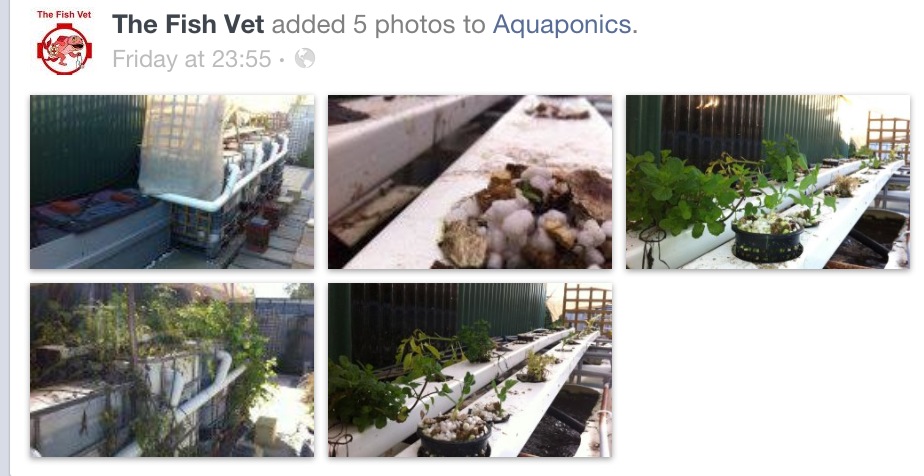
What plants do well in aquaponic NFT?

I’ve been able to grow vine crops (cherry tomatoes, peas), herbs (mint, coriander) and lettuce. Other crops you can try include strawberries, Asian veggies and wheat grass.

Check out pics of my setup at http://www.facebook.com/thefishvetdrloh

Make sure you LIKE the “fin” page.

A solution against shark attacks.

Shark netting, drum lines, exclusion areas / swimming enclosures?

Check out the latest findings as it applies to Perth’s beaches:

http://www.perthnow.com.au/news/western-australia/wa-shark-report-open-to-the-public/story-e6frg13u-1226463792738?from=public_rss&utm_source=twitterfeed&utm_medium=twitter

Brainless, slow, but deadly!


Dr Don Stremme shared this with us:


 How Can a Jellyfish This Slow Be So Deadly?

http://www.smithsonianmag.com/science-nature/How-Can-a-Jellyfish-This-Slow-Be-So-Deadly-Its-Invisible-165590366.html?utm_source=smithsoniantopic&utm_medium=email&utm_campaign=20120902-Weekender

How often should you feed seahorses?

The rule of thumb in most aquaria, it is recommended to feed the fish two to three times a day, as much as they will consume within 5 minutes. The case might be different in seahorses. Reading this article, I wonder if we can glean from it that seahorses should be fed more continuously through the daytime and not at all during the night, “The gut of caged seahorses was generally full during daytime but declined in the evening, becoming almost empty at midnight


Aquaculture
Volume 359, Number 5 (August 2012)
Diet composition and feeding periodicity of the seahorse Hippocampus barbourireared in illuminated sea cages
Authors: Luis Maria B. Garcia, Grace V. Hilomen-Garcia, Fritzie T. Celino, Tomas T. Gonzales, Ronald J. Maliao
Author Affiliations:
no affiliations available
Source: Aquaculture, Volume 359, Number 5 (August 2012)
Page Numbers: 1 – 5
Available Full Text:
Full Text: Subscription Required to view full text
Format: PDF
Size: Unknown
Location: Publisher’s Site
Authentication: Publisher’s Site
Abstract: The zooplankton prey composition and feeding periodicity of juvenile and adult seahorses Hippocampus barbourireared in illuminated and non-illuminated sea cages were compared. Mean frequency of occurrence (%FO), prey composition (%N), and gut fullness of seahorses were calculated from analyses of gut contents. Compared with juvenile seahorses, adults consumed more variety of prey consisting of copepods, larvae of decapods, polychaetes and fish, and euphausid shrimps. Calanoid copedods were found in the gut of more juvenile (%FO=47) and adult (%FO=64) seahorses in illuminated cages but harpacticoid copepods were ingested by more juvenile fish (%FO=50) in non-illuminated cages. Decapod larvae (%N=66) in illuminated cages dominated the diet of juvenile seahorses, whereas in non-illuminated cages harpacticoid copepods (%N=59) did. Calanoid copepods and decapod larvae (%N=91–97) comprised the bulk of ingested prey among adult seahorses in all experimental cages. The gut of caged seahorses was generally full during daytime but declined in the evening, becoming almost empty at midnight, particularly among juveniles. Cage illumination commencing at midnight increased the number of filled guts at dawn (0400h) among juvenile and adult seahorses. Unlike adult seahorses over a 24-h period, the overall incidence of filled guts among juveniles was not different between those in non-illuminated and illuminated cages. These results provide an alternative to growing caged H. barbourion cultured live food, particularly copepods attracted by night illumination.
Citation: Luis Maria B. Garcia, Grace V. Hilomen-Garcia, Fritzie T. Celino, Tomas T. Gonzales, Ronald J. Maliao . Diet composition and feeding periodicity of the seahorse Hippocampus barbourireared in illuminated sea cages. Aquaculture, Volume 359, Number 5 (August 2012), pp. 1-5, <http://ejournals.ebsco.com/direct.asp?ArticleID=4A6C89E79B3A8C923BAE&gt;
URL: http://ejournals.ebsco.com/direct.asp?ArticleID=4A6C89E79B3A8C923BAE

20120810-074322.jpg

NOVICE international conference – aquatic stream – October 4-5, 2012.

This arrived to me via several sources including AquavetMed eNews, WAVMA and NOVICE:

NOVICE International Conference – Aquatic Veterinary Education Programme

The 2012 NOVICE Conference is scheduled for October 4-5, 2012 at the Faculty of Veterinary Medicine, Bucharest, Romania. NOVICE is the Network Of Veterinary Information & Communication Technology in Education, an EU funded Project which aims to investigate the use of Web 2.0 tools for lifelong learning and the development of a veterinary online community, seewww.noviceproject.eu for more information.

The conference and aquatic programme seek to bring together individual involved with, or interested in current and future aquatic veterinary education throughout the world. In particular, interactive and didactic workshops will focus on new approaches and models for supplementing veterinary curricula, continued education & professional development, and life-long learning.

Attendees will have the opportunity to discuss and conclude innovative approaches using Web 2.0 and other e-media, to fulfill a rapidly growing need for well qualified aquatic veterinarians, with the following objectives:

• To increase awareness and emphasize important developments in global aquatic veterinary education

• To illustrate advances in using NOVICE for training future aquatic veterinary practitioners

Aquatic Veterinary Education Programme Specifics

Thursday, October 4, 2012

11:45 A. David Scarfe “International Approaches to Expanding Aquatic Veterinary Educational and Day-One Competency”

13:45-15:15 (Workshop) Theme – “Supplementing Veterinary Curricula & CEPD with Aquatic Veterinary Medicine” (A. David Scarfe moderator/facilitator)

Du¹an Paliæ (15 min) “WAVMA Aquatic Veterinary Day-One Competency Program”

Richmond Loh (15 min) “Aquatic Veterinary Board Certification & Specialization Programs”

Greg Lewbart (15 min) “Encouraging Aquatic Courses in Veterinary School Curricula”

Facilitated speaker/audience discussion (45 min) will focus on “Identifying Future Directions & Needs for Aquatic Veterinary Curriculum Courses & Continuing Education & Professional Development”

Friday, October 5, 1012

12:15 Laura-Daniela Urdes “Promoting Aquatic Vet Education through NOVICE & Other Social Media”

13:45-15:15 (Workshop) Theme – “NOVICE & Web-based Aquatic Veterinary Education Programs” (Laura-Daniela Urdes moderator/facilitator)

Jaime Rofina (15 min) “University of Utrecht’s NOVICE Fish Medicine Course”

Devon Dublin (15 min) “Using NOVICE and Other Social Media to Promote Aquatic Veterinary Medicine”

Chris Walster (15 min) “WAVMA WebCEPD (Webinars) for Global Aquatic Veterinary Education”

Facilitated speaker/audience discussion (45 min) will focus on “Identifying Future Directions & Needs for NOVICE, Social Media & Other Web-based Platforms for Expanding Aquatic Veterinary Education”

For more information on the full NOVICE Conference, housing & registration go towww.novice-conference.com.

A flyer is attached for further distribution.

Aquatic Stream Schedule.pdf
How does photoperiod affect growth?

In many cultured animals, increasing the day length has been associated with increased feed intake and therefore, increased growth rate. The reverse seems to be true for the arctic charr, at least in the juvenile phase.http://www.thefishvet.com.au

Aquaculture
Volume 353, Number 11 (June 2012)
Enhanced growth of farmed Arctic charr (Salvelinus alpinus) following a short-day photoperiod
Authors: Snorri Gunnarsson, Albert K. Imsland, Sten I. Siikavuopio, Jón Árnason, Arnþór Gústavsson, Helgi Thorarensen
Author Affiliations:
no affiliations available
Source: Aquaculture, Volume 353, Number 11 (June 2012)
Page Numbers: 75 – 81
Available Full Text:
Full Text: Subscription Required to view full text
Format: PDF
Size: Unknown
Location: Publisher’s Site
Authentication: Publisher’s Site
Abstract: The short and long term effects of short photoperiods on growth and maturity were investigated in 240 individually tagged juvenile Arctic charr (Salvelinus alpinus). The Arctic charr were reared at constant temperature (12°C) and on four different light regimes; one group on continuous light (LD24:0) as control and three groups experienced a period of short day (LD8:16) on a three subsequent 6week periods i.e. 24th September–6thNovember (LD8:16Sep–Nov), 6th November–19th December (LD8:16Nov–Dec), 19th December-29th January (LD8:16Dec–Jan). Before and after the short photoperiod treatment the groups were reared at continuous light. The growth of the fish was monitored over a period of 11months. At the termination of the experiment in September 2009, the body mass of the three groups receiving a short day period (LD8:16 Sep–Nov, LD8:16 Nov–Dec and LD8:16 Dec–Jan) was significantly higher (13.9%, 12.9% and 10.7% respectively) than that of the group reared at continuous light (LD24:0). The three groups receiving the short photoperiod did not differ in weight at the end of the trial so the time of the year at which the short photoperiod was applied did not seem to be of importance regarding the growth enhancement. The maturation rate did not appear to be affected by the photoperiod treatments. The improved growth was mainly a result of a higher feed intake and improved feed conversion efficiency for the period following transfer of the charr from a short photoperiod to the continuous light. Application of such a winter photoperiod during the juvenile phase can, therefore, be used as a tool to increase the biomass and growth rate in Arctic charr farming.
Citation: Snorri Gunnarsson, Albert K. Imsland, Sten I. Siikavuopio, Jón Árnason, Arnþór Gústavsson, Helgi Thorarensen . Enhanced growth of farmed Arctic charr (Salvelinus alpinus) following a short-day photoperiod. Aquaculture, Volume 353, Number 11 (June 2012), pp. 75-81, ;
URL: http://ejournals.ebsco.com/direct.asp?ArticleID=4242A8AA50DD97827D52

http://www.thefishvet.com.au

Three bacterial strains isolated from an abalone postlarval culture system.


Aquaculture International: Journal of the European Aquaculture Society
Volume 20, Number 5 (October 2012)
Effect of three bacterial isolates from a commercial hatchery on early red abalone (Haliotis rufescens) postlarvae
Authors: Casandra Anguiano-Beltrán, Ricardo Searcy-Bernal 1, Adrián García-Ortega 2, Zaúl García-Esquivel 1, Enrique Valenzuela-Espinoza 1
Author Affiliations:
1: Instituto de Investigaciones Oceanológicas, Universidad Autónoma de Baja California, Km 107 Carretera Tijuana-Ensenada, CP 22860 Ensenada, BC, Mexico
2: Laboratorio de Virología y Biología Molecular, Centro Regional de Estudios y Diagnóstico Fitosanitario del Comité Estatal de Sanidad Vegetal de Baja California, Km 1.5 Carretera a San Felipe s/n, Col. Ex-Ejido Xochimilco, CP 21380 Mexicali, BC, Mexico
Source: Aquaculture International: Journal of the European Aquaculture Society, Volume 20, Number 5 (October 2012)
Page Numbers: 993 – 1001
Available Full Text:
Full Text: Subscription Required to view full text
Format: PDF
Size: unknown
Location: Publisher’s Site
Authentication: EBSCOhost EJS
Abstract:
Abstract

Three bacterial strains, GHrC11, GHrC13 and GHrC15, were isolated from an abalone postlarval culture system in a commercial farm at Baja California, México. The strains were phenotypically characterized and sequenced (16S rDNA). Strain GHrC11 was a Gram-positive coccobacillum, while strains GHrC13 and GHrC15 were Gram-negative bacilli. Strain GHrC11 was identified as Exiguobacterium sp. The strains GHrC13 and GHrC15 were identified as Vibrio splendidus. The effects of these strains for the development of early abalone postlarvae (2 days old) were evaluated following a completely randomized design with three replicates using 5-mL-volume Petri dishes as experimental units. The experiment considered two different bacterial concentrations of each strain (103 and 105 cells ml-1) and two controls (with and without the benthic diatom Navicula incerta). After 10 days of experimentation, the highest mortality (90 ± 5.8 %) and the lowest growth rate (4.1 ± 0.1 µm day-1) were recorded for the strain GHrC11. In contrast, the lower mortality (16.7 ± 3.3 %) and the highest growth rate (11.2 ± 0.9 µm day-1) corresponded to the control fed N. incerta. Our results suggest that pathogenic effects of these bacterial strains were stronger than any potential benefits derived from the ingestion of bacteria by early abalone postlarvae. In conclusion, the most pathogenic strain was GHrC11, and the intensity of pathogenicity could be ordered as Exiguobacterium sp. > V. splendidus (C13) > V. splendidus (C15).
Citation: Casandra Anguiano-Beltrán, Ricardo Searcy-Bernal, Adrián García-Ortega, Zaúl García-Esquivel, Enrique Valenzuela-Espinoza . Effect of three bacterial isolates from a commercial hatchery on early red abalone (Haliotis rufescens) postlarvae. Aquaculture International: Journal of the European Aquaculture Society, Volume 20, Number 5 (October 2012), pp. 993-1001, <http://ejournals.ebsco.com/direct.asp?ArticleID=4DD58EC89147A1B5302E&gt;
URL: http://ejournals.ebsco.com/direct.asp?ArticleID=4DD58EC89147A1B5302E

21 Of The Freakiest Fish Caught On “River Monsters”

This arrived in my email inbox. I thought I should share this with you.


21 Of The Freakiest Fish Caught On River Monsters
All of these were caught by Jeremy Wade, the silver-fox madman who hosts River Monsterson Animal Planet. And, yes, he releases everything he catches.
1
A 7-feet-long, 111-pound alligator gar caught in the Trinity River in Texas.
2.
A 150-pound arapaima was caught in the Rio Maderia floodplain lake in Brazil.
3.
A massive bull shark caught in southern Africa’s Zambezi River.
4.
An electric eel found in the Amazon River, which can grow up to eight feet long and weigh up to 44 pounds.
5.
A freshwater sawfish, which can grow to 20 feet and over 400 pounds.
6.
A giant Siamese carp, or giant barb, caught in the Mekong river. Only a fraction of its adult size, this fish is capable of growing to 10 feet and 660 pounds, making it one of the largest species of freshwater fish on the planet.
7.
A giant freshwater stingray. At roughly 400 pounds, this is the largest river fish Jeremy Wade has ever captured.
8.
A goliath tigerfish, a giant-sized relative of the piranha, found in the Congo River in the heart of central Africa.
9.
A 161-pound goonch catfish, caught in a river in northern India. This catch measured 5 feet, 7 inches from head to tail with a 41-inch girth and 44-inch “wingspan.”
10.
An African lungfish. The largest specimens can reach about 6.6 feet in length.
11.
A small Vundu catfish. This fish is capable of reaching over 5 feet in length, and its maximum known weight is 121 pounds.
12.
A New Zealand longfin eel, which can reach up to 5 feet in legth.
13.
A Nile perch. This species can grow to 6 feet in length and weigh over 500 pounds.
14.
A 1-pound black piranha, the largest of the roughly 40-known piranha species.
15.
A Cuiu-Cuiu, a prehistoric-looking catfish found in the Orinoco and surrounding rivers of the Amazon. The Cuiu-Cuiu can grow to 3 feet in length and weigh over 40 pounds. It has scutes along the back half of its body that give support to the tail fin; these give the Cuiu-Cuiu an armored appearance, common in ancient fish.
16.
The red-bellied pacu is related to the flesh-eating piranha, but unlike its notorious cousin it feeds mainly on insects and vegetation. It uses its large, humanlike choppers as a tool for cracking open rubber tree nuts, crushing seeds and chopping up sea herbs and various other food sources.
17.
A short-tailed river stingray. This fish typically grows to 4.9 feet in diameter and over 450 pounds in weight.
18.
A wels catfish weighing 163 pounds and measuring 7 feet, 4 inches from head to tail. The largest wels can reach up to 10 feet and weigh over 330 pounds.
19.
A white sturgeon, the largest and most primitive freshwater fish in North America. The biggest white sturgeon on record stretched more than 20 feet in length and weighed almost 1,800 pounds.
20.
A Japanese giant salamander, the second largest salamander in the world, after the Chinese giant salamander. It grows to around five feet in length. (Not a fish, granted, but still freaky)
21.
A close relative of the piranha, the payara is often called the “vampire fish” because of its long fangs, which can grow to 6 inches in length. This little-known but frightening-looking fish is found in the Orinoco River in Venezuela.


Follow me on: Facebook “Fin Page” LinkedinYouTubeTwitterBlog

Yours sincerely,

Dr Richmond Loh

BSc, BVMS, MPhil (Vet Path), MANZCVS (Aquatics), MANZCVS (Pathobiology), DipPM.
Veterinarian | Adjunct Senior Lecturer Murdoch University | WAVMA Communications Committee Member |
Secretary Aquatic Animal Health Chapter – Australian and New Zealand College of Veterinary Scientists (ANZCVS)
The Fish Vet, Perth, Western Australia, AUSTRALIA. Mobile Veterinary Service for fish and other aquatic creatures.
http://www.thefishvet.com.au
Ph: +61 (0)421 822 383