What causes “Siamese” twin seahorses?

Dr Jo Bannister shared this article with me from the Journal of Fish Diseases.

The causes include over-ripened eggs, pollutants, low dissolved oxygen and thermal shock induction.

Check out the pictures of the conjoined twin seahorses taken from the article:

20121018-232555.jpg

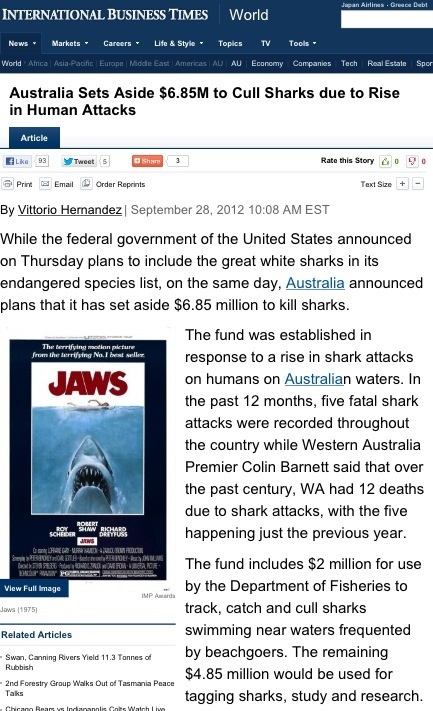
Is the Dept of Fisheries WA going to cull the great white sharks?

The mass media makes it out that the Dept of Fisheries are going to go out and cull these magnificent creatures. I’m sure you may have “Liked” a few things on Facebook in the bid to protest against this and maybe even attended a rally or two.

The facts are that the Minister gave the CEO of the Dept of Fisheries WA, the authority to decide whether a shark should be killed, on a case by case basis. They did not make it policy for the wholesale culling of sharks.

Quite the reverse. A lot of resources have been put in place to find ways of deterring the fish from populated beaches, to keep the community safe from predation. Sharks are being tagged so that individuals will be identifiable and their habits studied.

Who do we believe? We might have to wait and see.

20121018-155834.jpg

What are approved drugs? – Food & Drug Administration, Center for Veterinary Medicine – Letter to Aquaculture Professionals

Did you know that even if even if a marketed product has the same active ingredient as an FDA-approved drug, it doesn’t mean it’s also FDA-approved?

Having read this from my email inbox today (see below), I thought I should add that we really should be supporting the companies that are taking the time and resources to get the various aquatic medicines registered. It may cost us a little more, but without these companies putting such things forward, we’d have nothing to use legally. So, saving a few dollars over here today, may mean that you might not have an industry tomorrow. We must support each other if we are to grow the industry.


Follow me on: Facebook “Fin Page” – YouTube – Blog – Linkedin – Twitter

Yours sincerely,

Dr Richmond Loh

BSc, BVMS, MPhil (Vet Path), MANZCVS (Aquatics), MANZCVS (Pathobiology), DipPM.
Veterinarian | Adjunct Senior Lecturer Murdoch University | WAVMA Communications Committee Member |
Secretary Aquatic Animal Health Chapter – Australian and New Zealand College of Veterinary Scientists (ANZCVS)
The Fish Vet, Perth, Western Australia, AUSTRALIA. Mobile Veterinary Service for fish and other aquatic creatures.
http://www.thefishvet.com.au
Ph: +61 (0)421 822 383


———- Forwarded message ———-
From: Dr. David Scarfe <DScarfe@avma.org>
Date: Thu, Oct 18, 2012 at 2:05 AM
Subject: AquaVetMed: FDA Letter to Aquaculture Industry re: Marketed Approved Aquaculture Drugs
To:

October 17, 2012

Food & Drug Administration, Center for Veterinary Medicine – Letter to Aquaculture Professionals


Dear Aquaculture Professional:


The U.S. Food and Drug Administration (FDA) wants to remind you that not all drugs currently marketed for fish are approved. And even if a marketed product has the same established name (active ingredient) as an FDA-approved drug, that doesn’t mean it’s also FDA-approved.


Please see the table below for a list of all FDA-approved fish drugs. If a product currently marketed for fish isn’t listed, it’s not FDA-approved, and therefore, hasn’t been shown to be safe and effective in fish. For example, only the four listed formalin products are approved by FDA for fish. Any other formalin-containing products marketed are not FDA-approved.


FDA rigorously evaluates an animal drug before approving it. As part of the approval process, the drug company must prove to FDA that:

•       The drug is safe and effective for a specific use in a specific animal species. For food fish intended for human consumption, the drug company must also prove that food made from fish treated with the drug is safe for people to eat;

•       The manufacturing process is adequate to preserve the drug’s identity, strength, quality, and purity; and

•       The drug’s labeling is truthful and complete.


FDA’s role doesn’t stop after the agency approves an animal drug. As long as the drug company markets the animal drug, the agency continues to monitor the drug’s:

•       Safety and effectiveness to determine if concerns arise that were unknown at the time of approval;

•       Manufacturing process to ensure quality and consistency are maintained; and

•       Labeling to make sure the information remains truthful and complete.


FDA-Approved Fish Drugs <snip>


FDA-approved animal drugs are scientifically shown to be safe and effective when used according to the directions on the label. If the approved drugs are for food fish, food made from treated fish is safe for people to eat. FDA-approved animal drugs also meet the agency’s strict standards for quality, purity, and potency.


The Center for Veterinary Medicine (CVM) at FDA is responsible for ensuring that safe and effective drugs are available for animals. If you have questions or would like more information, please call the CVM Communications Staff at 240-276-9300, or email us at AskCVM@fda.hhs.gov.


Sincerely,

FDA’s Center for Veterinary Medicine


See the source (http://tinyurl.com/coxq2sp) for full letter that lists drugs currently approved for aquaculture in the USA.


FDA also keeps lists approved drugs used for Immersion, Injectable and as Medicated Feeds updated at http://tinyurl.com/bo6j2vo.


___________________________

AquaVetMed e-News provides information to veterinary and veterinary-allied subscribers concerning aquatic animal medicine, health, welfare, public health and seafood safety, obtained from a variety of sources (largely AquaVetMed subscribers). While provided by the American Veterinary Medical Association’s, Aquatic Veterinary Medicine Committee and are for public distribution, they do not necessarily reflect the opinion of the AVMA or the veterinary profession. See the AVMA Terms of Use (http://tinyurl.com/29h2rf) for further information.


If e-News information is used elsewhere please acknowledge AquaVetMed as the source.  Encourage individuals to subscribe rather than distribute through list serves.


Messages may contain attachments that will have been scanned for known viruses.


Subscription and Contributions: Interested veterinarians and veterinary-allied professionals can subscribe, unsubscribe, or contribute pertinent news or information, by sending a message with “For AquaVetMed -” and the topic in the subject line, to dscarfe@avma.org.  


Note: Undelivered e-mails will not be resent; Subscribers will be deleted from the list after repeated undelivered or bounced messages and will have to re-subscribe.


Visit our website: www.avma.org


________________________________


What caused the massive catfish kill in the Brisbane River?

White spot disease and a fungus was blamed for catfish kill.

Via

The AquaticHealth.net Community Digest

Read more here:
http://m.qt.com.au/news/parasite-and-fungus-blamed-catfish-kill/1583102/


Yours sincerely,

Dr Richmond Loh
BSc BVMS MPhil MANZCVS (Aq & Pathol)
The Fish Vet, Perth, Western Australia.
Veterinary Medicine for fish.
http://www.thefishvet.com.au
Ph: +61 (0)421 822 383

Rare whale beached in Hawaii infected with deadly marine-mammal virus | Smithsonian Science

Via

The AquaticHealth.net Community Digest

http://smithsonianscience.org/2012/10/rare-whale-beached-in-hawaii-infected-with-deadly-marine-mammal-disease/


Yours sincerely,

Dr Richmond Loh
BSc BVMS MPhil MANZCVS (Aq & Pathol)
The Fish Vet, Perth, Western Australia.
Veterinary Medicine for fish.
http://www.thefishvet.com.au
Ph: +61 (0)421 822 383

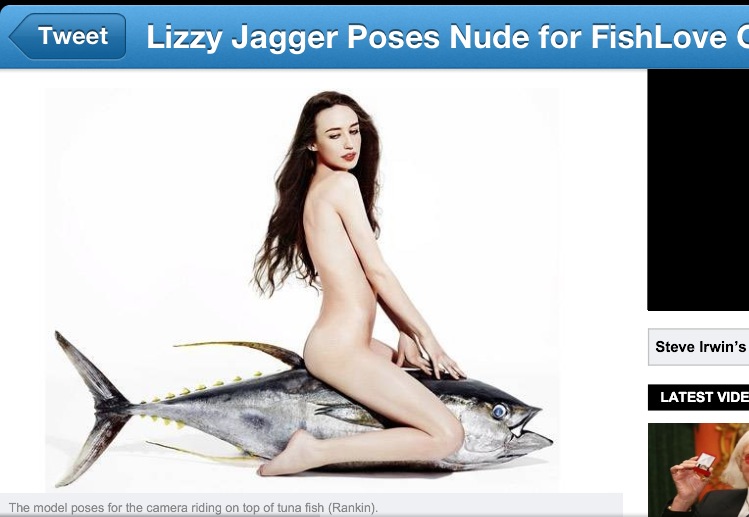
Lizzy Jagger Poses Nude for FishLove Campaign.

Lizzy Jagger Poses Nude for FishLove Campaign.
http://www.ibtimes.co.uk/articles/393764/20121012/lizzy-jagger-poses-nude-fishlove-campaign.htm


Yours sincerely,

Dr Richmond Loh
BSc BVMS MPhil MANZCVS (Aq & Pathol)
The Fish Vet, Perth, Western Australia.
Veterinary Medicine for fish.
http://www.thefishvet.com.au
Ph: +61 (0)421 822 383

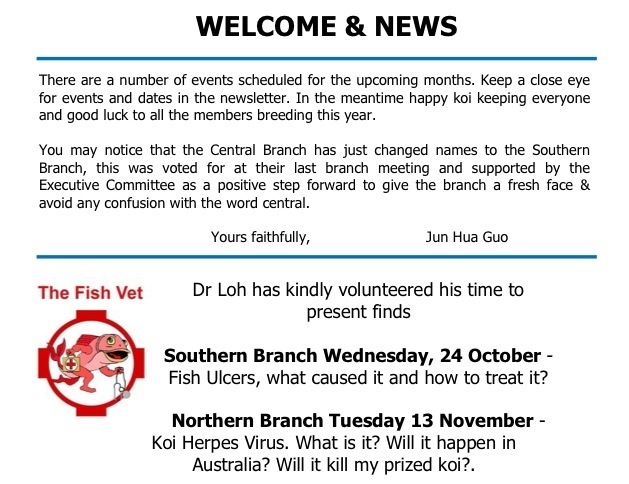
Dr Loh addresses the Koi Society with two talks.

Want to know about ulcers in koi fish? Want to know about koi herpesvirus? Then come along to the next two Koi Society of Western Australia’s meetings.

Details are provided below.

20121017-200716.jpg

20121017-200736.jpg

Hydrogen peroxide (H2O2) to treat amoebic gill disease (AGD) in salmon.

Journal of Fish Diseases
Volume 35, Number 11 (November 2012)
Preliminary success using hydrogen peroxide to treat Atlantic salmon, Salmo salar L., affected with experimentally induced amoebic gill disease (AGD)
Authors: M B Adams, P B B Crosbie, B F Nowak
Author Affiliations:
no affiliations available
Source: Journal of Fish Diseases, Volume 35, Number 11 (November 2012)
Page Numbers: 839 – 848
Available Full Text:
Full Text: Subscription Required to view full text
Format: PDF
Size: unknown
Location: Publisher’s Site
Authentication: EBSCOhost EJS
Abstract: Currently, the only effective and commercially used treatment for amoebic gill disease (AGD) in farmed Tasmanian Atlantic salmon is freshwater bathing. Hydrogen peroxide (H2O2), commonly used throughout the aquaculture industry for a range of topical skin and gill infections, was trialled in vitroand in vivoto ascertain its potential as an alternative treatment against AGD. Under in vitroconditions, trophozoites of Neoparamoeba peruranswere exposed to three concentrations of H2O2in sea water (500, 1000 and 1500 mg L-1) over four durations (10, 20, 30 and 60 min) each at two temperatures (12 and 18 °C). Trophozoite viability was assessed immediately post-exposure and after 24 h. A concentration/duration combination of 1000 mg L-1for >10 min demonstrated potent amoebicidal activity. Subsequently, Atlantic salmon mildly affected with experimentally induced AGDwere treated with H2O2at 12 and 18 °C for 15 min at 1250 mg L-1and their re-infection rate was compared to freshwater-treated fish over 21 days. Significant differences in the percentage of filaments affected with hyperplastic lesions (in association with amoebae) and plasma osmolality were noted between treatment groups immediately post-bath. However, the results were largely equivocal in terms of disease resolution over a 3-week period following treatment. These data suggest that H2O2treatment in sea water successfully ameliorated a clinically light case of AGDunder laboratory conditions.
Citation: M B Adams, P B B Crosbie, B F Nowak . Preliminary success using hydrogen peroxide to treat Atlantic salmon, Salmo salar L., affected with experimentally induced amoebic gill disease (AGD). Journal of Fish Diseases, Volume 35, Number 11 (November 2012), pp. 839-848, <http://ejournals.ebsco.com/direct.asp?ArticleID=4806A1B1E8B8F7759199&gt;
URL: http://ejournals.ebsco.com/direct.asp?ArticleID=4806A1B1E8B8F7759199


Follow me on: Facebook “Fin Page” – YouTube – Blog – Linkedin – Twitter 

Yours sincerely,

Dr Richmond Loh

BSc, BVMS, MPhil (Vet Path), MANZCVS (Aquatics), MANZCVS (Pathobiology), DipPM.
Veterinarian | Adjunct Senior Lecturer Murdoch University | WAVMA Communications Committee Member |
Secretary Aquatic Animal Health Chapter – Australian and New Zealand College of Veterinary Scientists (ANZCVS)
The Fish Vet, Perth, Western Australia, AUSTRALIA. Mobile Veterinary Service for fish and other aquatic creatures.
http://www.thefishvet.com.au
Ph: +61 (0)421 822 383

Small-Brained Fish Make More Babies.

Can such a finding be extrapolated to other species?

www.the-scientist.com/?articles.view/articleNo/32348/title/Small-Brained-Fish-Make-More-Babies/


Yours sincerely,

Dr Richmond Loh
BSc BVMS MPhil MANZCVS (Aq & Pathol)
The Fish Vet, Perth, Western Australia.
Veterinary Medicine for fish.
http://www.thefishvet.com.au
Ph: +61 (0)421 822 383

Fish Vet Job opportunity – Mote Marine Lab.

From Dr Rob Oz Ossiboff 3:16am Oct 17

If anyone knows of anyone eligible, here is a listing for a fellowship at the Mote Marine Lab. They are looking for a DVM/PhD ready by the start of summer 2013.

http://www.mote.org/index.php?src=gendocs&link=JobOpportunites&category=JOBS#MPD


Yours sincerely,

Dr Richmond Loh
BSc BVMS MPhil MANZCVS (Aq & Pathol)
The Fish Vet, Perth, Western Australia.
Veterinary Medicine for fish.
http://www.thefishvet.com.au
Ph: +61 (0)421 822 383