Hmmmm… This article reminds me that a lot of people are certainly confused about freshwater versus marine fishes. It astounds me…
Are Fish Aggregating Devices (FADs) bad for marine life?
There has been some recent activity on Twitter about FADs. FADs are artificially put, flotsam as a fishing aid since many fish will gather around such structures.
There’s been a lot of negative press surrounding FADs, but this is all in relation to overfishing and by catch issues (see article link below).
Click to access PEG_OSD_FADs_English_Final.pdf
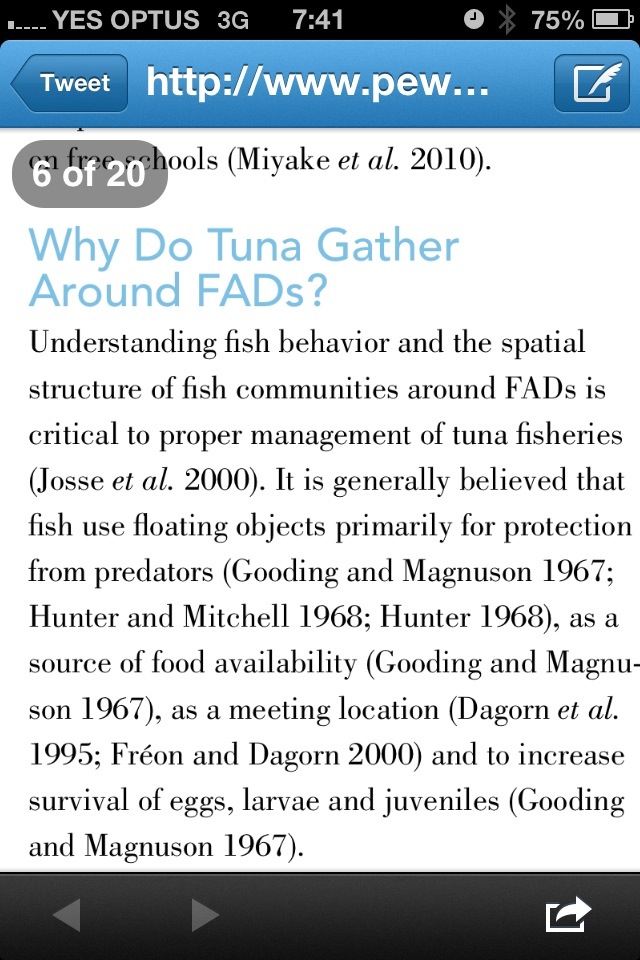
But I wonder if we can turn things around, and use this gem of fishing knowledge to replenish marine life? See pictured below, an excerpt from the above document:
I would liken this to putting out nest boxes for birds and bats, like maintaining wildlife corridors in suburbia, like sinking a ship to make an artificial reef.
What do you think? Do you think that we could be installing FADs around the place, but protect them from being fished? Would this create alternative nursery-like habitats to help with replenishing fish stocks in a semi-natural way?
Aquatic Animal Diseases Significant to Australia: Identification Field Guide 4th Edition – User Guide – DAFF.
South Australia’s aquatic animal disease response capabilities will be under the microscope.
AUSTRALIA – South Australia’s aquatic animal disease response capabilities will be under the microscope in coming weeks, as part of a national exercise to test our emergency response preparedness.
http://aquatichealth.net/node/62980
—
Yours sincerely,
Dr Richmond Loh
BSc BVMS MPhil MANZCVS (Aq & Pathol)
The Fish Vet, Perth, Western Australia.
Veterinary Medicine for fish.
http://www.thefishvet.com.au
Ph: +61 (0)421 822 383
Welfare considerations of triploid fish.
It seems like triploids have different optimal environmental parameters among other things. Could this be the reason for the increased incidence of AGD (amoebic gill disease), yersiniosis and other diseases among salmon farms?
;
| Reviews in Fisheries Science | |||||||||||||||||
| Volume 20, Number 4 (October 2012) | |||||||||||||||||
 |
Welfare Considerations of Triploid Fish | ||||||||||||||||
| Authors: | ThomasW. K. Fraser 1, PerGunnar Fjelldal 2, Tom Hansen 2, Ian Mayer 1 | ||||||||||||||||
| Author Affiliations: |
|
||||||||||||||||
| Source: | Reviews in Fisheries Science, Volume 20, Number 4 (October 2012) | ||||||||||||||||
| Page Numbers: | 192 – 211 | ||||||||||||||||
| Available Full Text: |
|
||||||||||||||||
| Abstract: | Aquaculture production continues to increase to satisfy global demand, and as such, issues relating to its environmental sustainability and the welfare of fish are becoming more prominent within society. Sterile triploid fish (possessing one additional chromosome set to the more natural diploid state) are in use in aquaculture and fisheries management to avoid the problems associated with unwanted early sexual maturation and genetic interactions between wild and cultured fish. Triploids are physiologically and behaviorally similar to diploids, although ploidy effects do exist.This review focuses on the welfare of triploid fish within aquaculture and fisheries management. The main conclusions are that triploids appear more susceptible to temperature stress, have a higher incidence of deformities, and are less aggressive than their diploid counterparts. However, considerable knowledge gaps exist in triploid physiology and performance; therefore, triploid requirements for water quality, nutritional requirements, stocking densities, and slaughter methods cannot be fully assessed. In addition, other than growth and survival, no information exists on the performance of triploids when released into natural environments, and this is of considerable concern, as triploids are commonly used in catch-and-release fisheries. These matters become more pressing with today’s increased emphasis on animal welfare. | ||||||||||||||||
| Citation: | ThomasW. K. Fraser, PerGunnar Fjelldal, Tom Hansen, Ian Mayer . Welfare Considerations of Triploid Fish. Reviews in Fisheries Science, Volume 20, Number 4 (October 2012), pp. 192-211, ; | ||||||||||||||||
| URL: | http://ejournals.ebsco.com/direct.asp?ArticleID=4F5B87B07B0C1390F7DF | ||||||||||||||||
and other
The mystery of lobster shell disease | Deep Sea News
AquaVetMed: Aquatic Veterinarian Position – Nova Scotia Department of Fisheries & Aquaculture (Canada)
Fish vet job..
Begin forwarded message:
From: “Dr. David Scarfe” ;
Date: 25 October 2012 2:47:14 AWST
Subject: AquaVetMed: Aquatic Veterinarian Position – Nova Scotia Department of Fisheries & Aquaculture (Canada)
October 24, 2012
Permanent Position – Veterinarian 1-2, Aquaculture, Shelburne. Nova Scotia Department of Fisheries & Aquaculture
Aquaculture Division, Quote Competition #REL-0474CD-CB
Closing Date: November 20, 2012
Salary Range: $56,044.82 – $83,638.10/annually (eligibility of a market adjustment of 15% may be applicable.)
Duties:
· Reporting to the Provincial Fish Health Veterinarian, Aquaculture Division, the incumbent provides a full spectrum fish health extension service, including the provision of rapid and competent disease diagnosis for the aquaculture industry and to the fish culture section of the Office.
· Laboratory and other findings are reported to the producer where required, recommendations are made for treatment and/or control. The incumbent will routinely serve as the practitioner and will be responsible for the clinical care for the stocks in question. Will represent the province and provide services to fulfill mandates of the Office legislation and policy.
· Conduct field investigations into fish health problems on private farms within the aquaculture industry and on the Office’s fish culture facilities, including the collection and field preparation of specimens for laboratory analysis.
· Conduct post mortems, examine specimens and run tests to diagnose fish diseases. Conduct investigative research of fish disease problems and their treatment.
· Provide written reports or findings and consult with Aquaculturists, Fish Health Officials and practising Veterinarians, both in person and by telephone. Prepare and deliver presentation to Aquaculturists, Government Officials, students and the public on fish health matters.
· Administrative and supervisory duties that include ordering laboratory supplies, verifying and signing reports and provide supervision and direction to fish health staff.
· Represent the Province on fish health matters to Provincial counterparts and Federal Regulatory bodies; provide direction regarding divisional fish health policy.
Qualifications:
The successful candidate must have a Doctor of Veterinary Medicine and meet the qualifications for license to practice with the Nova Scotia Veterinary Medical Association. The candidate must have excellent skills in communicating with clients, colleagues and other government officials. Background and training in aquatic animal health is an asset. The candidate must be capable of extensive travel, work in remote areas, on the water around fish farms and boats, working extended hours and be available for on-call duty. A driver’s license is required, as well as computer literacy.
Applications from all qualified candidates are welcomed and encouraged. An offer of employment is conditional upon the completion of all applicable background checks and confirmation of credentials, the results of which must be satisfactory to the employer.
For more information and to apply online, go to http://tinyurl.com/8eo8v8o.
___________________________
AquaVetMed e-News provides information to veterinary and veterinary-allied subscribers concerning aquatic animal medicine, health, welfare, public health and seafood safety, obtained from a variety of sources (largely AquaVetMed subscribers). While provided by the American Veterinary Medical Association’s, Aquatic Veterinary Medicine Committee and are for public distribution, they do not necessarily reflect the opinion of the AVMA or the veterinary profession. See the AVMA Terms of Use (http://tinyurl.com/29h2rf) for further information.
If e-News information is used elsewhere please acknowledge AquaVetMed as the source. Encourage individuals to subscribe rather than distribute through list serves.
Messages may contain attachments that will have been scanned for known viruses.
Subscription and Contributions: Interested veterinarians and veterinary-allied professionals can subscribe, unsubscribe, or contribute pertinent news or information, by sending a message with “For AquaVetMed -” and the topic in the subject line, to dscarfe@avma.org.
Note: Undelivered e-mails will not be resent; Subscribers will be deleted from the list after repeated undelivered or bounced messages and will have to re-subscribe.
Visit our website: http://www.avma.org
_________________________
How often should you clean your pearl… oysters?
| Journal of the World Aquaculture Society | |||||||||||||||||
| Volume 43, Number 4 (August 2012) | |||||||||||||||||
|
Seasonal Fouling Stress on the Farmed Pearl Oyster, Pinctada fucata, from Southeastern Arabian Sea | ||||||||||||||||
| Authors: | Vasant Kripa 1, Kolliyil S. Mohamed 1, Tharammal S. Velayudhan 1 | ||||||||||||||||
| Author Affiliations: |
|
||||||||||||||||
| Source: | Journal of the World Aquaculture Society, Volume 43, Number 4 (August 2012) | ||||||||||||||||
| Page Numbers: | 514 – 525 | ||||||||||||||||
| Available Full Text: |
|
||||||||||||||||
| Abstract: | Biofouling on the periostracum of pearl oysters and on the cages has been considered as a stress factor causing mortality of the farmed stock, reducing growth rates and also affecting pearl quality. In farming experiments using the pearl oyster, Pinctada fucata, at Kollam Bay (India), biofouling was found to be a problem. This study was conducted to understand the effect of fouling on the mortality of pearl oysters kept in suspended culture, to identify the main foulers, the seasonal variation in biofouling and species successions in the community with reference to abiotic factors. The average monthly mortality rate (MR) was estimated as 0.117 ± 0.002 and the monthly variations were significantly different (P< 0.01). The total fouling (0.163 ± 0.002 g/g oyster) and biofouling weights (0.166 ± 0.007 g/g oyster) were high in December when the fouling community was composed of several species and dominated by the ascidian, Didemnum sp. December was also the period when the MRs peaked indicating that this organism was the main cause of mortality in pearl farms in Kollam Bay. A clear seasonality in the fouling community (25 species belonging to nine phyla) has been observed in the present study. On the basis of this study, monthly cleaning of oysters is advocated except during December, January, and March when the cleaning should be fortnightly. | ||||||||||||||||
| Citation: | Vasant Kripa, Kolliyil S. Mohamed, Tharammal S. Velayudhan . Seasonal Fouling Stress on the Farmed Pearl Oyster, Pinctada fucata, from Southeastern Arabian Sea. Journal of the World Aquaculture Society, Volume 43, Number 4 (August 2012), pp. 514-525, <http://ejournals.ebsco.com/direct.asp?ArticleID=4758AD4ABC34649EEB1D> | ||||||||||||||||
| URL: | http://ejournals.ebsco.com/direct.asp?ArticleID=4758AD4ABC34649EEB1D | ||||||||||||||||
—
Follow me on: Facebook “Fin Page” – YouTube – Blog – Linkedin – Twitter
—
Yours sincerely,
Dr Richmond Loh
BSc, BVMS, MPhil (Vet Path), MANZCVS (Aquatics), MANZCVS (Pathobiology), DipPM.
Veterinarian | Adjunct Senior Lecturer Murdoch University | WAVMA Communications Committee Member |
Secretary Aquatic Animal Health Chapter – Australian and New Zealand College of Veterinary Scientists (ANZCVS)
The Fish Vet, Perth, Western Australia, AUSTRALIA. Mobile Veterinary Service for fish and other aquatic creatures.
http://www.thefishvet.com.au
Ph: +61 (0)421 822 383
http://www.thefishvet.com.au
Ph: +61 (0)421 822 383
Environmental concern over Gladstone harbour: “Independent science” vs “industry-funded science” – It’s time to speak up!
Dear all,
Please find an update by the leading independant veterinarian about the on-going saga of whether agrichemicals are causing harm to the environment, showing its effects first, in aquatic organisms.
Richmond.
ACTIVIST GREENS CRYING WOLF ON FISH DEFORMITIES – 160609.pdf
RoundupandBirthDefects.pdf
———- Forwarded message ———-
From: Matt Landos
Date: Tue, Oct 23, 2012 at 9:23 PM
Subject: independent science vs industry funded science- Gladstone- time to speak up
Hi All,
My full report for the public interest on Gladstone Harbour dredging and sick aquatic life will be released v soon. I hope the media inform the public who may then rightly demand adequate management of coastal development to protect the inshore aquatic ecosystems and the GBR. What is taking place in Gladstone Harbour is a national disgrace- the evidence-based findings of my study do not agree with the view of Qld DEHP, or the opinions expressed from Tony Burke’s office, that Australia’s largest ever harbour dredging project (within a World Heritage Area) is being managed well.
I expect that some in Govt. and elsewhere will attempt to discredit the report, and will be unsurprised if the attacks become personal. I’ve already experienced these tactics on the Noosa two-headed bass pesticide case, when the lobby group for agrichemicals, Croplife Australia, released the attached press release on me. Notably they avoided the science, preferring to sell doubt, rather than evidence-based science. In that case I requested on ten’s of occasions to seek a meeting with the Minister for Agriculture Joe Ludwig, to explain the ecosystem and human health problems associated with unsafe agrichemical use in Australia. On all occasions I was refused- all polite letters sent (about 100 over 3 years) were rebutted, with rhetoric, failing to address the peer reviewed science I presented. Alas Croplife, accesses the Minister routinely- weekly an APVMA staff member told me.
Science has never been less valuable to society than it has become right now.
The resistance of Govt and big business to the release of uncomfortable science, which runs contrary to their public statements, or their balance sheets has become the norm. But still economic development at any cost is an irrational approach to management of the planet and long-term business in my view.
One question is, what will the response of the rest of the scientific community be?
CSIRO are already on the record suggesting all is well in their dubiously timed water quality report on the smallest tides of the year from Dec 2011, http://www.csiro.au/Port-Curtis-survey-2011. Alas they never looked at any of the animals, yet declared the area healthy- a great result for Gladstone- seriously- What the? When asked by media if they had read my preliminary reports (free online)- they replied “no”.
But, more recently they were more circumspect on ABC Catalyst. http://www.abc.net.au/catalyst/stories/3593812.htm now suggesting we should look at the animals affected.
Will other voices be heard?
I hope so. Looking outside Australia for a moment at what is taking place to another independent scientist, trying to flag serious risks (links below) and attached report,… it can get mighty lonely as an independent scientist. Like Seralini, Tyrone Hayes, or Rachel Carson, I expect that there are imperfections in my report, or investigations methodology, but there is also a lot of credible evidence and analysis that should not be swept under the “mining at any cost for economic development” carpet.
http://www.foodandwaterwatch.org/blogs/of-course-monsanto-says-its-safe/
Stay tuned-Gladstone report release should be lodged online for free download at : www.gladstonefishingresearchfund.org.au
Let’s hope the less common knowledge gets heard and we have honest, rational and scientific discourse on this critical issue.
http://independentsciencenews.org/health/seralini-and-science-nk603-rat-study-roundup/
“When those with a vested interest attempt to sow unreasonable doubt around inconvenient results, or when governments exploit political opportunities by picking and choosing from scientific evidence, they jeopardize public confidence in scientific methods and institutions, and also put their own citizenry at risk. Safety testing, science-based regulation, and the scientific process itself, depend crucially on widespread trust in a body of scientists devoted to the public interest and professional integrity. If instead, the starting point of a scientific product assessment is an approval process rigged in favour of the applicant, backed up by systematic suppression of independent scientists working in the public interest, then there can never be an honest, rational or scientific debate.”
best wishes
Matt
Dr Matt Landos BVSc(HonsI)MACVS
Director, Future Fisheries Veterinary Service Pty Ltd
Honorary lecturer, associate researcher, University of Sydney
PO Box 7142, East Ballina NSW 2478
Skype: matt.landos
How to treat koi ulcers talk – tonight.
What are the causes if ulcers/red spots in koi fish? How to diagnose the cause of the fish disease? What treatments are available? Do I need antibiotics? The answers to these questions and more will be discussed with plenty of pictures to illustrate and a short video clip will be shown at tonight’s Koi Society of WA’s meeting. We hope to see you there. Details of the venue and time are in the picture below.