Antibiotic awareness week.

I went to the GP the other day because I had a cold and he very easily wrote me out a script for some antibiotics. I suppose it’s OK because "man flu" is very much worse than any other kind.

Check out what the Australian Veterinary Association put out on the use of antibiotics
http://ava.informz.net/admin31/content/template.asp?sid=8490&brandid=2034&uid=500431798&mi=656521&ptid=36

Flesh-eating lice spread by fish farms kill 39% of wild salmon – Scotland.

This article came to my attention via Aquavetmed.

It’s lucky in a way that this does not apply to our salmon farming because of two things:

1. Our salmon do not have fish lice (and we’d like to keep it that way);
2. We don’t have a ‘wild’ population of salmon that farmed fish can affect (since salmon [and trout and the like] aren’t natives of Australia).

Read more about the flesh eating lice here-
http://m.scotsman.com/news/environment/flesh-eating-lice-spread-by-fish-farms-kill-39-per-cent-of-wild-salmon-1-2616431

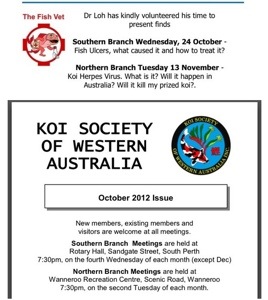
Don’t forget, Dr Loh The Fish Vet, will address the Koi Club on KHV and biosecurity – tomorrow night.

There are plans to release koi herpesvirus in Australia. How can we prevent it from happening? What biosecurity measures must you take?

So, Come along and hear what this nasty disease can do to your precious fish.

20121105-091402.jpg

When can we eat your fish?

One of the FAQs I get is when can will your pet fishes grow big enough to eat?

I was at a friend’s house for lunch on the weekend and he’d just acquired three layer chickens. I thought I’d get my turn at asking him this question… “When can we eat your chooks?” He wasn’t at all impressed and responded,”After I eat you!”

In-depth understanding of shark bits – biology of sharks and rays.

Check out this great resource on elasmobranchs –

http://www.elasmo-research.org/index.html

Was Jonah really swallowed by a big fish?

I thought this might suit as a Sunday post.

http://thebiblicalfoundation.org.au/index.php/component/content/article/78-tbf/106-q-was-jonah-really-swallowed-by-a-big-fish

Taiwanese engineer first florescent pink angelfish.

When I visited New York, I was amazed at the variety of genetically engineered danios with fluorescent colours. These guys that took millions of dollars of technology to develop, were selling for under $5/fish!

Now the Taiwanese have developed fluorescent angelfish!

The article below was shared by Simon Lau.
http://www.taipeitimes.com/News/taiwan/archives/2012/11/09/2003547259

Integrated Aquaculture/Agriculture

Journal of Applied Aquaculture Volume 23, Number 3 (July 2011) Improving Water Use Efficiency in Semi-Arid Regions through Integrated Aquaculture/Agriculture Authors: Sami Abdul-Rahman 1 Author Affiliations:

1: Department of Biology, Faculty of Arts and Sciences, American University of Beirut

Source: Journal of Applied Aquaculture, Volume 23, Number 3 (July 2011) Page Numbers: 212 – 230 Available Full Text:
Abstract: Two experiments were performed in the Bekaa plain in Lebanon to evaluate the feasibility of integrating aquaculture with established agriculture production in order to increase water productivity. Both experiments consisted of four plant management treatments: 1) Aquaculture effluent irrigation and no fertilizer; 2) aquaculture effluent irrigation and inorganic fertilizer; 3) well water irrigation and no fertilization; and 4) well water irrigation with inorganic fertilizer. In the first experiment, tilapia growth and radish production using aquaculture effluent were evaluated. All fish survived and grew, and radish production was improved by irrigating with aquaculture effluent. In the second experiment, maize (Zea mays) in large plots was irrigated with aquaculture effluent. Irrigation with effluent water improved maize production and improved soil nitrogen availability. In both experiments, fish production improved water value index and water use efficiency. Results suggest that aquaculture effluent can supplant inorganic fertilizers and could actually yield better crop production.

Citation: Sami Abdul-Rahman . Improving Water Use Efficiency in Semi-Arid Regions through Integrated Aquaculture/Agriculture. Journal of Applied Aquaculture, Volume 23, Number 3 (July 2011), pp. 212-230, <http://ejournals.ebsco.com/direct.asp?ArticleID=428285EF57CC7DD4C6E5&gt;

URL: http://ejournals.ebsco.com/direct.asp?ArticleID=428285EF57CC7DD4C6E5