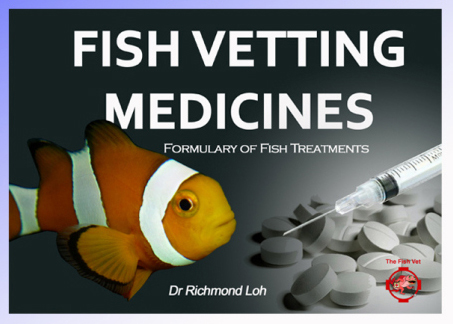
Fish Vetting Medicines: Formulary of Fish Treatments.

With nearly 300 drug entries, it is a comprehensive yet practical, quick access reference; making it an indispensible resource for anyone interested in fish health including veterinarians. It’s like MIMS for fish!

Its content organisation is designed for enhanced navigability with medicines arranged by:

  • Pathogen type (disease causing organisms),
  • Therapeutic use or groups,
  • Common disease conditions,
  • And in alphabetical order.

Read more here.

Fish-e trivia for Monday-itis: What’s bigger than a giant squid?

It’s the Colossal Squid!


I learnt this from my colleague’s 8-year-old! … and verified on Wikipedia!


From Wikipedia:


The giant squid (genus: Architeuthis) is a deep-ocean dwelling squid in the family Architeuthidae, represented by as many as eight species. Giant squid can grow to a tremendous size (see Deep-sea gigantism): recent estimates put the maximum size at 13 m (43 ft) for females and 10 m (33 ft) for males from caudal fin to the tip of the two long tentacles (second only to the colossal squid at an estimated 14 m (46 ft),[1] one of the largest living organisms). The mantle is about 2 m (6.6 ft) long (more for females, less for males), and the length of the squid excluding its tentacles is about 5 m (16 ft). Claims of specimens measuring 20 m (66 ft) or more have not been scientifically documented.

The colossal squid (Mesonychoteuthis hamiltoni, from Greek mesos (middle), nychus (claw), and teuthis (squid)), sometimes called the Antarctic orgiant cranch squid, is believed to be the largest squid species in terms of mass. It is the only known member of the genus Mesonychoteuthis. Though it is known from only a few specimens, current estimates put its maximum size at 12–14 m (39–46 ft) long,[1] based on analysis of smaller and immature specimens, making it the largest known invertebrate.


I can’t wait till my little boy starts to teach me new and wonderful things such as this!

Renew your WAVMA membership.

At WAVMA (World Aquatic Veterinary Medical Association, a global professional body serving veterinarians in aquatic animal health industries), we are ready to roll out several new member-only services and programs late this year or early in 2013, including WebCEPD (webinars), the Cert-AqVP program, discounted book purchasing, and a lot more. We don’t want any of you to miss out on these. Stay tuned for information.

To help you through membership renewal and updating your profile: to check your current membership status, the data in your profile, and to renew membership for 2013, you will need to log into your profile at http://www.wavma.org/wavma-members/member-profile.cfm?.

This information was provided through the Communications Committee.

Yours sincerely,

Dr Richmond Loh
President-elect WAVMA

What’s your biggest fish health issue?

Since I started blogging, I’ve been sharing tips, strategies and advice on optimising aquatic animal health, whether it be ornamental pet fish, breeder units, public aquaria, backyard aquaponics, educational facilities or large scale aquaculture farms.

I’ve really put a lot of effort into delivering the very best content I can in a format that’s easy to understand… and the feedback I’ve received to date has been great!

But I need your help…

I’d like to continue delivering content that helps you succeed…

Obviously I can choose whatever topics I think will help you the most (and there’s a lot to cover) but it makes a lot more sense to find out what your biggest challenges are when it comes to rearing your fish.

If I know that, then I’ll be able to deliver content that aligns with what you want to hear about most.

All you need to do is write your biggest challenge(s) in the comments section below…

The more detail you provide the better it’ll be because it will help me focus my content on exactly where you’re stuck.
Immune response of fishes to ciliates.

Immune response of fishesnext term to ciliates

H.W. Dickerson Corresponding Author Contact Information, , T.G. Clark∗∗

a Department of Medical Microbiology, College of Veterinary Medicine, University of Georgia, Athens, GA 30602, USA

b Department of Microbiology and Immunology, College of Veterinary Medicine, Cornell University, Ithaca, NY 14853, USA

Available online 13 February 2004.

Abstract

Ciliates are highly evolved protists comprising a phylum of diverse species, many of which are opportunistic or obligate parasites. Ciliates parasitic to previous termfishnext term consist of salt and freshwater forms with endo- or ectoparasitic modes of infection. Some of the more commonly encountered genera include Chilodonella, Brooklynella, Ophryoglenina, Ichthyophthirius, Cryptocaryon, Uronema, Tetrahymena, Epistylus, and Trichodina. Species range from obligate parasites and commensals to opportunistic, facultative forms. Some parasitic ciliates are highly pathogenic and previous termfishesnext term in closed environments such as aquaria and farm ponds are particularly susceptible to high mortalities. Nevertheless, previous termfishnext term have evolved an immune system capable of mounting an effective protective response against parasite challenge. Much of the experimental research on immunity against ciliates has been carried out with Ichthyophthirius multifiliis, on obligate parasite that invades surface epithelia of virtually all freshwater previous termfishnext term species. Interest in the immune response against I. multifiliis stems from the fact that convalescent previous termfishnext term become resistant to subsequent challenge (suggesting the possibility of immunoprophylaxis), and the need to curtail severe losses caused by this parasite in intensively farmed previous termfishes. Furthermore, I. multifiliis has proven to be a useful experimental model because it is amenable to study under laboratory conditions. In this review cellular and humoral factors involved in both innate and acquired immunity against ciliates are covered and include natural killer cells, phagocytic cells, and antibody responses. Current ideas on the mechanisms of antibody-mediated cutaneous immunity against I. multifiliis are discussed and approaches toward the development of vaccines against this and other ciliate parasites are presented.

Keywords: Immunity; previous termFish; Ciliates; Ichthyophthirius multifiliis

Dredging and mass fish deaths – Phuket!

Let’s hope it’s not more than a simple low DO issue.

http://www.phuketnews.asia/2012/11/phuket-mass-fish-deaths-put-flood-prevention-project-on-hold/

Interactive webinar – Project Neptune – ABIN – Wednesday the 5th of December 2012.

Interested in “hooking up” with other aquatic animal health experts in an interactive webinars?

Dr Marissa McNamara will be providing an on-line demonstration of Neptune (the aquatic animal health database) at the beginning of December. The purpose of the demonstration is to show users how the database works, how to search for and enter information, etc. She will also provide a preview of the whole slide imaging site, which will be available soon in Neptune, and already contains 180 scans of the slides she has collected throughout 2012.  

The demonstration will be on Wednesday the 5th of December at 2:00pm Qld time3:00pm NSW time, 12 noon WA time.

The demonstration will be held using Adobe Connect. To attend simply click on the link below. If you have not attended an ABIN Web Conference previously, please run the test connection link a day prior to the presentation. Audio for the presentation will be via a toll-free teleconference line, also listed below. If you do not have access to the website you can still listen to the presentation on the phone, however please do not listen to the presentation over the computer. Listeners who are calling in should mute their computer speakers. Also, listeners should mute their phones until question time if possible, as background noise is sometimes audible in the presentation.

Please feel free to invite anyone you think would be interested, and international phone numbers can be provided if necessary. Future demonstrations will be provided for anyone who cant make this one.

The Australian Toll-Free Number:

Phone Number: 1800 720 493
Participant passcode: 290 508 0292

ABIN Helpdesk (issues on the day)

Phone: 1300 136 376
Email: helpdesk@abin.org.au

ABIN Aquatic Animal Health Webinar Room
 (Click on this link on the day) 
https://connect.abin.org.au/aquaticanimalhealth/

ABIN Test Link
 (Click on this link prior to the meeting to test your browser will connect to ABINconnect) 
http://connect.abin.org.au/common/help/en/support/meeting_test.htm

ABIN Helpdesk (issues and trouble-shooting)

Phone: 1300 136 376
Email: helpdesk@abin.org.au

Please do not hesitate to contact me if you have any questions.

Regards,

Marissa

Dr Marissa McNamara
Scientist
Biosecurity Intelligence Unit, Biosecurity Queensland
Department of Agriculture, Fisheries and Forestry
39 Kessels Road, Coopers Plains Qld  4108 

e marissa.mcnamara@daff.qld.gov.au
t 07 3276 6067


Spring time spawning for fish.

Several people have contacted me, interested in spawning their fish, maybe using hormonal induction (e.g. hCG, Ovaprim or carp pituitary extract), whether it be koi or silver perch, for example.

Some of the reasons for using hormones to induce breeding is so that you can get the right timing and the right pairings for selective breeding. Also, there is evidence to suggest that egg retention may be the cause of deaths during spawning (https://thefishvet.com/2012/01/11/egg-retention-may-be-the-cause-of-deaths-during-spawning/). Egg retention in koi may also predispose them to ovarian cancers. Hormonal induction will also maximise the fertility (hence, larger numbers of young) and it also means fewer unfertilised eggs hanging around that would otherwise attract bacteria and fungal disease. These are just some of the advantages of using hormonal induction to aid in the process of fish breeding.

The local weather has been up and down lately and even if people have had successful spawns, their fry may have suffered the recent cold shift in weather. But I’d predict that the weather from now on will be rather stable and warm and that it is a good time to spawn your fishes.

For koi, the water temperature must be able to be maintained above 21°C. Whereas, for silver perch, spawning occurs in
water temperatures of 23-30°C. Silver perch females mature in the third year at about 34cm and males mature males at 23 cm.

For a pictorial guide to using hormonal induction, see a previous post –https://thefishvet.com/2012/02/02/pictorial-guide-for-fish-breeding-using-hormones/