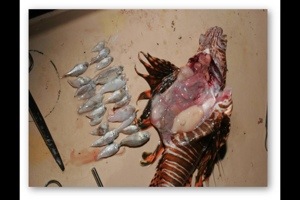
Lionfish plague. Can targeted removal of lionfish make a difference?

;

;

Reviews in Fisheries Science
Volume 20, Number 4 (October 2012)
Coping with the Lionfish Invasion: Can Targeted Removals Yield Beneficial Effects?
Authors: ThomasK. Frazer 1, CharlesA. Jacoby 2, MorganA. Edwards 1, SavannaC. Barry 1, CarrieM. Manfrino 3
Author Affiliations:
1: Fisheries and Aquatic Sciences Program, School of Forest Resources and Conservation, University of Florida
2: Soil and Water Science Department, University of Florida
3: Department of Geology & Meteorology, Kean University
Source: Reviews in Fisheries Science, Volume 20, Number 4 (October 2012)
Page Numbers: 185 – 191
Available Full Text:
Full Text: Subscription Required to view full text
Format: PDF
Size: unknown
Location: Publisher’s Site
Authentication: EBSCOhost EJS
Abstract: Invasive species generate significant environmental and economic costs, with maintenance management constituting a major expenditure. Such costs are generated by invasive Indo-Pacific lionfish (Pteroisspp.) that further threaten already stressed coral reefs in the western Atlantic Ocean and Caribbean Sea. This brief review documents rapid range expansion and potential impacts of lionfish. In addition, preliminary experimental data from targeted removals contribute to debates about maintenance management. Removals at sites off Little Cayman Island shifted the size frequency distribution of remaining lionfish toward smaller individuals whose stomachs contained less prey and fewer fish. Fewer lionfish and decreased predation on threatened grouper, herbivores and other economically and ecologically important fishes represent key steps toward protecting reefs. However, complete evaluation of success requires long-term data detailing immigration and recruitment by lionfish, compensatory growth and reproduction of lionfish, reduced direct effects on prey assemblages, and reduced indirect effects mediated by competition for food. Preventing introductions is the best way to avoid impacts from invasive species, and early detection linked to rapid response ranks second. Nevertheless, results from this case study suggest that targeted removals represent a viable option for shifting direct impacts of invasive lionfish away from highly vulnerable components of ecosystems.
Citation: ThomasK. Frazer, CharlesA. Jacoby, MorganA. Edwards, SavannaC. Barry, CarrieM. Manfrino . Coping with the Lionfish Invasion: Can Targeted Removals Yield Beneficial Effects?. Reviews in Fisheries Science, Volume 20, Number 4 (October 2012), pp. 185-191, ;
URL: http://ejournals.ebsco.com/direct.asp?ArticleID=4D2DB9DD4D1A1FA1731F

20121022-160712.jpg

Check out how many fish this lionfish can consume!

Picture courtesy of Joanne Marie De Lourdes via Facebook.

Why do some fish die from white spot disease when others don’t?

I get this question a lot. This paper attempts to explains that the genetics of the fish play a large role in resistance to the white spot parasite.

;

Journal of Fish Diseases
Volume 35, Number 12 (December 2012)
Susceptibility of three strains of blue catfish, Ictalurus furcatus(Valenciennes), to Ichthyophthirius multifiliis
Authors: D-H Xu, P H Klesius, B G Bosworth, N Chatakondi
Author Affiliations:
no affiliations available
Source: Journal of Fish Diseases, Volume 35, Number 12 (December 2012)
Page Numbers: 887 – 895
Available Full Text:
Full Text: Subscription Required to view full text
Format: PDF
Size: unknown
Location: Publisher’s Site
Authentication: EBSCOhost EJS
Abstract: This study compared the susceptibility of three blue catfish strains (D&B,USDA101 and USDA102) to the parasite Ichthyophthirius multifiliis(Ich). In Trial I, a cohabitation study (all strains stocked communally) was conducted and fish were exposed to theronts at 0, 200, 1000, 5000 or 25 000 theronts fish-1, respectively. All fish died when exposed to theronts at 5000 or 25 000 theronts fish-1. When exposed to 1000 theronts fish-1, USDA102 strain of blue catfish showed significantly lower mortality (78.5%) compared to USDA101 and D&B strains (92.7% and 100%). In Trial II, the same three strains of blue fish were evaluated for their susceptibility to Ich with strains challenged in separate tanks by adding Ich theronts at 0, 200 and 1000 theronts fish-1, respectively. All D&Band USDA101 blue catfish died; however, 42.3% of USDA102 strain survived the infection when exposed to 1000 theronts per fish. The results indicate that there are differences among strains of blue catfish for susceptibility to Ich, and these differences will be useful in the development of improved catfish germplasm for commercial aquaculture.
Citation: D-H Xu, P H Klesius, B G Bosworth, N Chatakondi . Susceptibility of three strains of blue catfish, Ictalurus furcatus(Valenciennes), to Ichthyophthirius multifiliis. Journal of Fish Diseases, Volume 35, Number 12 (December 2012), pp. 887-895, ;
URL: http://ejournals.ebsco.com/direct.asp?ArticleID=4913A625B97643BE36D9

Dr Loh is awarded the George Alexander Foundation International Fellowship at the 22nd Annual Fellowship Awards tonight.

The ceremony will be held at Melbourne Town Hall this evening. There will be short speeches from the Lord Mayor, The Hon Robert Doyle, our CEO Bella Irlicht AM, the Secretary of the Department of Education and Early Childhood Development, Richard Bolt and a current Fellow, Ros Walker. The ISS Institute Founder, Sir James Gobbo AC, CVO will also participate in the presentations. At the conclusion of the speeches, the Fellowship Certificates will be presented.
20121112-135946.jpg
The aim of this Fellowship is to promote the acquisition of higher-level skills and an appreciation of international best practice in several areas. Dr Loh has been selected because of his passion and it is genuine recognition of the significant contribution he has already made and will be making in the years to come. Letters of support can be accessed by following the link (https://thefishvet.com/2012/05/19/congratulations-to-dr-richmond-loh-who-has-been-awarded-the-george-alexander-foundation-international-fellowship-2012/).
With this award, Dr Loh plans to attend Seavet course (http://conference.ifas.ufl.edu/ame/seavet/) during June 2013 in Florida, USA. The 2-week course will cover marine megafauna subjects such as sharks, stingrays, fish, pinnipeds, cetaceans, manatees, turtles and penguins.  Dr Loh has been gathering a list of relevant contacts so that the new learnings can be disseminated upon his  return.

If you  wish to be on this mailing list, please reply by email (to thefishvet@gmail.com) with the following information:

  • Full Name
  • Job Title
  • Organisation
  • Phone Number
  • email

Also, you may wish to register with Dr Loh’s various social media platforms (see links below) for more informal chatter about aquatic animal health.

Follow TheFishVet on: Facebook “Fin Page” – YouTube – Blog – Linkedin – Twitter

Yours sincerely,

Dr Richmond Loh

BSc, BVMS, MPhil (Vet Path), MANZCVS (Aquatics), MANZCVS (Pathobiology), DipPM.

Veterinarian | Adjunct Senior Lecturer Murdoch University | WAVMA President-elect |

Secretary Aquatic Animal Health Chapter – Australian and New Zealand College of Veterinary Scientists (ANZCVS)

The Fish Vet, Perth, Western Australia, AUSTRALIA. Mobile Veterinary Service for fish and other aquatic creatures.
http://www.thefishvet.com.au
Ph: +61 (0)421 822 383


Just bumped into a fresh grad vet student at Perth airport just then.

Off to Melbourne to play with some fishes, meet some fishy colleagues, attend an awards ceremony and a wedding.

‘Cells from hell’ (previously known as Pfeisteria hysteria).

“Pfiesteria piscicida and a second species, Pfiesteria shumwayae, have been implicated as the primary causative agents of well over a billion fish deaths… When human flesh comes in contact with water infested by the Cells, blisters and abscesses can form on the exposed skin as well as on the chest and face. According to researchers at the North Carolina State University, other symptoms of Pfiesteria piscicida exposure are a “drugged” effect; red eyes, severe headaches, blurred vision, nausea/vomiting, asthma-like difficulty breathing, kidney and liver dysfunction, acute short-term memory loss, and serious difficulty being able to read, remember one’s own name, dial a telephone number, or do simple arithmetic…. ability to produce toxins that can aerosolise. In this free-moving form, the toxins can be inhaled to affect more people and animals…”

Read more here –
http://www.abc.net.au/science/slab/cells/default.htm

Shared by my colleague, Dr Chris Hawkins.

Too many love bites led to the separation of these leopard sharks.

Cute story shared by my friend Yancey.

http://www.abc.net.au/news/2012-11-27/breeding-leopard-shark-takes-one-too-many-bites/4395654

The living fossil – Coelacanth – a life history.

This is such an interesting read and thought I’d share it with you.

Is this fish the missing link? Or does it suggest that evolution doesn’t exist?

madjellyfish.blogspot.co.uk/2012/11/the-coelacanth-living-fossil-tetrapod.html?m=1


Yours sincerely,

Dr Richmond Loh
BSc BVMS MPhil MANZCVS (Aq & Pathol)
The Fish Vet, Perth, Western Australia.
Veterinary Medicine for fish.
http://www.thefishvet.com.au
Ph: +61 (0)421 822 383