My niece just shared this joke with me.
Q. What do you get if you cross a fish with two elephants?
A. Swimming trunks!
All about Fish Vetting – Dr Richmond Loh
My niece just shared this joke with me.
Q. What do you get if you cross a fish with two elephants?
A. Swimming trunks!
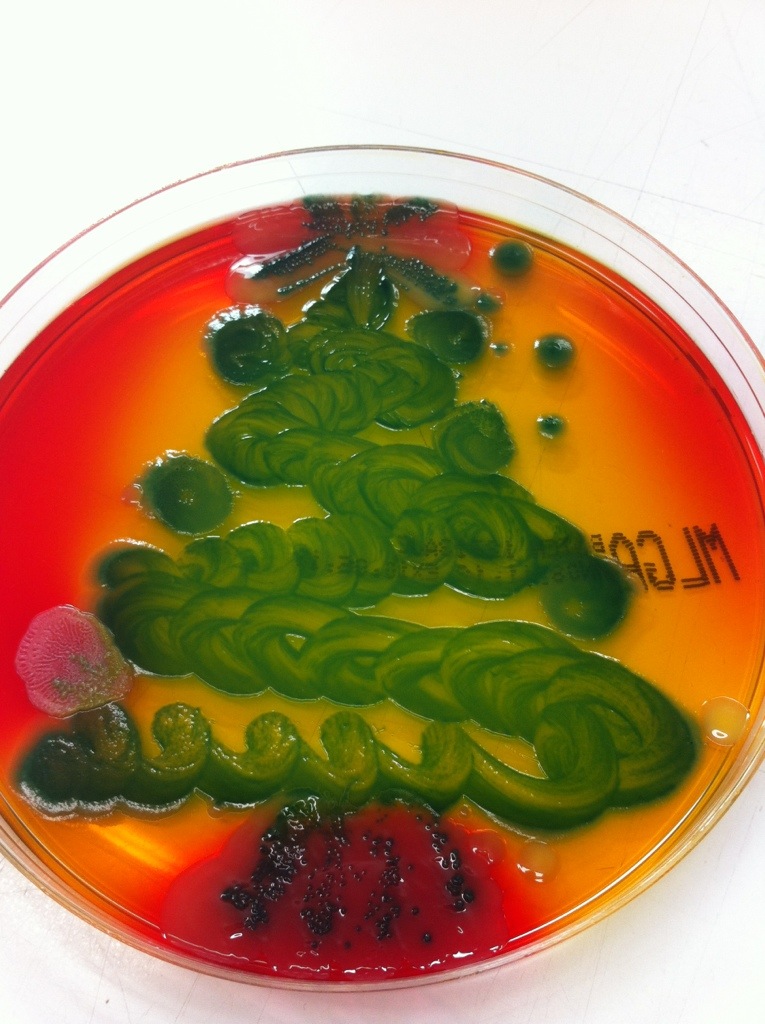
I saw a fungus tree on FB and so I asked my bacteriologist friend, Sam Hair, if he could make me a bacteria tree.
Pictured is a bacteria tree on chromogenic agar plate. The green foliage is E. coli, the pink baubles are Pseudomonas aeruginosa, and the star and tree trunk are Enterobacter cloacae. But with the E. coli being motile, it has invaded the star, trunk and balls. I’ve uploaded a time lapse video to show you the making of our bacterial Christmas tree – http://youtu.be/s3LH9H_WQRQ.
I’d like to take this opportunity to thank you for following and for sharing, and wish you a very merry Christmas and a happy new year!
Stay tuned for more great stuff.Sign Out
What do you call a saintly fish?
An angelfish.
Have a great Christmas everyone!
December 18, 2012
Crayfish Harbor Fungus That’s Wiping Out Amphibians
National Geographic News – Freshwater crustaceans could be the key to understanding how the chytrid fungus persists in the ecosystem long after the last amphibian is gone. Scientists have found a new culprit in spreading the disease that’s been driving the world’s frogs to the brink of extinction: crayfish.
In the last few decades, the disease caused by the chytrid fungus has been a disaster for frogs and other amphibians. More than 300 species are nearly extinct because of it. Many probably have gone extinct, but it can be difficult to know for sure when a tiny, rare species disappears from the face of the Earth. “This pathogen is bad news. It’s worse news than any other pathogen in the history of life on Earth as far as we know it,” says Vance Vredenburg, a conservation biologist at San Francisco State University who studies frogs but did not work on the new study.
The chytrid fungus was only discovered in the late 1990s. Since then, scientists have been scrambling to figure out how it spreads and how it works. One of the biggest mysteries is how chytrid can persist in a frogless pond. Researchers saw it happen many times and were perplexed: If all of a pond’s amphibians were wiped out, and a few frogs or salamanders came back and recolonized the pond, they would also die—even though there were no amphibians in the pond to harbor the disease.
One possible reason is that chytrid infects other animals. For a study published today in Proceedings of the National Academy of Sciences, Taegan McMahon, a graduate student in ecology at the University of South Florida in Tampa, looked at some possible suspects and focused on crayfish, those lobster-like crustaceans living in freshwater. They seemed like a good possibility because they’re widespread and because their bodies have a lot of keratin, a protein the fungus attacks. In the lab, McMahon exposed crayfish to the disease and … … .
See the source (http://tinyurl.com/cbrj8sq) for the full story and much more.
[The article published in PNAS is accessible at http://tinyurl.com/d8nkd9d. ADS-Mod.]
___________________________
AquaVetMed e-News provides information to veterinary and veterinary-allied subscribers concerning aquatic animal medicine, health, welfare, public health and seafood safety, obtained from a variety of sources (largely AquaVetMed subscribers). While provided by the American Veterinary Medical Association’s, Aquatic Veterinary Medicine Committee and are for public distribution, they do not necessarily reflect the opinion of the AVMA or the veterinary profession. See the AVMA Terms of Use (http://tinyurl.com/29h2rf) for further information.
If e-News information is used elsewhere please acknowledge AquaVetMed as the source. Encourage individuals to subscribe rather than distribute through list serves.
Messages may contain attachments that will have been scanned for known viruses.
Subscription and Contributions: Interested veterinarians and veterinary-allied professionals can subscribe, unsubscribe, or contribute pertinent news or information, by sending a message with “For AquaVetMed -” and the topic in the subject line, to dscarfe@avma.org.
Note: Undelivered e-mails will not be resent; Subscribers will be deleted from the list after repeated undelivered or bounced messages and will have to re-subscribe.
Visit our website: www.avma.org
________________________________
| Journal of the World Aquaculture Society | |||||||||||||||||
| Volume 43, Number 6 (December 2012) | |||||||||||||||||
 |
Comparative Analysis of Different Fish Polyculture Systems | ||||||||||||||||
| Authors: | Leonardo J. G. Barcellos 1, Rosmari M. Quevedo 1, Luiz Carlos Kreutz 1, Filipe Ritter 1, Adalberto Pandolfo 1, Marcelo Hemkemeier 1, Luciane Colla 1, Leonardo B. Silva 2, Gessi Koakoski 3, João G. S. da Rosa 3 | ||||||||||||||||
| Author Affiliations: |
|
||||||||||||||||
| Source: | Journal of the World Aquaculture Society, Volume 43, Number 6 (December 2012) | ||||||||||||||||
| Page Numbers: | 778 – 789 | ||||||||||||||||
| Available Full Text: |
|
||||||||||||||||
| Abstract: | Fish polyculture may increase the maximum standing crop of a pond by utilizing a wider range of available food and ecological niches. To identify a better polyculture system for the fish production practiced in southern South America, a 167-d experiment was conducted in 16 earthen ponds (250 m2). The control group contained a traditional combination of carps: 35% common carp (CC), 35% grass carp, 15% silver carp (SC), and 15% bighead carp (BC). The T25%, T50%, and T75% groups consisted of ponds in which CC was replaced by jundiá (JN), and SC and BC were replaced by Nile tilapia at substitution rates of 25%, 50%, and 75%, respectively. The yields of the T25%, T50%, and T75% groups were higher than those of the control group. The effluents generated in the control and T25% groups had lower total phosphorus levels than those generated in the other groups. Considering that all the substituted groups demonstrated better growth performance than the control group and that the T25% group was also better in terms of effluent quality and economic performance, we concluded that fish polyculture in South America would be optimized using a species ratio tested in T25% groups. | ||||||||||||||||
| Citation: | Leonardo J. G. Barcellos, Rosmari M. Quevedo, Luiz Carlos Kreutz, Filipe Ritter, Adalberto Pandolfo, Marcelo Hemkemeier, Luciane Colla, Leonardo B. Silva, Gessi Koakoski, João G. S. da Rosa . Comparative Analysis of Different Fish Polyculture Systems. Journal of the World Aquaculture Society, Volume 43, Number 6 (December 2012), pp. 778-789, <http://ejournals.ebsco.com/direct.asp?ArticleID=43FF9F7438B85E8DAEE7> | ||||||||||||||||
| URL: | http://ejournals.ebsco.com/direct.asp?ArticleID=43FF9F7438B85E8DAEE7 | ||||||||||||||||
See page 6 of the newsletter.
———- Forwarded message ———-
From: ANZCVS <ANZCVS_36dd5738-4901-421b-b54e-96ca5bda9ea1@mailsprout.com.au>
Date: Fri, Dec 21, 2012 at 8:31 AM
Subject: December College Courier
December College Courier
Dear DR LOH,
The December College Courier is now available to download – please click here to download your copy now.
==============2012_Dec_Courier_ANZCVS=================
Elaine Lowe
College Manager
Australian and New Zealand College of Veterinary Scientists
Building 3
Garden City Office Park
2404 Logan Road
EIGHT MILE PLAINS QLD 4113
Telephone: 07 3423 2016
Fax: 07 3423 2977
Web http://www.acvsc.org.au
I’ve been telling everyone about my very own aquaponics setup in the backyard and thought I’d share it with you. It has been up and running since Christmas 2011 and so it’s 1 year old now. Of course a purist aquaculturist would never deviate from circular tanks, but this seems to be adequate for my needs and I managed to pick up these caged tanks at a good price. One thing to be careful is that you should know what these tanks contained previously and to make sure it’s safe for the fish and safe for you. My tanks were purchased locally and they have only had animal feed material in it.
It took a couple of weeks of designing and sourcing the materials, half a day to piece together and got moderately sunburnt. Then some slight modifications along the way, with the latest addition being the automatic water top ups. I hope you’ll enjoy it as much as I’ve enjoyed experimenting and putting this video together.
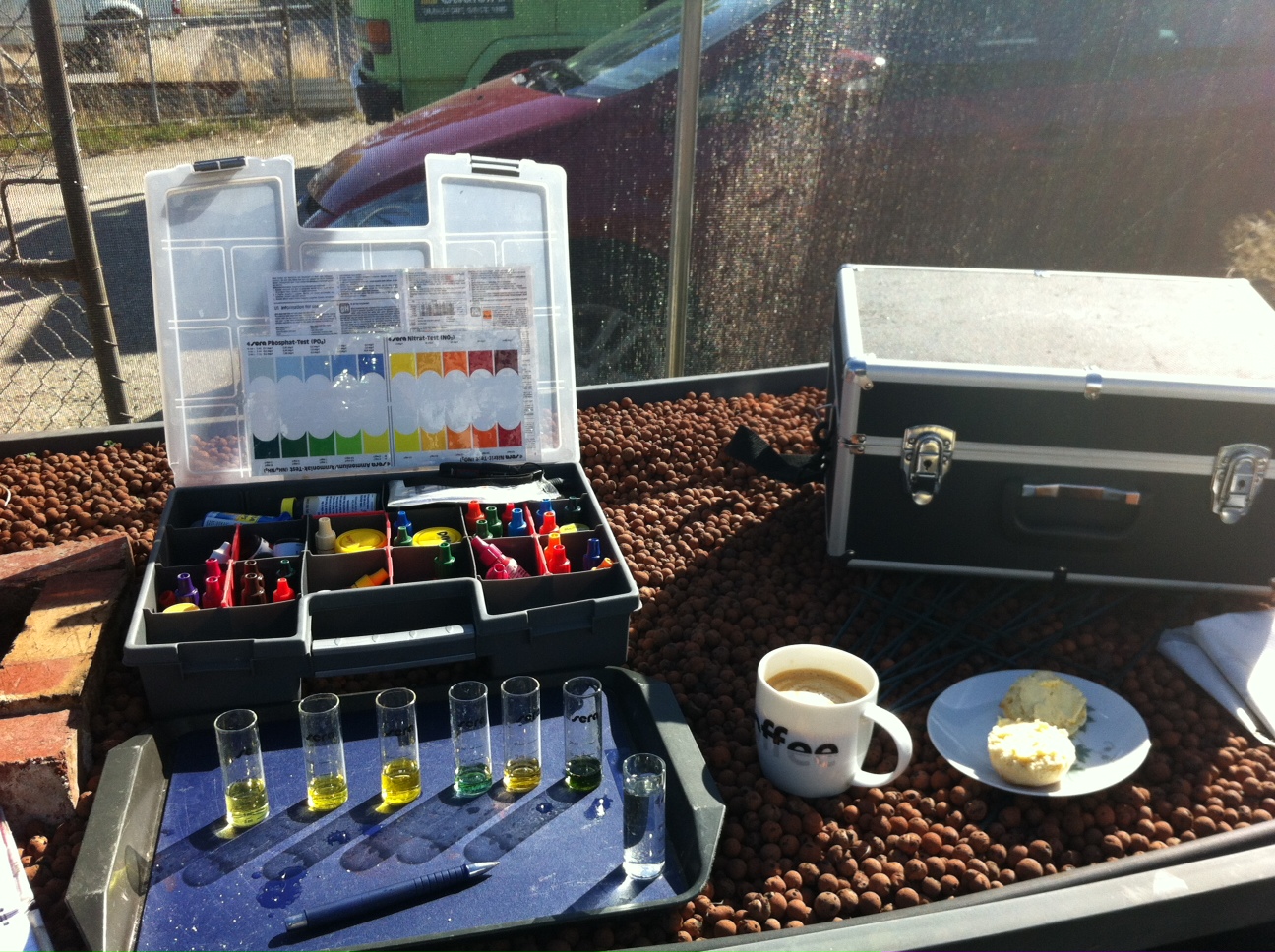
A great start to the day is when you get perfect water quality results at a client’s, good quality coffee and some breaky.
This setup is a 800L koi tank hooked up to an external biofilter as part of their Aquaponics system (the planter tray sits over the top of the fish tank to provide shade). The biofilter ensures that there’ll be nil ammonia and nitrite which is great for every fish tank. Also, I’ve found that clients with planted tanks tend to have negligible nitrate, as was the case here.
So, this was a quick pre-Christmas check on fish health before everyone goes away on holidays. And with the weather forecast of a 40degC day on Christmas Day, you can’t be too careful!
A clean bill of health for these guys.
Check out my koi demolishing the bread.