Read more about the prawn farming project in Senegal that has the added benefit of reducing human cases of schistosomiasis – http://aquatichealth.net/node/68357
Fish joke for Monday-itis: A fish that’s all hands.
What do you call a fish that can’t keep their hands to themselves?
A Groper!
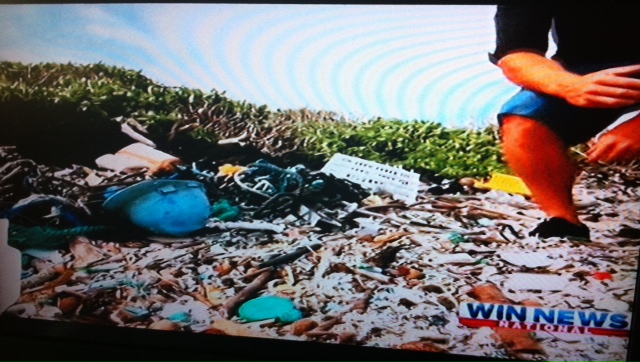
Tsunami junk washes up on Hawaiian shores.
Fish, birds and other marine life eating the stuff to their detriment.
Are households willing to pay for improved fish welfare for farmed salmon?
Interesting article below.
| Aquaculture | |||||||||||||||||
| Volume 375, Number 3 (January 2013) | |||||||||||||||||
 |
Households’ willingness-to-pay for improved fish welfare in breeding programs for farmed Atlantic salmon | ||||||||||||||||
| Authors: | K.M. Grimsrud, H.M. Nielsen, S. Navrud, I. Olesen | ||||||||||||||||
| Author Affiliations: |
|
||||||||||||||||
| Source: | Aquaculture, Volume 375, Number 3 (January 2013) | ||||||||||||||||
| Page Numbers: | 19 – 27 | ||||||||||||||||
| Available Full Text: |
|
||||||||||||||||
| Abstract: | There is a growing concern about the welfare of farmed fish. Current breeding programs typically focus on profitability through emphasizing fast growth of the fish. This research, however, finds that a representative sample of Norwegian households are willing to pay an increased tax for farmed Atlantic salmon that is selected for traits related to fish welfare. In an Internet survey, a random and representative sample of Norwegian households were asked to choose among breeding programs for farmed Atlantic salmon that differed with regards to costs and the following four traits related to fish welfare; frequency of deformities (Deform), frequencies of injuries (Injur), resistance to Salmon Lice (Lepeophtheirus salmonis) (Lice) and resistance to diseases (Health). The survey participants were given six different choice sets, and in each they chose one of three alternative salmon breeding programs. Two of the alternative breeding programs would give improvements in at least one of the trait attributes and would result in an earmarked tax per household per year. The third alternative was the status quo option, i.e. a zero earmarked tax with focus only on growth enhancing traits and profitability in breeding programs. Based on the estimation results of random parameter logit models mean willingness to pay (WTP) was estimated for all households and for the subsample of households purchasing farmed salmon. The average WTP was higher for the subsample that purchases farmed salmon compared to the full sample. For households that purchase farmed salmon, the average WTP in terms of an earmarked tax for all attributes were significant and highest for Lice (1034NOK/yr), followed by Health (749NOK/yr). The WTP for Deform (282NOK/yr) and Injur (256NOK) were nearly the same. For the full sample of household, the average WTP was significantly different from zero at the 5% level only for Health (613.1NOK/yr) and Lice (951.2NOK/yr). This study provides evidence that there is a high WTP among all Norwegian households to improve the welfare of farmed Atlantic salmon through increased resistance to diseases and Salmon Lice, which may imply less use of medicines and chemicals in the production process. Only households that purchase farmed salmon are willing to pay an earmarked tax to reduce deformities and injuries. | ||||||||||||||||
| Citation: | K.M. Grimsrud, H.M. Nielsen, S. Navrud, I. Olesen . Households’ willingness-to-pay for improved fish welfare in breeding programs for farmed Atlantic salmon. Aquaculture, Volume 375, Number 3 (January 2013), pp. 19-27, <http://ejournals.ebsco.com/direct.asp?ArticleID=4CE5BB8137FC41DBA892> | ||||||||||||||||
| URL: | http://ejournals.ebsco.com/direct.asp?ArticleID=4CE5BB8137FC41DBA892 | ||||||||||||||||
Are you keeping your fish feed outside?
Storing fish feed near the fish is convenient, but in the hot summer the feed can go off.
I’ve had a case where salmon feed was not stored in an insulated shed, and one hot summer in Tasmania (yes shockingly, Tasmania can get rather warm!) their fish started dying in numbers. Down the microscope, I saw hepatic necrosis and some saponification of adipocytes. Deaths abated once new feed was brought in to replace the ones that went off.
So this summer, make sure you keep your fish feed stored properly.
Biological control of mosquitoes using Gambusias to curb Dengue.
Gambusias (mosquito fish) are being bred and distributed widely in an effort to curb Dengue. This fish was chosen due to its robustness (they are able to tolerate water temperatures from close to freezing to 34 degrees Celsius) and for their ability to create self-sustaining populations where they are introduced. Let’s hope they’re not causing ‘habitat pollution’ as these fish eat more than just mosquito larvae as was found out in Australia.
Read more here – http://aquatichealth.net/node/68046
The 24th International Conference of the World Association for the Advancement of Veterinary Parasitology will be in Perth, Australia.
Conference Details
25th – 29th August 2013
Perth, Western Australia, Australia
Website: http://www.waavp2013perth.com/
Contact person: Kylie Skinner
WAAVP 2013 attracts parasitologists globally to discuss the latest advances in research relevant to veterinary parasitology. Embracing a broad field of applied parasitology it provides opportunity to look to the future celebrating our 50th Birthday!
Organized by: Australian Society of Parasitology
Deadline for abstracts/proposals: 31st March 2013
Check the event website for more details – http://www.waavp2013perth.com/
Also, there will be a satellite Fish Diseases Workshop before the event.
Where and when? Murdoch University Perth, Thursday 22 August – Saturday 24 August 2013.
This 3-day workshop will be held at the teaching multi-header microscope suites at the Murdoch University School of Veterinary and Life Sciences. The workshop is designed with the fish health diagnostician as well as researcher/ would-be-researcher in mind. At the end of the workshop, participants will have developed some level of confidence in carrying out sound disease investigations in finfish, appreciate normal finfish histology as well as be able to recognize significant and emerging diseases of important cultured finfish species in Asia and Australia.
The workshop will cover both freshwater ornamental fish and marine food fish. There will be opportunity to spend some time on histological materials that participants are encouraged to bring along to the workshop. Participants will receive a set of DVDs of selected virtual microscopy slides reviewed during the workshop, which will serve as invaluable resource reference materials. There will be ample opportunity to seek the opinions of presenters as well as other participants during the workshop.
The workshop program will be announced as soon as it has been finalized. Do register your interest with the conference organizers.
The workshop program will be announced as soon as it has been finalized. Do register your interest with the conference organizers.
For more information, please contact Dr Susan Gibson-Kueh at S.Kueh@murdoch.edu.au
The simplest and cheapest kind of aquaponics.
You don’t need a lot of materials, money, space and time to set up your own aquaponics. If you have a pond, you can start one right away! I consider the floating planters a form of aquaponics and it resembles the commercially used deep water culture (also called raft systems). Start growing your own vegetables or flowery plants to spruce up your pond. Having a planted pond has many advantages and having them in floating baskets will avoid a lot of the pitfalls as is explained in this video.
So, I hope that after watching this video, I hope to see everyone with these in their fish ponds.
wild-caught shrimp fed one large meal of artificial diet and immediately frozen make better feed for seahorse broodstock.
| Journal of the World Aquaculture Society | |||||||||||||||||
| Volume 43, Number 6 (December 2012) | |||||||||||||||||
| |
Growth, Reproductive Performances, and Brood Quality of Long Snout Seahorse, Hippocampus guttulatus, Fed Enriched Shrimp Diets | ||||||||||||||||
| Authors: | Jorge Palma 1, José P. Andrade 1, Dominique P. Bureau 2 | ||||||||||||||||
| Author Affiliations: |
|
||||||||||||||||
| Source: | Journal of the World Aquaculture Society, Volume 43, Number 6 (December 2012) | ||||||||||||||||
| Page Numbers: | 802 – 813 | ||||||||||||||||
| Available Full Text: |
|
||||||||||||||||
| Abstract: | This investigation examined the effect of using enriched shrimp (Atlantic ditch shrimp, Palaemonetes varians) diets on growth of long snout seahorse, Hippocampus guttulatus, and its effect on the reproduction rate and brood quality. Three diets were (1) natural wild-caught shrimp (natural shrimp diet-control diet), (2) wild-caught shrimp fed an artificial feed for 10 d (enriched shrimp diet), and (3) wild-caught shrimp fed one large meal of artificial diet and immediately frozen (ingested artificial feed shrimp diet). These diets were fed to seahorses during a 12-wk growth trial. At the end, significant differences on the final wet weight were found between seahorses fed the three different treatments (P< 0.009). Seahorses fed ingested artificial feed shrimp diet had more broods (9), generated more juveniles per brood (299 ± 87), and significantly bigger juveniles (12.4 ± 1 mm) than seahorses fed natural shrimp diet and enriched shrimp diet. Significant differences in the morphometry of juveniles hatched from parents fed the three different dietary treatments (Wilk’s ? = 0.2, F(6,460)= 47.41, P< 0.0001) were also found. Results indicate that the combined use of a natural diet (shrimp) and an artificial diet benefit growth and feed utilization by seahorses and have a direct impact on the reproductive rate and brood quality of H. guttulatus. | ||||||||||||||||
| Citation: | Jorge Palma, José P. Andrade, Dominique P. Bureau . Growth, Reproductive Performances, and Brood Quality of Long Snout Seahorse, Hippocampus guttulatus, Fed Enriched Shrimp Diets. Journal of the World Aquaculture Society, Volume 43, Number 6 (December 2012), pp. 802-813, <http://ejournals.ebsco.com/direct.asp?ArticleID=482BB169715B46FEB51E> | ||||||||||||||||
| URL: | http://ejournals.ebsco.com/direct.asp?ArticleID=482BB169715B46FEB51E | ||||||||||||||||
6-day heat wave forecast for Perth.
Check out my previous post – https://thefishvet.com/2012/03/09/put-your-axolotls-in-the-fridge/
