Fish of the Week: Frogfish

Jessie Sanders, DVM, CertAqV's avatarAquatic Veterinary Services

Frogfish (family Antennariidae)

This week features one of the oddest members of the fish family is the frog fish. From just looking at its picture, you can tell that it has a unique adaptation: it has feet! Well, not really. They use their pectoral and pelvic fins to walk along the sea floor. Mainly a benthic animal, waiting for a snack to come along, they usually make a run or trot to capture dinner. Sometimes, they sit so still that they have been mistaken for sponges. Some species of frogfish have a unique lure, called an illicium, right above their mouths that they use to lure unsuspecting snacks into its clutches.

Watch a video of them walking around! 

View original post

Dangers of (mis)use of prophylactic antibiotics by hobbyists.

Shared by my friend, Dr Rob Ossiboff:

“Here is an interesting story on antibiotic resistant bacteria in aquarium fish; one of the major suspected drivers is the (mis)use of prophylactic antibiotics by hobbyists. I was amazed at how many types of antibiotics can be acquired over the counter by hobbyists. One of your jobs as aquatic vets will be to educate about the dangers of such use.”

http://www.smartplanet.com/blog/report/fancy-fish-could-harbor-dangerous-bacteria/1226

Help celebrate Dr Loh’s 1000th blog post! You are invited to a Free Webinar on ‘How to become a fish vet?’.

With this blog, it marks my 1,000th post! To celebrate, Dr Loh, The Fish Vet, has joined with The Webinar Vet to create a free Webinar event. I’d like to invite you to learn a bit about how I came to become The Fish Vet and how others may follow. I hope to be able to ‘virtually’ meet you.

For more information, see below:

“How to get your ‘flipper’ in, to become a fish vet.”
Join us for a Webinar on April 4
Space is limited.
Reserve your Webinar seat now at:
http://webinarvet.com.au/upcoming-webinars/#how-to-get-your-flipper-in-to-become-a-fish-vet
The field of veterinary medicine is diverse, furthermore, the field of aquatic veterinary medicine is just as diverse. If you are a veterinarian who would like to expand your clientele to include more than just the traditional species, then this webinar is for you. But how do you get in to fish medicine? This presentation will provide you with my roadmap on how you can be a fish vet. It will detail the skills, knowledge and equipment you need; and then utilising avenues such as the local veterinary clinic, ornamental fish retailers, hobby groups and social media too. This would ensure that the public has access to veterinarians for their fish, satisfying the needs of both the veterinarians and their clients.What you’ll learn:1. Realise that veterinarians are well-equipped practice fish medicine.
2. Learn practical tips for practicing veterinary fish medicine.
3. Learn about different networking opportunities to get into the market.

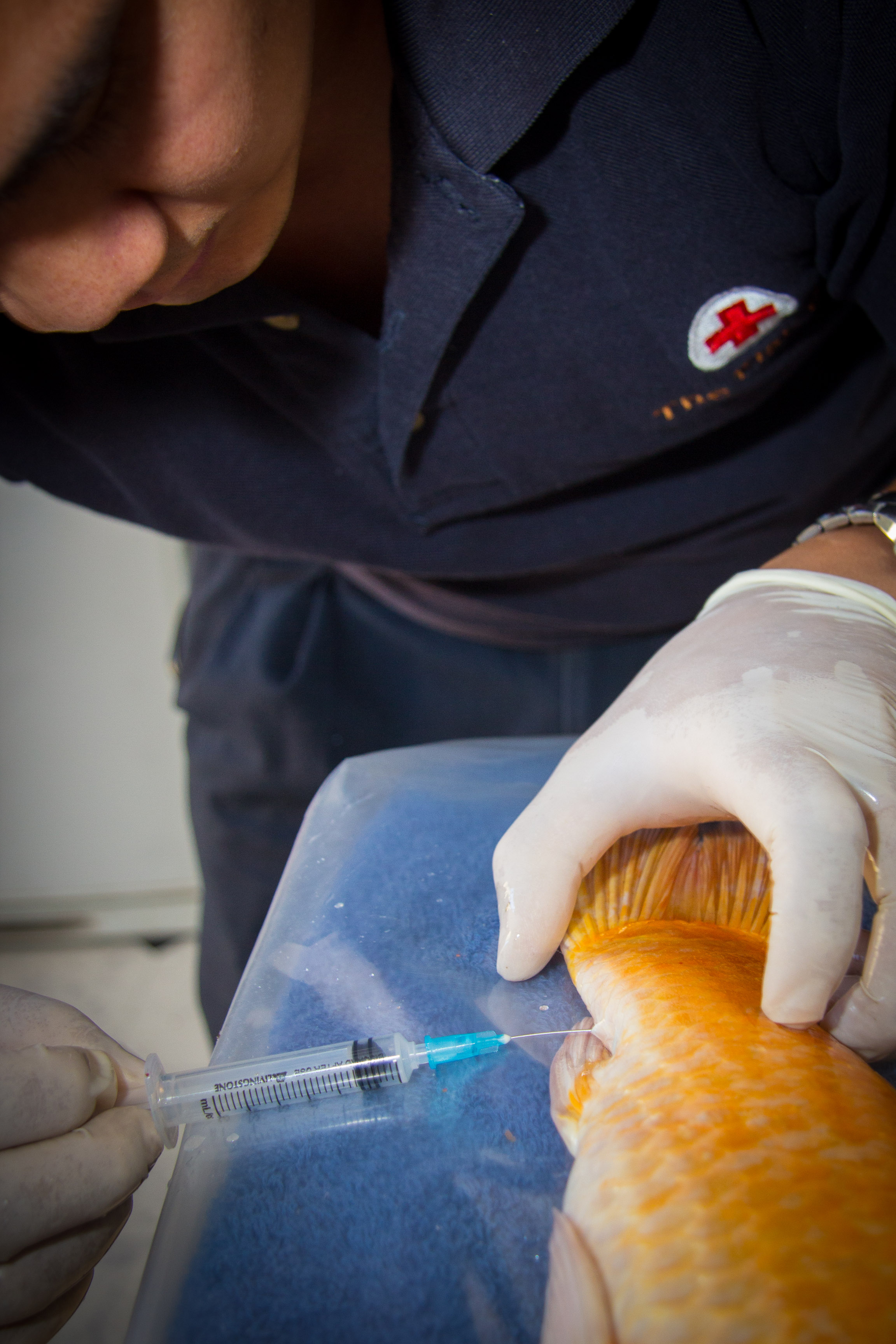
The Fish Vet takes a blood sample from a koi.

Title: “How to get your ‘flipper’ in, to become a fish vet.”
Date: Thursday, April 4, 2013
Time: 7:30 PM – 8:30 PM AEDT (Australian Eastern Daylight Saving’s time)

Time: 4:30 PM – 5:30 PM WST (Australian Western Standard time)

After registering you will receive a confirmation email containing information about joining the Webinar.NB: when you click on the link that says “purchase” you will find that there is no charge.
System Requirements
PC-based attendees
Required: Windows® 7, Vista, XP or 2003 Server
Mac®-based attendees
Required: Mac OS® X 10.6 or newer
Mobile attendees
Required: iPhone®, iPad®, Android™ phone or Android tablet

(be sure to check www.timeanddate.com/worldclock/converter.html for your local time)


DON’T MISS OUT AND REGISTER NOW!

Follow me on: Facebook “Fin Page”YouTubeBlogLinkedinTwitter


Yours sincerely,

Dr Richmond Loh
BSc, BVMS, MPhil (Vet Path), MANZCVS (Aquatics), MANZCVS (Pathobiology), DipPM.
Veterinarian | Adjunct Senior Lecturer Murdoch University | WAVMA President-Elect |
Secretary Aquatic Animal Health Chapter – Australian and New Zealand College of Veterinary Scientists (ANZCVS)
The Fish Vet, Perth, Western Australia, AUSTRALIA.

Mobile Veterinary Medical & Diagnostic Services for fish and other aquatic creatures.
http://www.thefishvet.com.au
Ph: +61 (0)421 822 383Looking for more books? Check out this site.

Check out The Fish Vet’s fishy pictures during his recent visit to Hong Kong.

Dear Fish Fanciers,

Check out pictures at Ocean Park at this link.

Check out the Fa Yuen Street Wet Markets at this link.

Check out the array of ornamental fish shops along Tung Choi Street at this link.

Copper alloy mesh (CAM) net yielded better productivity indexes and higher net economic benefits than those of nylon net with anti-fouling coating.

Bigger initial investment, but ultimately, the non-fouling of nets means better water flow and better growing environment for the fish, reducing stress for better health and productivity, avoiding diseases and losses.


Aquaculture Economics & Management: Official Journal of the International Association of Aquaculture Economics and Management
  Volume 17, Number 1 (March 2013)
     ECONOMIC IMPACTS OF USING COPPER ALLOY MESH IN TROUT AQUACULTURE: CHILEAN EXAMPLE
   Authors: ExequielP. González 1, CarlosFelipe Hurtado 1, Langley Gace 2, Alberto Augsburger 3
   Author Affiliations:
 1: School of Marine Sciences, Pontificia Universidad Católica de Valparaíso
 2: International Copper Association Ltd.
 3: Fundación Chile
   Source: Aquaculture Economics & Management: Official Journal of the International Association of Aquaculture Economics and Management, Volume 17, Number 1 (March 2013)
   Page Numbers: 71 – 86
   Available Full Text:
Full Text: Subscription Required to view full text
Format: PDF
Size: Unknown
Location: Publisher’s Site
Authentication: Publisher’s Site
   Abstract: Commercial aquaculture continues to expand as it strives to meet growing global demand for healthier protein. In this context, farmers are under great pressure to address problems of biofouling and predation, all while reducing operational costs and losses. Copper alloy mesh (CAM) has been shown to provide solutions to these problems, yet there has not been an in-depth study of economic benefits of adopting this new technology. This study was conducted in Chile using one 2010 grow-out cycle of trout (Oncorhynchus mykiss) and combined productivity indicators with economic analysis based on investment theory. Results showed that CAM net yielded better productivity indexes and higher net economic benefits than those of nylon net with anti-fouling coating. Sensitivity analyses showed a greater effect on the profitability of nylon versus CAM and a reduced elasticity of pen profitability with respect to the rental cost of CAM.
   Citation: ExequielP. González, CarlosFelipe Hurtado, Langley Gace, Alberto Augsburger . ECONOMIC IMPACTS OF USING COPPER ALLOY MESH IN TROUT AQUACULTURE: CHILEAN EXAMPLE. Aquaculture Economics & Management: Official Journal of the International Association of Aquaculture Economics and Management, Volume 17, Number 1 (March 2013), pp. 71-86, <http://ejournals.ebsco.com/direct.asp?ArticleID=4D49878F23A00F91C82D&gt;
   URL: http://ejournals.ebsco.com/direct.asp?ArticleID=4D49878F23A00F91C82D

New sensitive test for fish mycobacteriosis.

Mycobacteriosis plagues the ornamental fish industry. From my experience, I can tend to diagnose fish disease in ornamentals based on the species. If it’s a Siamese fighting fish or a gourami that’s sick, it’s usually always fish TB. This condition is also very common in the live bearers and in danios. There is no cure for is. In animal research facilities, some manage it by turning over their entire collection every 6 months since such fishes are usually sourced from the local pet or fish store and they cannot guarantee their stock to be specific pathogen free.

Now in the aquaculture industry, work has been done to create an early diagnostic tool. I hope this technology will have a trickle down effect and that we may be able to utilise it in the ornamental industry. Perhaps we can use it to create and demonstrate specific pathogen free fish.

Read more about the test below:

From: “Dr. David Scarfe”
Date: 18 January 2013 0:58:35 AWST
Subject: AquaVetMed: New Information & Diagnostics on Mycobacteriosis in Fish

January 17, 2013
New Information on Mycobacteriosis in Fish

Norwegian School of Veterinary Science – Mycobacteriosis in fish is a disease that is difficult to detect and therefore often underdiagnosed. For the same reason, information about the effects of this disease on the fish farming industry has been limited. The development of two diagnostic tests has led to the discovery of a mycobacterium which causes disease in both cod and salmon and has never been detected in Norway before.
Reports submitted to the authorities of mycobacteriosis (tuberculosis) in fish have been sporadic and have only stemmed from aquarium fish or wild fish, not farmed fish. This is probably due to under diagnosis.

Adam Zerihun’s doctoral research has led to the development of two methods of diagnosis based on real-time PCR and immunohistochemistry respectively. The tests are extremely sensitive and have been instrumental in detecting a mycobacterium that has never been found in Norway before. The bacterium was found both in farmed salmon and in burbot and experimental infection showed that Atlantic cod was very susceptible to the bacterium and became diseased. The isolated bacterium was identified as Mycobacterium salmoniphilum.

In cod and burbot infected with M. salmoniphilum, Zerihun discovered serious nodules, while only small or no such changes were found in infected Atlantic salmon. The formation of nodules in cod was shown to undergo several phases of development. The identification and characterization of these different stages are important for the appraisal of disease development and in order to estimate the time of infection. Zerihun’s study indicates that the occurrence of the disease in farmed Atlantic salmon and in cod is more widespread than previously thought, both with regard to the range of host and climate variations.

Since the formation of nodules is not a typical symptom in salmon infected with M. salmoniphilum, it is highly probable that many cases of tuberculosis in salmon remain undiscovered. Fish that lose weight without there being any apparent disease or specific cause are classified in fish farming as “lost fish”. A mycobacterial infection can be lurking behind various different symptoms, where weight loss is one characteristic.

For this reason, many salmon infected with tuberculosis can be the undetected reason for losses in the industry. The stress that arises when many fish are kept in closely packed surroundings weakens their immune system and allows mycobacteria to reproduce in many individuals. These factors are known to promote the occurrence of mycobacteriosis.

[More information on Mulualem Adam Zerihun’s doctoral research and thesis (“Mycobacteriosis in marine and freshwater fishes: characterization of the disease and identification of the infectious agents”) is available at http://www.nvh.no/en/Home/News/News-stories/Mycobacteriosis-in-fish/. ADS-Mod.]

___________________________
AquaVetMed e-News provides information to veterinary and veterinary-allied subscribers concerning aquatic animal medicine, health, welfare, public health and seafood safety, obtained from a variety of sources (largely AquaVetMed subscribers). While provided by the American Veterinary Medical Association’s, Aquatic Veterinary Medicine Committee and are for public distribution, they do not necessarily reflect the opinion of the AVMA or the veterinary profession. See the AVMA Terms of Use (http://tinyurl.com/29h2rf) for further information.

If e-News information is used elsewhere please acknowledge AquaVetMed as the source. Encourage individuals to subscribe rather than distribute through list serves.

Messages may contain attachments that will have been scanned for known viruses.

Subscription and Contributions: Interested veterinarians and veterinary-allied professionals can subscribe, unsubscribe, or contribute pertinent news or information, by sending a message with “For AquaVetMed -” and the topic in the subject line, to dscarfe@avma.org.

Note: Undelivered e-mails will not be resent; Subscribers will be deleted from the list after repeated undelivered or bounced messages and will have to re-subscribe.

Visit our website: http://www.avma.org

________________________________

DEFRA (UK) Lifts KHV Ban.

It took five years and I’d expect, an enormous amount of funds and time to enforce the KHV ban to finally arrive at this outcome.

Countries that are currently KHV-free, stay on the alert.

From: “Dr. David Scarfe”
Date: 7 February 2013 2:27:07 AWST
Subject: AquaVetMed: DEFRA (UK) Lifts KHV Ban

February 6, 2013
Notification – Withdrawal of Confirmed Designations for Koi Herpesvirus (KHV)

UK Department of Environment, Food & Rural Affairs (Defra) – Confirmed Designations for the control of KHV disease have been lifted from all of the sites listed below following successful completion of a four year KHV monitoring and retest programme, conducted by the Fish Health Inspectorate at Cefas.

Each of the fisheries were placed under movement controls in the form of a confirmed designation notice for the control of KHV disease following an initial outbreak in 2008.

During the subsequent monitoring and retest period, there have been no further occurrences of clinical KHV disease and all samples of fish taken from these sites consistently tested negative for the presence of KHV.

Fisheries Involved
• Shirkoak Fishing Lake, Woodchurch, Ashford, Kent
• Pavyotts Mill Carp Fishery, East Coker, Yeovil, Somerset
• Lynsters Lakes and The Colne Valley Pits, Hertfordshire and Greater London
• Old Mill Fishery, The Old Mill, Stoford, Yeovil, Somerset
• Pine Lake Fisheries, Oak Field Farm, Kirton Lane, Thorne, Doncaster, S. Yorks
• Wassell Grove Fisheries, Wassell Grove Lane, Hagley, Stourbridge, Worcestershire
• Press Manor Fishery, Birkin Lane, Ashover, Chesterfield, Derbyshire
• Moor Hall Lakes, Moor Hall Farm, Ninfield, Battle, East Sussex

For more details see http://tinyurl.com/b3zlk6s.
___________________________
AquaVetMed e-News provides information to veterinary and veterinary-allied subscribers concerning aquatic animal medicine, health, welfare, public health and seafood safety, obtained from a variety of sources (largely AquaVetMed subscribers). While provided by the American Veterinary Medical Association’s, Aquatic Veterinary Medicine Committee and are for public distribution, they do not necessarily reflect the opinion of the AVMA or the veterinary profession. See the AVMA Terms of Use (http://tinyurl.com/29h2rf) for further information.

If e-News information is used elsewhere please acknowledge AquaVetMed as the source. Encourage individuals to subscribe rather than distribute through list serves.

Messages may contain attachments that will have been scanned for known viruses.

Subscription and Contributions: Interested veterinarians and veterinary-allied professionals can subscribe, unsubscribe, or contribute pertinent news or information, by sending a message with “For AquaVetMed -” and the topic in the subject line, to dscarfe@avma.org.

Note: Undelivered e-mails will not be resent; Subscribers will be deleted from the list after repeated undelivered or bounced messages and will have to re-subscribe.

Visit our website: http://www.avma.org
________________________________

Veterinary Aquatic Lab Animal Care & Husbandry CEPD – May, 2013 – UPEI, Canada.

———- Forwarded message ———-
From: Dr. David Scarfe <DScarfe@avma.org>
Date: Thu, Feb 28, 2013 at 10:51 PM
Subject: AquaVetMed: Veterinary Aquatic Lab Animal Care & Husbandry CEPD (May, 2013 – UPEI, Canada)
To: 

February 28, 2013

Canadian Aquaculture Institute – Introductory & Advanced Veterinary Aquatic Animal Care and Husbandry CEPD


Canadian Aquaculture Institute is pleased to announce the following upcoming workshops: Health and Husbandry of Aquatic Laboratory Animals  (May 27 & 28, 2013) and Advanced Aquatic Animal Care and Husbandry (May 29 & 30, 2013)


These workshops will be offered at the Atlantic Veterinary College, University of Prince Edward Island, Charlottetown. The target audience for these workshops includes Attending, Clinical or Consulting Veterinarians, Facility Managers, Aquatic Facility Technicians, and Animal Care Committee Members working with academic or research institutions that house laboratory aquatic animals and/or review animal care protocols involving manipulating fish in the wild. The workshops provide hands-on experience in procedures for aquatic laboratory animals.


These workshops are designed to fulfill the requirements of Continuing Education for Attending, Clinical or Consulting Veterinarians, Facility Managers and Facility Technicians as required by the Canadian Council on Animal Care.


Health and Husbandry of Aquatic Laboratory Animals – May 27 & 28, 2013

Didactic lectures & wet labs will cover:

•       CCAC Guidelines

•       CCAC Discussion on Common Issues for Aquatic Animal Personnel

•       Pain Assessment in Fish

•       Institutional Animal Care Committee Concerns with Aquatic Animal Protocols

•       Fish Restraint, Anaesthesia and Blood Collection

•       Aquatic Facility Design and Troubleshooting

•       Lab Based Biosecurity and Experimental Design in Fish

•       Water Quality Examination and Trouble shooting

•       Introduction to General Pathology of Aquatic Species Including Common Disease Conditions

•       Communication between Veterinarians and Staff in Aquatic Laboratory Environments

•       Zebrafish / Aquarium Systems

•       Fish Necropsy, Basic Diagnostics and Sample Submission


Advanced Aquatic Animal Care and Husbandry – May 29 & 30, 2013

Didactic lectures & wet labs will cover:

  • ·        Advanced Fish Pathology and Aquatic Species Diagnostics
  • ·        Managing Pathogen and Husbandry Related Disease Outbreaks
  • ·        Salt Water Salmonid System Maintenance
  • ·        Sourcing of Laboratory Aquatic Animal Species
  • ·        Anaesthesia, Blood Collection and Surgery in Xenopus
  • ·        Surgery in fish
  • ·        Field-Based Biosecurity and Experimental Design in Finfish
  • ·        Aquatic Wildlife Research Methodology
  • ·        Maintaining Xenopus in Laboratory Environment
  • ·        Sharing SOP’s in Aquatic Animal Research
  • ·        Disease Treatment Methods in Laboratory Aquatic Systems
  • ·        Clinical Radiology and Ultrasonography of Fish


Cost – Tuition for EACH of the two-day workshops is $670 CAN funds plus tax, with one lunch and nutrition breaks provided. Space is limited, so please register early.


For more information, to register, and for accommodation, please go to http://lifelonglearning.upei.ca/cai


___________________________

AquaVetMed e-News provides information to veterinary and veterinary-allied subscribers concerning aquatic animal medicine, health, welfare, public health and seafood safety, obtained from a variety of sources (largely AquaVetMed subscribers). While provided by the American Veterinary Medical Association’s, Aquatic Veterinary Medicine Committee and are for public distribution, they do not necessarily reflect the opinion of the AVMA or the veterinary profession. See the AVMA Terms of Use (http://tinyurl.com/29h2rf) for further information.


If e-News information is used elsewhere please acknowledge AquaVetMed as the source.  Encourage individuals to subscribe rather than distribute through list serves.


Messages may contain attachments that will have been scanned for known viruses.


Subscription and Contributions: Interested veterinarians and veterinary-allied professionals can subscribe, unsubscribe, or contribute pertinent news or information, by sending a message with “For AquaVetMed -” and the topic in the subject line, to dscarfe@avma.org.  


Note: Undelivered e-mails will not be resent; Subscribers will be deleted from the list after repeated undelivered or bounced messages and will have to re-subscribe.


Visit our website: www.avma.org


________________________________


— 
Follow me on: Facebook “Fin Page” – YouTube  – Blog – Linkedin – Twitter
 

Yours sincerely,

Dr Richmond Loh 
BSc, BVMS, MPhil (Vet Path), MANZCVS (Aquatics), MANZCVS (Pathobiology), DipPM.
Veterinarian | Adjunct Senior Lecturer Murdoch University | WAVMA President-Elect |
Secretary Aquatic Animal Health Chapter – Australian and New Zealand College of Veterinary Scientists (ANZCVS)
The Fish Vet, Perth, Western Australia, AUSTRALIA. 

Mobile Veterinary Medical & Diagnostic Services for fish and other aquatic creatures.
http://www.thefishvet.com.au
Ph: +61 (0)421 822 383

Looking for more books? Check out this site.

Veterinary Aquatic Lab Animal Care & Husbandry CEPD – May, 2013 – UPEI, Canada.

———- Forwarded message ———-
From: Dr. David Scarfe <DScarfe@avma.org>
Date: Thu, Feb 28, 2013 at 10:51 PM
Subject: AquaVetMed: Veterinary Aquatic Lab Animal Care & Husbandry CEPD (May, 2013 – UPEI, Canada)
To: 

February 28, 2013

Canadian Aquaculture Institute – Introductory & Advanced Veterinary Aquatic Animal Care and Husbandry CEPD


Canadian Aquaculture Institute is pleased to announce the following upcoming workshops: Health and Husbandry of Aquatic Laboratory Animals  (May 27 & 28, 2013) and Advanced Aquatic Animal Care and Husbandry (May 29 & 30, 2013)


These workshops will be offered at the Atlantic Veterinary College, University of Prince Edward Island, Charlottetown. The target audience for these workshops includes Attending, Clinical or Consulting Veterinarians, Facility Managers, Aquatic Facility Technicians, and Animal Care Committee Members working with academic or research institutions that house laboratory aquatic animals and/or review animal care protocols involving manipulating fish in the wild. The workshops provide hands-on experience in procedures for aquatic laboratory animals.


These workshops are designed to fulfill the requirements of Continuing Education for Attending, Clinical or Consulting Veterinarians, Facility Managers and Facility Technicians as required by the Canadian Council on Animal Care.


Health and Husbandry of Aquatic Laboratory Animals – May 27 & 28, 2013

Didactic lectures & wet labs will cover:

•       CCAC Guidelines

•       CCAC Discussion on Common Issues for Aquatic Animal Personnel

•       Pain Assessment in Fish

•       Institutional Animal Care Committee Concerns with Aquatic Animal Protocols

•       Fish Restraint, Anaesthesia and Blood Collection

•       Aquatic Facility Design and Troubleshooting

•       Lab Based Biosecurity and Experimental Design in Fish

•       Water Quality Examination and Trouble shooting

•       Introduction to General Pathology of Aquatic Species Including Common Disease Conditions

•       Communication between Veterinarians and Staff in Aquatic Laboratory Environments

•       Zebrafish / Aquarium Systems

•       Fish Necropsy, Basic Diagnostics and Sample Submission


Advanced Aquatic Animal Care and Husbandry – May 29 & 30, 2013

Didactic lectures & wet labs will cover:

  • ·        Advanced Fish Pathology and Aquatic Species Diagnostics
  • ·        Managing Pathogen and Husbandry Related Disease Outbreaks
  • ·        Salt Water Salmonid System Maintenance
  • ·        Sourcing of Laboratory Aquatic Animal Species
  • ·        Anaesthesia, Blood Collection and Surgery in Xenopus
  • ·        Surgery in fish
  • ·        Field-Based Biosecurity and Experimental Design in Finfish
  • ·        Aquatic Wildlife Research Methodology
  • ·        Maintaining Xenopus in Laboratory Environment
  • ·        Sharing SOP’s in Aquatic Animal Research
  • ·        Disease Treatment Methods in Laboratory Aquatic Systems
  • ·        Clinical Radiology and Ultrasonography of Fish


Cost – Tuition for EACH of the two-day workshops is $670 CAN funds plus tax, with one lunch and nutrition breaks provided. Space is limited, so please register early.


For more information, to register, and for accommodation, please go to http://lifelonglearning.upei.ca/cai


___________________________

AquaVetMed e-News provides information to veterinary and veterinary-allied subscribers concerning aquatic animal medicine, health, welfare, public health and seafood safety, obtained from a variety of sources (largely AquaVetMed subscribers). While provided by the American Veterinary Medical Association’s, Aquatic Veterinary Medicine Committee and are for public distribution, they do not necessarily reflect the opinion of the AVMA or the veterinary profession. See the AVMA Terms of Use (http://tinyurl.com/29h2rf) for further information.


If e-News information is used elsewhere please acknowledge AquaVetMed as the source.  Encourage individuals to subscribe rather than distribute through list serves.


Messages may contain attachments that will have been scanned for known viruses.


Subscription and Contributions: Interested veterinarians and veterinary-allied professionals can subscribe, unsubscribe, or contribute pertinent news or information, by sending a message with “For AquaVetMed -” and the topic in the subject line, to dscarfe@avma.org.  


Note: Undelivered e-mails will not be resent; Subscribers will be deleted from the list after repeated undelivered or bounced messages and will have to re-subscribe.


Visit our website: www.avma.org


________________________________


— 
Follow me on: Facebook “Fin Page” – YouTube  – Blog – Linkedin – Twitter
 

Yours sincerely,

Dr Richmond Loh 
BSc, BVMS, MPhil (Vet Path), MANZCVS (Aquatics), MANZCVS (Pathobiology), DipPM.
Veterinarian | Adjunct Senior Lecturer Murdoch University | WAVMA President-Elect |
Secretary Aquatic Animal Health Chapter – Australian and New Zealand College of Veterinary Scientists (ANZCVS)
The Fish Vet, Perth, Western Australia, AUSTRALIA. 

Mobile Veterinary Medical & Diagnostic Services for fish and other aquatic creatures.
http://www.thefishvet.com.au
Ph: +61 (0)421 822 383

Looking for more books? Check out this site.