Pictures from my recent trip to visit Shark Bay during the Easter break.

We did a total of 2063.7 km, north of my base in Perth, WA. That’s a lot of road covered!

I got to see dolphins, dugongs, sea turtles, sea snakes, sharks and more! On the terrestrial front, some kangaroos, emus, pelicans and others.

Check out some of the pictures on my Facebook Fanpage.

Follow me on: Facebook "Fin Page"YouTubeBlogLinkedinTwitter


Yours sincerely,

Dr Richmond Loh DipProjMgt, BSc, BVMS, MPhil (Pathology) Murdoch, MANZCVS (Aquatics & Pathobiology).
Veterinarian | Adjunct Lecturer Murdoch University | WAVMA President-Elect |
Secretary Aquatic Animal Health Chapter – Australian and New Zealand College of Veterinary Scientists (ANZCVS).
The Fish Vet, Perth, Western Australia, AUSTRALIA. Mobile Veterinary Medical & Diagnostic Services for fish and other aquatic creatures.
http://www.thefishvet.com.au
Ph: +61 (0)421 822 383

Looking for more books? Check out this site.

Mine killed river life. Will reopening the mine resurrect it?

Locals no longer stop to drink the water or swim at Hanrahan’s Creek. The water is freakish green and blue.

The copper concentrations they measured were about 377 milligrams per litre, where a pristine or high conversation stream would be about 0.001 milligrams per litre.

When Redbank Copper acquired the mine in 2006 (some ten years after it was closed) it inherited legal responsibility for the environmental problems. The company is currently attempting to raise $7.5m from investors, arguing that the only way to correct the problems is to restart the mine.

Learn more here –
the-redbank-copper-mine-poisoned-hanrahans-creek

Don’t forget to join Dr Loh’s free Webinar on ‘How to become a fish veterinarian?’ April 4.

Dr Loh, The Fish Vet, has joined with The Webinar Vet to create a free Webinar event. I’d like to invite you to learn a bit about how I came to be The Fish Vet and how others may follow. I hope to be able to ‘virtually’ meet you.

For more information, see below:

“How to get your ‘flipper’ in, to become a fish vet.”
Join us for a Webinar on April 4
Space is limited.
Reserve your Webinar seat now at:
http://webinarvet.com.au/upcoming-webinars/#how-to-get-your-flipper-in-to-become-a-fish-vet
The field of veterinary medicine is diverse, furthermore, the field of aquatic veterinary medicine is just as diverse. If you are a veterinarian who would like to expand your clientele to include more than just the traditional species, then this webinar is for you. But how do you get in to fish medicine? This presentation will provide you with my roadmap on how you can be a fish vet. It will detail the skills, knowledge and equipment you need; and then utilising avenues such as the local veterinary clinic, ornamental fish retailers, hobby groups and social media to.
This would ensure that the public has access to veterinarians for their fish, satisfying the needs of both the veterinarians and their clients.What you’ll learn:
1. Realise that veterinarians are well-equipped practice fish medicine.
2. Learn practical tips for practicing veterinary fish medicine.
3. Learn about different networking opportunities to get into the market.

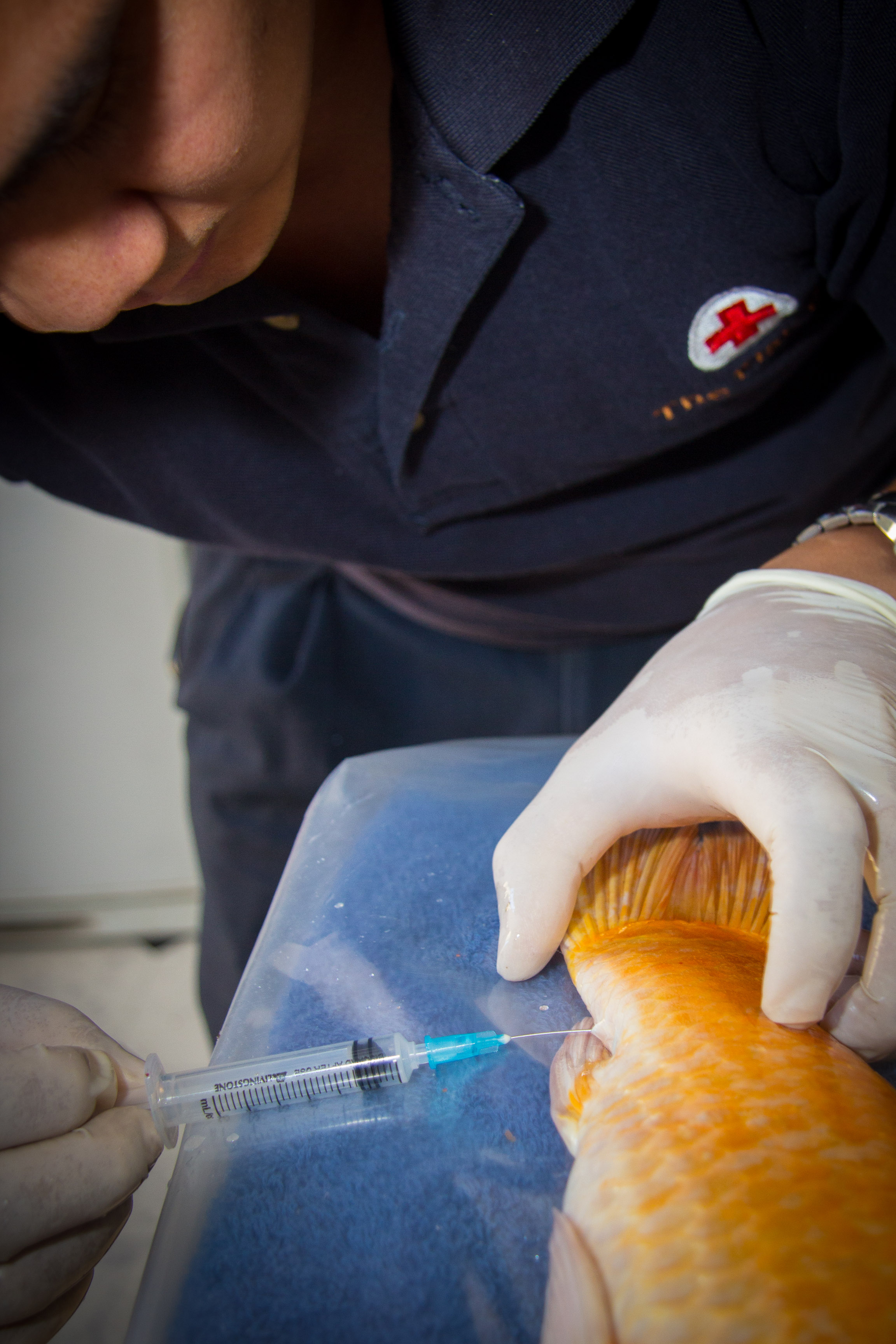
The Fish Vet takes a blood sample from a koi.

Title: “How to get your ‘flipper’ in, to become a fish vet.”
Date: Thursday, April 4, 2013
Time: 7:30 PM – 8:30 PM AEDT (+11 GMT)
After registering you will receive a confirmation email containing information about joining the Webinar.
System Requirements
PC-based attendees
Required: Windows® 7, Vista, XP or 2003 Server
Mac®-based attendees
Required: Mac OS® X 10.6 or newer
Mobile attendees
Required: iPhone®, iPad®, Android™ phone or Android tablet

(be sure to check http://www.timeanddate.com/worldclock/converter.html for your local time)

Select time and place to convert from

Choose: Australia – Western Australia – Perth’s,

Thursday, 4th April, 4:30pm.


Follow me on: Facebook “Fin Page”YouTubeBlogLinkedinTwitter


Yours sincerely,

Dr Richmond Loh
BSc, BVMS, MPhil (Vet Path), MANZCVS (Aquatics), MANZCVS (Pathobiology), DipPM.
Veterinarian | Adjunct Senior Lecturer Murdoch University | WAVMA President-Elect |
Secretary Aquatic Animal Health Chapter – Australian and New Zealand College of Veterinary Scientists (ANZCVS)
The Fish Vet, Perth, Western Australia, AUSTRALIA.

Mobile Veterinary Medical & Diagnostic Services for fish and other aquatic creatures.
http://www.thefishvet.com.au
Ph: +61 (0)421 822 383Looking for more books? Check out this site.

Brand new discovery. A newt that looks like a croc!

Found in Vietnam.
Read more here –
http://news.mongabay.com/2013/0318-hance-crocodilenewt-new.html?80b4j0Pb3R2USVHX.99

Fish Joke for Monday-itis: Nobody.

Q. Which aquatic creature can you say is a nobody?

A. An octopus, or any member of the cephalopod group. Cephal = head. Pod = foot. It has ‘no body’!

By yours truly.

National fish stock status – Australia – 2012.

The Status of key Australian fish stocks reports provides the first national assessments of our wild capture fish stocks, incorporating information from all eight fisheries management jurisdictions into a single set of reports.

The productivity and sustainability of wild-capture fisheries depends heavily on the state of wild fish stocks. A fundamental aim of fisheries management is to ensure that fish stocks are maintained at sustainable levels.

Learn more here :
http://fish.gov.au/Pages/default.aspx

Coral trout with melanoma skin cancer!

Related to the hole in the ozone layer?

Learn more here – http://scienceillustrated.com.au/blog/nature/australian-fish-have-high-incidence-of-skin-cancer-too/

NIAA sets up a new Aquatic Livestock Committee.

———- Forwarded message ———-
From: Dr. David Scarfe <DScarfe@avma.org>
Date: Wed, Feb 20, 2013 at 4:10 AM
Subject: AquaVetMed: New NIAA Aquatic Livestock Committee – Press Release
To:

February 19, 2013

NIAA Adds Aquatic Livestock Committee

COLORADO SPRINGS, CO—The National Institute for Animal Agriculture has expanded its net and has added an Aquaculture/Aquatic Livestock Committee to its list of species committees. NIAA’s draft objectives statement for the newly formed Aquatic Livestock Committee underpins its purpose: “To advance sustainable aquatic livestock (aquaculture) industries, the committee will address key issues relevant to farmed aquatic animal health, well-being, seafood safety, public health and environmental concerns.”

“NIAA carries a strong legacy of providing the U.S. livestock industry with a forum to collectively address issues of common interest, and we are now expanding our endeavors to include aquaculture,” states Dr. David Scarfe, Assistant Director, Scientific Activities at the American Veterinary Medical Association, and co-chair of NIAA’s Aquaculture/Aquatic Livestock Committee. “The Aquatic Livestock Committee is a perfect fit for NIAA, as aquatic animal farming involves people producing, raising and caring for aquatic animals in controlled environments.”

Todd Low, Manager of Hawaii Department of Agriculture’s Aquaculture and Livestock Support Services Program and co-chair of the new committee with Scarfe, adds that it’s exciting times for aquaculture and for NIAA which established the Aquatic Livestock Committee in 2012.

“Aquaculture is the fastest growing sector of the agricultural economy,” Low states. “And, while the United States is a small producer when it comes to global aquaculture, our country is a major player as it supplies a variety of advanced technology, equipment, feed and investment to aquaculture around the world.”

In addition to NIAA’s business conference’s general sessions that will address topics such as translating agricultural advancements to the public and meeting the demand for food through the application of technology and knowledge, four aquaculture-specific presentations by leading experts are scheduled for the Aquaculture Livestock Committee meeting on Tuesday, April 16. The presentations, which are designed to stimulate this new committee to consider primary actions that can help the U.S. industries grow and thrive, include:

1) Current Status of U.S. Aquaculture

2) U.S. Aquaculture: The Past, Today and the Future

3) Problems, Stumbling Blocks and Solutions for U.S. Aquaculture

4) NIAA Aquatic Livestock Committee Structure and Function

The committee meeting will wrap up with a facilitated open discussion identifying issues and solutions to advance U.S. aquaculture. Areas of discussion will address consumer acceptance of production practices, consumer hardware/equipment/technology, the future of traditional farming practices, biotechnology and national research, priorities and directions for feeding the world in 2050.

“If you are involved in aquaculture—as a producer, veterinarian, scientist, government representative, or work in allied industry, then we urge you to attend NIAA’s upcoming conference, April 15-18, in Louisville, Ky., and get involved with the Aquatic Livestock Committee from the very start,” Low states. “This is where those of us from various areas of aquaculture can come together to address timely topics such as public health and environmental concerns, seafood safety, aquatic animal health and wellbeing in a unified manner and learn from each other.”

To learn more about NIAA’s new Aquatic Livestock Committee or the organization’s April 15-18 conference in Louisville, Ky., or to become a member of the new committee, please contact NIAA at (719) 538-8847 or email NIAA at niaa@animalagriculture.org.

The National Institute for Animal Agriculture provides a forum for building consensus and advancing proactive solutions for animal agriculture—the beef, dairy, swine, sheep, goats, equine, poultry and aquaculture industries—and provides continuing education and communication linkages for animal agriculture professionals. NIAA is dedicated to programs that work towards the eradication of disease that pose risk to the health of animals, wildlife and humans; promote a safe and wholesome food supply for our nation and abroad; and promote best practices in environmental stewardship, animal health and well-being. NIAA members represent all facets of animal agriculture.

Contact: Teres Lambert; Ph 970-689-3653; tlambert@animalagriculture.org.

National Institute for Animal Agriculture

13570 Meadowgrass Drive, Suite 201, Colorado Springs, CO 80921

Phone 719-538-8843 • Fax 719-538-8847 • NIAA@animalagriculture.orgwww.animalagriculture.org.

___________________________

AquaVetMed e-News provides information to veterinary and veterinary-allied subscribers concerning aquatic animal medicine, health, welfare, public health and seafood safety, obtained from a variety of sources (largely AquaVetMed subscribers). While provided by the American Veterinary Medical Association’s, Aquatic Veterinary Medicine Committee and are for public distribution, they do not necessarily reflect the opinion of the AVMA or the veterinary profession. See the AVMA Terms of Use (http://tinyurl.com/29h2rf) for further information.

If e-News information is used elsewhere please acknowledge AquaVetMed as the source. Encourage individuals to subscribe rather than distribute through list serves.

Messages may contain attachments that will have been scanned for known viruses.

Subscription and Contributions: Interested veterinarians and veterinary-allied professionals can subscribe, unsubscribe, or contribute pertinent news or information, by sending a message with “For AquaVetMed -” and the topic in the subject line, to dscarfe@avma.org.

Note: Undelivered e-mails will not be resent; Subscribers will be deleted from the list after repeated undelivered or bounced messages and will have to re-subscribe.

Visit our website: www.avma.org

________________________________

Follow me on: Facebook “Fin Page”YouTubeBlogLinkedinTwitter


Yours sincerely,

Dr Richmond Loh
BSc, BVMS, MPhil (Vet Path), MANZCVS (Aquatics), MANZCVS (Pathobiology), DipPM.
Veterinarian | Adjunct Senior Lecturer Murdoch University | WAVMA President-Elect |
Secretary Aquatic Animal Health Chapter – Australian and New Zealand College of Veterinary Scientists (ANZCVS)
The Fish Vet, Perth, Western Australia, AUSTRALIA.

Mobile Veterinary Medical & Diagnostic Services for fish and other aquatic creatures.
http://www.thefishvet.com.au
Ph: +61 (0)421 822 383Looking for more books? Check out this site.

Time to harvest your Barra or keep them warm.

Now we are well and truly past the warm summer months and apart from maybe a few more warms days, the weather in the Southern Hemisphere is getting a little chilly. If you have any tropical fish outside, consider bringing them inside and/or installing some water heaters for the fish. Those who’ve barramundi in their Aquaponics setup may consider harvesting them.

The cooler temperatures will have immunosuppressive effects on the fish and succumb to fungal or protozoal, skin or gill diseases. It is best to avoid this.

Can you help me by telling me what your water temperature is right now? Have your barramundi shown any signs of disease yet? I’m keeping a log of this.

Click here for the water temperature requirements of barramundi.

A warning about the use of pyrethroids.

My colleague, Dr Matt Landos, shared this with me:


“Interesting piece of work from US, looking at distribution of pyrethroids in urban creek sediments. Origin is presumably household use. Household uses in Australia are climbing with do-it-yourself spider control, lawn ant control, etc…


The paper shows movement off the application site, into waterways, at levels capable of causing toxicity to sensitive invertebrates. Notably the registration of these product did not predict this would happen, or that once bound to sediment they could remain bioavailable and toxic.


The same impacted invertebrates are the essential food resource for fish larvae amongst other critters. Reduction of density will impact recruitment of wild fishes.”


Learn more by clicking on the link below –

Pyrethroid article.