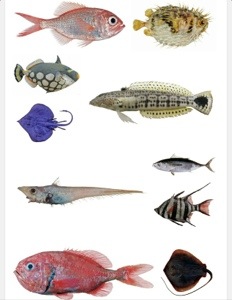
When do you use ‘fish’ and when do you use ‘fishes’?

Question: when i was young ‘fish’ was used for singular and plural. In recent years i’ve heard people use ‘fish’ and ‘fishes’ for plural. I was taught the latter was wrong, but maybe now it’s considered correct? Your thoughts?

Answer:
My dad was old school taught and he says that ‘fishes’ refers to multiple fish species. Otherwise, ‘fish’ is like ‘sheep’, to be used plural or singular.

So, it’s legit if it’s for multiple fish species. If you’re talking about a pen of a thousand salmon, then it’s ‘fish’ in the plural sense if the word. But a thousand ‘fishes’ in the coral reef because there are lots of different species.

A whopper Tasmanian King Crab!

I received this via an email forward…

 
He was destined for the pot – if they had found one big enough to fit. 
But Claude the Tasmanian giant crab was saved from death when the fisherman who caught him sold him to a British aquarium for 
3,000. 
Now, after a 29-hour plane journey from Australia – where giant crab meat is a delicacy – and two weeks in quarantine, Claude is ready to meet his public.
 

cid:1.960444470@web74105.mail.tp2.yahoo.com 
Catch of the day: Held up by Sealife aquarist Jemma Battric, Claude weighs a mighty 15lbs and measures 15 inches wide – when he is fully grown he will weigh a whopping 30lbs and gain an extra three inches


cid:2.960444470@web74105.mail.tp2.yahoo.com
Lucky escape: The Tasmanian King Crab is a delicacy in its native Australia and was destined for the dinner table until it was snapped up by a British aquarium worker. He paid 3,000 for three and had them flown to the UK  He will go on display at the Sea Life centre in Weymouth , Dorset, on Thursday, and his two companions will be  moved to other centres in Birmingham and Berlin if Claude responds well to his new home. 
Currently he is being kept on his own in a specially made cylindrical tank, ten feet tall and six feet wide, but the aquarium will intro duce some coldwater fish once he is settled. 


cid:3.960444470@web74105.mail.tp2.yahoo.com
Mini me: Claude dwarfs a British Shore crab who is put on his back for size and to show just how gigantic he is
  
cid:4.960444470@web74105.mail.tp2.yahoo.com
Big crab, small appetite: ‘The crabs don’t eat very much despite being one of the largest species and they will feed on shrimp, prawns, and squid when they are here,’ said Jemma Battrick, aquarist at Weymouth Sea Life  
In the wild, crabs eat any dead or dying matter they find on the seabed but Claude is currently dining on diced mackerel and squid and is reportedly very happy with his gourmet diet.
 
Rob Hicks, head marine biologist for Sea Life, said: ‘They are such impressive creatures we thought that it was worth the cost and effort of flying them halfway round the world so the y can flourish in an aquarium display.
 
‘They had a stopover in Hong Kong and arrived with us two weeks ago. It took them a few days to get over the jet-lag but now they’re feeding happily and don’t seem any the worse for their trip.’
 
Jemma Battrick, aquarist at Weymouth Sea Life said: ‘When I found out we were getting the crabs in I was really excited.
 cid:5.960444470@web74105.mail.tp2.yahoo.com

 
Massive claws: Rob Hicks, head marine biologist for Sea Life, said: ‘They are such impressive creatures we thought that it was worth the cost and effort of flying them half-way round the world to so they can flourish in an aquarium display’
 

‘We already have a tank here for them so it will be easy to move them in, and they will go on display straight away.
 
‘The crabs don’t eat very much despite being one of the largest species and they will feed on shrimp, prawns, and squid when they are here.
 
‘We want to increase their numbers but in Australia people eat them and I think visitors to the Sea Life will be shocked when they find that out because they look so magnificent. 


Artemia munches on bacteria when there’s no algae.

Reading this article made me think of an alternative use for Artemia nauplii. What if, we can harness their hunger for bacteria to help with cases of pathogenic bacterial blooms? This might be particularly useful in hatchery situations, provided of course that the Artemia nauplii do not predate on your cultured organisms.

Aquaculture
  Volume 391, Number 2 (April 2013)
     Bacteria contribute to Artemianutrition in algae-limited conditions: A laboratory study
   Authors: Huynh Thanh Toi, Pascal Boeckx, Patrick Sorgeloos, Peter Bossier, Gilbert Van Stappen
   Author Affiliations:
no affiliations available
   Source: Aquaculture, Volume 391, Number 2 (April 2013)
   Page Numbers: 1 – 7
   Available Full Text:
Full Text: Subscription Required to view full text
Format: PDF
Size: Unknown
Location: Publisher’s Site
Authentication: Publisher’s Site
   Abstract: We investigated the effect of the stimulation of bacterial growth on Artemia performance in combination with a standard and with a low algal feeding regime. In both regimes, organic carbon (supplied as sucrose or soluble potato starch) and 15N labeled inorganic nitrogen (supplied as NaNO3) were used to stimulate bacterial growth in the Artemia cultures at C/N ratio 10 and 50. After a culture period of 15days, significantly improved biomass production was obtained in all treatments with the low algae feeding regime, supplemented by carbohydrate addition. In addition, results of 15N accumulation and fatty acid analysis in Artemia indicated that Artemia utilized more bacteria in algae-limited conditions. Our study shows that bacteria can be used as a nutrient source for Artemia compensating for suboptimal algae supply. In Artemia pond cultures, carbohydrate addition may hence potentially be used to stimulate the conversion of nitrogen waste into heterotrophic bacterial biomass. This can be converted into protein-rich Artemia biomass, especially when algae are in sub-optimal supply. These findings open perspectives for alternative Artemia pond production protocols, in addition to the present management procedures that exclusively focus on phytoplankton blooms as nutrient source to sustain dense Artemia populations.
   Citation: Huynh Thanh Toi, Pascal Boeckx, Patrick Sorgeloos, Peter Bossier, Gilbert Van Stappen . Bacteria contribute to Artemianutrition in algae-limited conditions: A laboratory study. Aquaculture, Volume 391, Number 2 (April 2013), pp. 1-7, <http://ejournals.ebsco.com/direct.asp?ArticleID=456F9ACE297733BDC76B&gt;
   URL: http://ejournals.ebsco.com/direct.asp?ArticleID=456F9ACE297733BDC76B

Zebrafish Biomedical Research Workshop (King’s College, UK) – May 3-4, 2013.

Forwarded message below:

From: “Dr. David Scarfe”
Date: 4 April 2013 0:35:05 AWST
Subject: AquaVetMed: Zebrafish Biomedical Research Workshop (King’s College, UK) – May 3-4, 2013

Zebrafish: an animal model in biomedical research – International Workshop (May 3-4, 2013)

Location: King’s College London (UK) harboring one of the largest European Zebra fish research facilities.

This workshop is the result of a collaboration between University College London, King’s College London, FGB, and COST action BM0804, the European Network on Fish Biomedical Models (EuFishBioMed).

Lectures will provide the latest information on the organisation of a modern Zebrafish (zebra danio) facility, animal husbandry and care, health monitoring, GMO technology, international legislation and guidelines and applied research technologies. Demonstrations of frequently used techniques are part of the programme.

For a more detailed brochure and registration details, follow this link- http://tinyurl.com/d59r5hb
___________________________
AquaVetMed e-News provides information to veterinary and veterinary-allied subscribers concerning aquatic animal medicine, health, welfare, public health and seafood safety, obtained from a variety of sources (largely AquaVetMed subscribers). While provided by the American Veterinary Medical Association’s, Aquatic Veterinary Medicine Committee and are for public distribution, they do not necessarily reflect the opinion of the AVMA or the veterinary profession. See the AVMA Terms of Use (http://tinyurl.com/29h2rf) for further information.

If e-News information is used elsewhere please acknowledge AquaVetMed as the source. Encourage individuals to subscribe rather than distribute through list serves.

Messages may contain attachments that will have been scanned for known viruses.

Subscription and Contributions: Interested veterinarians and veterinary-allied professionals can subscribe, unsubscribe, or contribute pertinent news or information, by sending a message with “For AquaVetMed -” and the topic in the subject line, to dscarfe@avma.org.

Note: Undelivered e-mails will not be resent; Subscribers will be deleted from the list after repeated undelivered or bounced messages and will have to re-subscribe.

Visit our website: http://www.avma.org

________________________________

Do you want to know what fish lives where? Then FishMap’s for you.

With FishMap you can find out what fish occur at any location or depth in the waters of Australia’s continental shelf and slope. You can also create species lists for any region that include photographs and illustrations, distribution maps and current scientific and common names.

It has the known geographical and depth ranges of over 4500 Australian marine fishes – including our 320 sharks and rays.

According to the Australian Bureau of Statistics more than five million Australians take part in recreational fishing in Australia as a leisure activity.
There is also a large commercial seafood and aquaculture industry which is worth over $2 billion annually and employs around 16,000 people.
Combined with the number of people who love a good feed of fish, there are a lot of people with a direct interest in the oceans and seas of Australia and what is in them.
Huw Morgan

Check out a gallery of images from FishMap in this blog post.
Some examples taken from the site:

20130306-080829.jpg

Unprecedented heat waves might explain the higher than normal calls about sick axolotls.

Read more about Australia’s climate this last summer:

http://www.facebook.com/ScienceAlert/posts/10151607668437518:0


Yours sincerely,

Dr Richmond Loh
DipProjMgt, BSc, BVMS, MPhil (Pathology) Murdoch, MANZCVS (Aquatics& Pathobiology).
The Fish Vet, Perth, Western Australia.
Veterinary Medicine for fish.
W: http://www.thefishvet.com.au
E: thefishvet
P: +61 (0)421 822 383

Want to eat raw oysters without risk of food poisoning?

Some researchers have found a way of depurating oysters so that the remaining bacterial counts in the oyster is minimal, and without sacrificing taste, texture and health of the oyster.

The process involves chilling the water to between 45 and 55 degrees Fahrenheit and sterilized it with ultraviolet light. Their method eliminated 99.9 per cent of the bacteria after four to five days. The oysters stayed alive during the purification, and their texture and taste were not altered.

Learn more here.

Why shellfish can become deadly

AN adult oyster filters and cleans up to 190 litres of water a day.

They swallow algae, and remove dirt and nitrogen pollution.

Sometimes during the filtering process, bacteria can trigger norovirus which remains in the oyster.

Eating shellfish infected with a norovirus can lead to food poisoning with vomiting, diarrhoea and abdominal pain.

Noroviruses are the most common cause of viral gastroenteritis in humans.

The disease is usually self-limiting and severe illness is rare but it can lead to blood infections of people with compromised immune systems – especially those with chronic liver disease – and can cause severe and life-threatening reactions.

Sourced from – http://www.themercury.com.au/article/2013/04/03/375973_tasmania-news.html

What’s the water temperature range that’s ideal for barramundi? What can they tolerate?

In commercial aquaculture operations, the temperature to maximise growth is around 27-30°C. But what’s their tolerance limits? And what happens in their natural settings?

In this handbook – Schipp, G, Bosmans, J & Humphrey J (2007) Northern Territory Barramundi Farming Handbook. Third revision. Northern Territory Government. – under 2.5 Environmental requirements, it states that “Barramundi fingerlings are known to survive in water… temperatures up to 35°C. They can also survive temperatures as low as 16°C.”

In this factsheet – Q. Allsop, P. de Lestang, R. Griffin and G. White, (2006) Barramundi – Your Questions Answered. Fishnote, No 27, DPIFM – it states that “Barramundi inhabit areas where the water temperature ranges between 23°C to 35°C, from the Ashburton River in the west to the Mary River in Queensland.”

In a dry season day, the ambient temperature in Northern Territory can fall to 15°C and the water temperature in barramundi farms in can drop to around 20°C.

I have had a case where a client with aquaponics setup saw their fish become sick in the middle of May in Perth, when water temperature ranges dropped to as low as 13-17°C. In another case, a barramundi in an outdoor aquarium became ill during the month of July in an unheated outdoor tank.

My colleague’s experience is that the water temperatures in barramundi farms get down to 15°C most years without mass mortality. Two years ago, in dams located in Queensland, water temperatures dropped to 11°C (which was extreme), and it was then that it caused mass mortality.

So, based on a combination of literature reviews of natural occurrences, experimental data and professional experience, the optimal temperature range for barramundi is between 25-30°C. The tolerance range for them would 16-35°C.

Here we should make a distinction that tolerance range means that they can survive this, but only for short periods and only if exposed to the extremes gradually.

Webinar on ‘How to become a Fish Vet”, by Dr Richmond Loh, is happening in 2 hours.

This live event is free of charge.

For more information, go to –
https://thefishvet.com/2013/04/02/dont-forget-to-join-dr-lohs-free-webinar-on-how-to-become-a-fish-veterinarian/

Note that a recording will be made, but this will only be available for people who subscribe to TheWebinarVet (and for a fee).

Follow me on: Facebook "Fin Page"YouTubeBlogLinkedinTwitter


Yours sincerely,

Dr Richmond Loh DipProjMgt, BSc, BVMS, MPhil (Pathology) Murdoch, MANZCVS (Aquatics & Pathobiology).
Veterinarian | Adjunct Lecturer Murdoch University | WAVMA President-Elect |
Secretary Aquatic Animal Health Chapter – Australian and New Zealand College of Veterinary Scientists (ANZCVS).
The Fish Vet, Perth, Western Australia, AUSTRALIA. Mobile Veterinary Medical & Diagnostic Services for fish and other aquatic creatures.
http://www.thefishvet.com.au
Ph: +61 (0)421 822 383

Looking for more books? Check out this site.