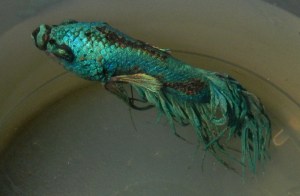
A microscopic walk through – Velvet disease in a Siamese fighting fish.

Did you know that the fish parasite that causes a condition called velvet disease, Oodinium, is actually an algae? This is the reason that the treatment of choice is a copper-based medication, and that keeping the aquarium lights off are some of the best methods for control? Re-infection is common since they are able to colonise the gut, so make sure that you treat continuously for at least 10 days.

Check out the most recent video I’ve uploaded – http://youtu.be/nksJqTOQMbk

You can read more about it by getting Dr Loh’s book, “Fish Vetting Essentials“.

Siamese fighting fish with velvet disease.

What causes the salmon to stress during summer?

This is a question asked of me by a colleague recently. What happens when the water temperature rises? Is it due to reduced dissolved oxygen levels or anoxia (link to article)? Is it due to impaired cardiovascular function (link to article)? Is it due to the increased presence of dangers such as jellyfish or algae? Is it immunosuppressive? Maybe reovirus might be playing a role?

When working at the labs in Tasmania as a veterinary fish pathologist, I did see quite a number of fish hearts which we described as having a “mural reaction” on microscopic examination. In simpler terms, there was a fuzziness to the look of the heart, indicating inflammation. Since such findings are not specific to any particular disease, there was also testing to look for the presence or absence of various pathogens, bacterial or viral. A thorough study would be indicated to correlate these findings with the water temperature and presence of pathogens.

Have a read of the articles below and see if it adds to more information.


Journal of Fish Diseases
Volume 36, Number 5 (May 2013)
Piscine reovirus (PRV) in wild Atlantic salmon,Salmo salarL., and sea-trout, Salmo truttaL., in Norway
Authors: Å. H. Garseth, C. Fritsvold, M. Opheim, E. Skjerve, E. Biering
Author Affiliations:
no affiliations available
Source: Journal of Fish Diseases, Volume 36, Number 5 (May 2013)
Page Numbers: 483 – 493
Available Full Text:
Full Text: Subscription Required to view full text
Format: PDF
Size: unknown
Location: Publisher’s Site
Authentication: EBSCOhost EJS
Abstract: This is the first comprehensive study on the occurrence and distribution of piscine reovirus (PRV) in Atlantic salmon, Salmo salarL., caught in Norwegian rivers. PRV is a newly discovered reovirus associated with heart and skeletal muscle inflammation (HSMI), a serious and commercially important disease affecting farmed Atlantic salmon in Norway. A cross-sectional survey based on real-time RT-PCRscreening of head kidney samples from wild, cultivated and escaped farmed Atlantic salmon caught from 2007 to 2009 in Norwegian rivers has been conducted. In addition, anadromous trout (sea-trout), Salmo truttaL., caught from 2007 to 2010, and anadromous Arctic char, Salvelinus alpinus(L.), caught from 2007 to 2009, were tested. PRVwas detected in Atlantic salmon from all counties included in the study and in 31 of 36 examined rivers. PRVwas also detected in sea-trout but not in anadromous Arctic char. In this study, the mean proportion of PRVpositives was 13.4% in wild Atlantic salmon, 24.0% in salmon released for stock enhancement purposes and 55.2% in escaped farmed salmon. Histopathological examination of hearts from 21 PRV-positive wild and one cultivated salmon (Ct values ranging from 17.0 to 39.8) revealed no HSMI-related lesions. Thus, it seems that PRVis widespread in Atlantic salmon returning to Norwegian rivers, and that the virus can be present in high titres without causing lesions traditionally associated with HSMI.
Citation: Å. H. Garseth, C. Fritsvold, M. Opheim, E. Skjerve, E. Biering . Piscine reovirus (PRV) in wild Atlantic salmon,Salmo salarL., and sea-trout, Salmo truttaL., in Norway. Journal of Fish Diseases, Volume 36, Number 5 (May 2013), pp. 483-493, <http://ejournals.ebsco.com/direct.asp?ArticleID=4F948FD160688861678E&gt;
URL: http://ejournals.ebsco.com/direct.asp?ArticleID=4F948FD160688861678E

National recognition of veterinary registration in NSW.

I’ve fallen slightly behind the times, but when the NSW Dept of Primary Industries called me recently to ask me to be their consultant fish veterinarian, I had to do some calling around to get veterinary registration in that state.

Then I found that if I was already registered in another Australian state, I didn’t have to get a secondary registration!

The NSW Veterinary Practice Act 2003 has been amended to accommodate National Recognition of Veterinary Registration (NRVR) as of 20 September 2011.

from: http://www.ava.com.au/newsarticle/national-recognition-veterinary-registration-nsw

Sweet!

Now I’m not only confined to working in WA, Victoria and Tasmania (see link to previous post), but I’m also now allowed to practice in NSW!

So, if you need to book me in for a site visit, there’ll be no delays in getting me out there to see your fish facility.

Follow me on: Facebook "Fin Page"YouTubeBlogLinkedinTwitter


Yours sincerely,

Dr Richmond Loh DipProjMgt, BSc, BVMS, MPhil (Pathology) Murdoch, MANZCVS (Aquatics & Pathobiology).
Veterinarian | Adjunct Lecturer Murdoch University | WAVMA President-Elect |
Secretary Aquatic Animal Health Chapter – Australian and New Zealand College of Veterinary Scientists (ANZCVS).
The Fish Vet, Perth, Western Australia, AUSTRALIA. Mobile Veterinary Medical & Diagnostic Services for fish and other aquatic creatures.
http://www.thefishvet.com.au
Ph: +61 (0)421 822 383
Looking for more books? Check out this site.

Advanced Fish/Shrimp Courses in Sustainable Aquaculture.

From: The University of St Andrews and TheFishSite.com
Date: 11 April 2013 21:34:39 AWST
To:
Subject: Advanced Fish/Shrimp Courses in Sustainable Aquaculture
Reply-To: The University of St Andrews and TheFishSite.com

NEW ADVANCED COURSES START 28th MAY 2013

Our TWO NEW on-line Postgraduate Certificates in Sustainable Aquaculture will start the last week in May 2013.

Enquire/Apply Now!

If you are interested in gaining an advanced qualification in either sustainable SHRIMP (invertebrates) or FISH (vertebrates) production from the University of St Andrews, now is the time to enquire/apply.

The award of Postgraduate Certificate in Sustainable Aquaculture requires 60 credits gained from taught modules over a one year period. There are two courses available, one focusing on vertebrates (fish) and the second on invertebrates (shellfish, molluscs etc.).

Benefits of e-Learning

There are many advantages to online learning. Here are a few to consider:

Convenience and Flexibility
Your learning can be organised to meet your schedule
There is no need to physically attend college
Learning is delivered at a pace to suit you
No time restrictions – courses are available 24/7
No physical restrictions – study at home, work, or on the road
For more details on both courses visit the Course Details page.

If you would like to discuss any aspect of the course please feel free to contact the course director:

Dr Neil Hazon
Scottish Oceans Research Institute
University of St Andrews.
Telephone: + 44 1334 463451
e-mail: nh1@st-andrews.ac.uk

Scientists to probe dolphin deaths | The Australian

http://m.theaustralian.com.au/news/nation/scientists-to-probe-dolphin-deaths/story-e6frg6nf-1226622996185


Yours sincerely,

Dr Richmond Loh
DipProjMgt, BSc, BVMS, MPhil (Pathology) Murdoch, MANZCVS (Aquatics& Pathobiology).
The Fish Vet, Perth, Western Australia.
Veterinary Medicine for fish.
W: http://www.thefishvet.com.au
E: thefishvet
P: +61 (0)421 822 383

Koi herpesvirus. Once it’s here, it’s here for eternity.

Do we really want to introduce it to Australia (see link to a previous post)?

Once released, you can never take it back.

The latest research on the epidemiology of KHV below, shows this is what could happen.


Journal of Fish Diseases
Volume 36, Number 5 (May 2013)
Do wild fish species contribute to the transmission of koi herpesvirus to carp in hatchery ponds?
Authors: M Fabian, A Baumer, D Steinhagen
Author Affiliations:
no affiliations available
Source: Journal of Fish Diseases, Volume 36, Number 5 (May 2013)
Page Numbers: 505 – 514
Available Full Text:
Full Text: Subscription Required to view full text
Format: PDF
Size: unknown
Location: Publisher’s Site
Authentication: EBSCOhost EJS
Abstract: The koi herpesvirus (KHV) has spread worldwide since its discovery in 1998 and causes disease and mortality in koi and common carp populations with a high impact on the carp production industry. Many investigations have been conducted to examine ways of distribution and to identify possible transmission vectors. The answers, however, raise many new questions. In the present study, different wild fish species taken from carp ponds with a history of KHVinfection were examined for their susceptibility to the virus. In the tissue of these fish, the virus load was determined and it was tested whether a release of the virus could be induced by stress and the virus then could be transferred to naive carp. Wild fish were gathered from carp ponds during acute outbreaks of virus-induced mortality in summer and from ponds stocked with carp carrying a latent KHVinfection. From these ponds, wild fish were collected during the harvesting process in autumn or spring when the ponds were drained. We found that regardless of season, temperature variation, age and infection status of the carp stock, wild fish from carp ponds and its outlets could be tested positive for the KHVgenome using real-time PCRwith a low prevalence and virus load. Furthermore, virus transfer to naive carp was observed after a period of cohabitation. Cyprinid and non-cyprinid wild fish can therefore be considered as an epidemiological risk for pond carp farms.
Citation: M Fabian, A Baumer, D Steinhagen . Do wild fish species contribute to the transmission of koi herpesvirus to carp in hatchery ponds?. Journal of Fish Diseases, Volume 36, Number 5 (May 2013), pp. 505-514, <http://ejournals.ebsco.com/direct.asp?ArticleID=488DAFFC68095DEB75FE&gt;
URL: http://ejournals.ebsco.com/direct.asp?ArticleID=488DAFFC68095DEB75FE

Did you know that there are going to be several cool aquariums being installed at Coventry Village?

Hot off the press! Coventry Village in Morley is installing 2 x 9000 litre units and 5 x 2700 litre units. This is an opportunity unlike any that has been seen for freshwater fish keeping in this state (if not Australia). How cool!

http://www.coventryvillage.com.au/contact-us/
Open until 7pm everyday (9pm Thursday’s)

Morley Aquariums have been tasked to set these up over the next fortnight and the displays will include 1 koi tank, 1 stingray/tank buster tank, 3 cichlid tanks, 1 red parrot cichlid tank & 1 rainbowfish tank.

Congratulations to Morley Aquariums for scoring the gig. I’m sure they’ll be in good hands!

Follow me on: Facebook "Fin Page"YouTubeBlogLinkedinTwitter


Yours sincerely,

Dr Richmond Loh DipProjMgt, BSc, BVMS, MPhil (Pathology) Murdoch, MANZCVS (Aquatics & Pathobiology).
Veterinarian | Adjunct Lecturer Murdoch University | WAVMA President-Elect |
Secretary Aquatic Animal Health Chapter – Australian and New Zealand College of Veterinary Scientists (ANZCVS).
The Fish Vet, Perth, Western Australia, AUSTRALIA. Mobile Veterinary Medical & Diagnostic Services for fish and other aquatic creatures.
http://www.thefishvet.com.au
Ph: +61 (0)421 822 383
Looking for more books? Check out this site.

20130420-223719.jpg

Which church did you get the fellowship from?

This is the question asked by one of my clients recently. It’s not a ‘church fellowship", so I thought the question was rather funny. And then, when explaining it to a classmate of mine, they asked if I had to sit exams similar to that I sat for my ‘Memberships’. Then it started me thinking that this fellowship business is not plainly understood. I did not have to sit exams for this. Then I looked up the definition of ‘fellowship’ online (http://www.thefreedictionary.com/fellowship) and came up with a whole heap of other meanings –

fellowship [ˈfɛləʊˌʃɪp] n1. the state of sharing mutual interests, experiences, activities, etc.
2. a society of people sharing mutual interests, experiences, activities, etc.; club
3. companionship; friendship
4. the state or relationship of being a fellow
5. (Christianity / Ecclesiastical Terms) a. mutual trust and charitableness between Christians
b. a Church or religious association

6. (Social Science / Education) Education a. a financed research post providing study facilities, privileges, etc., often in return for teaching services
b. a foundation endowed to support a postgraduate research student
c. an honorary title carrying certain privileges awarded to a postgraduate student

7. (Social Science / Education) (often capital) the body of fellows in a college, university, etc.

This Fellowship I received is definition #6a. I had to fill out an application form and attend a very rigorous interview process. So, it’s like a Scholarship where you go on a fact-finding trip, but with a Fellowship, you have a duty to disseminate the knowledge you have gained with your peers.

Thus, it is my intention to gather a list of relevant contacts so that I can disseminate the information upon my return as part of my Fellowship. I would like to start collating any questions you may have for me to ask the experts, so that the information I’ll be disseminating will be relevant to you. I’ve started a Google Document that you may add your questions to, under the respective headings. Questions can relate to finfish, sharks, rays, pinnipeds, cetaceans, manatees, turtles and penguins.

The virtual file will be called “Seavet 2013 Questions from ISSI Distribution List” and you can access it by clicking on this link.

Note that this file will be available to anyone with the link, so be careful not delete anyone else’s questions. Thank you for your interest and support.

Follow me on: Facebook "Fin Page"YouTubeBlogLinkedinTwitter


Yours sincerely,

Dr Richmond Loh DipProjMgt, BSc, BVMS, MPhil (Pathology) Murdoch, MANZCVS (Aquatics & Pathobiology).
Veterinarian | Adjunct Lecturer Murdoch University | WAVMA President-Elect |
Secretary Aquatic Animal Health Chapter – Australian and New Zealand College of Veterinary Scientists (ANZCVS).
The Fish Vet, Perth, Western Australia, AUSTRALIA. Mobile Veterinary Medical & Diagnostic Services for fish and other aquatic creatures.
http://www.thefishvet.com.au
Ph: +61 (0)421 822 383

Hagfish slime – the next big thing in fashion.

Could the silk produced from hagfish slime be turned into tights or breathable athletic wear, or even bullet-proof vests. How about lingerie and wedding dresses? The possibilities are endle

Read more here:
http://m.bbc.co.uk/news/magazine-21954779