Imported ornamental fish are colonised with antibiotic-resistant bacteria!

This is not a surprise, given that many ornamental fish exporters routinely use prophylactic medicines prior to shipping out fishes. Tetracycline and triple sulfa are the most commonly used antibiotics because they’re relatively cheap and easily accessible. The frequency and quantities used are high and it is expected that bacteria will most likely become resistant to these drugs. Thus, when I see fish with bacterial infections, these are the drugs I would stay far away from if I want to have success in treating them.


Journal of Fish Diseases
  Volume 36, Number 6 (June 2013)
     Imported ornamental fish are colonized with antibiotic-resistant bacteria
   Authors: S Rose, R Hill, L E Bermudez, T Miller-Morgan
   Author Affiliations:
no affiliations available
   Source: Journal of Fish Diseases, Volume 36, Number 6 (June 2013)
   Page Numbers: 533 – 542
   Available Full Text:
Full Text: Subscription Required to view full text
Format: PDF
Size: unknown
Location: Publisher’s Site
Authentication: EBSCOhost EJS
   Abstract: There has been growing concern about the overuse of antibiotics in the ornamental fish industry and its possible effect on the increasing drug resistance in both commensal and pathogenic organisms in these fish. The aim of this study was to carry out an assessment of the diversity of bacteria, including pathogens, in ornamental fish species imported into North America and to assess their antibiotic resistance. Kidney samples were collected from 32 freshwater ornamental fish of various species, which arrived to an importing facility in Portland, Oregon from Colombia, Singapore and Florida. Sixty-four unique bacterial colonies were isolated and identified by PCRusing bacterial 16Sprimers and DNAsequencing. Multiple isolates were identified as bacteria with potential to cause disease in both fish and humans. The antibiotic resistance profile of each isolate was performed for nine different antibiotics. Among them, cefotaxime (16% resistance among isolates) was the antibiotic associated with more activity, while the least active was tetracycline (77% resistant). Knowing information about the diversity of bacteria in imported ornamental fish, as well as the resistance profiles for the bacteria will be useful in more effectively treating clinical infected fish, and also potential zoonoses in the future.
   Citation: S Rose, R Hill, L E Bermudez, T Miller-Morgan . Imported ornamental fish are colonized with antibiotic-resistant bacteria. Journal of Fish Diseases, Volume 36, Number 6 (June 2013), pp. 533-542, <http://ejournals.ebsco.com/direct.asp?ArticleID=4DD981915AC7F935019A&gt;
   URL: http://ejournals.ebsco.com/direct.asp?ArticleID=4DD981915AC7F935019A

The science behind using alfaxalone as a sedative and anaesthetic in goldfish.

It’s great that clinical veterinarians are able to get into fish medicine with what they already stock in their pharmacy. Alfaxalone is a commonly used drug for cats and dogs and it can also be used to sedate or anaesthetise fish!


Aquaculture
  Volume 399, Number 2 (June 2013)
     Evaluation of the sedative and anaesthetic effects of five different concentrations of alfaxalone in goldfish, Carassius auratus
   Authors: S.H. Bauquier, J. Greenwood, T. Whittem
   Author Affiliations:
no affiliations available
   Source: Aquaculture, Volume 399, Number 2 (June 2013)
   Page Numbers: 119 – 123
   Available Full Text:
Full Text: Subscription Required to view full text
Format: PDF
Size: Unknown
Location: Publisher’s Site
Authentication: Publisher’s Site
   Abstract: Anecdotal publications describe induction of anaesthesia in fish with alfaxalone. This study’s objective was to determine the water concentrations of alfaxalone required to sedate and anaesthetise goldfish. The study was conducted as an unmasked, parallel design, randomised trial with five groups each of six healthy goldfish, Carassius auratus.Fish with a mean length (±SD) of 8.5 (±2.5) cm were immersed in individual water tank with controlled temperature (23–25°C), pH (6.8–7.2) and osmolality (38–45mOsm/L), at concentrations of 0.15, 0.5, 2.0, 5.0 and 7.5mg alfaxalone per litre, complexed with hydroxypropyl-beta cyclodextrin. Monitoring of fish included body approach reaction, maintenance of equilibrium, operculum movement and response to noxious stimuli. Depth of anaesthesia was determined using a modified published scale. A concentration of 0.15mg alfaxalone/L water was insufficient to induce sedation or anaesthesia. Mean sedation induction time±SD (range) after immersion at concentrations of 0.5 and 2.0mg alfaxalone/L were 37±7 (34–50) min and 7±1 (5–8) min respectively. Anaesthesia was not achieved at those concentrations. After immersion in water containing 5.0 and 7.5mg alfaxalone/L mean sedation induction times were 4±2 (2–6) min and 2±1 (1–2) min respectively, mean anaesthesia induction times were 28±8 (16–35) min and 14±2 (12–18) min respectively and mean full recovery times were 32±18 (20–67) min and 36±13 (23–53) min respectively. No adverse events were seen. The lowest water concentrations of alfaxalone identified to induce sedation and anaesthesia in goldfish (C. auratus) were 0.5mg/L and 5mg/L respectively.
   Citation: S.H. Bauquier, J. Greenwood, T. Whittem . Evaluation of the sedative and anaesthetic effects of five different concentrations of alfaxalone in goldfish, Carassius auratus. Aquaculture, Volume 399, Number 2 (June 2013), pp. 119-123, <http://ejournals.ebsco.com/direct.asp?ArticleID=4D8682E08F9AEDDE8B0B&gt;
   URL: http://ejournals.ebsco.com/direct.asp?ArticleID=4D8682E08F9AEDDE8B0B

Are your fish coming down with ulcers?

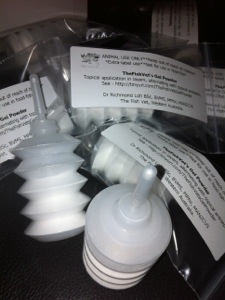
You may like to use topical medications for a cure. But these medicines such as betadine and mercurochrome wash off as soon as the fish is put back in the water? This would mean that there is no residual activity to protect the fish from bacterial re-infection. Is there a way of making the drugs ‘stick’ to the wound?

Yes there is. New stock of Gel Powder have arrived just in time. This powder, when applied to the wound will adhere firmly to the fish’s slippery skin, as well as absorbing the topical antiseptic. This forms a barrier that lasts more than just a few seconds in the water.

See a video on how it works by clicking here.

Place your order now.

20130509-173148.jpg

What’s The Fish Vet doing in Hawaii?

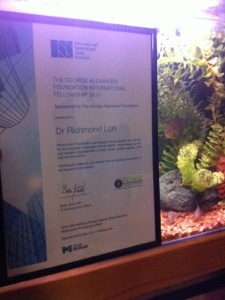
As part of the George Alexander International Fellowship Grant I was awarded, I’m planning on visiting these venues and colleagues. I’ve hired a car and have plugged in all the addresses in my GPS. Driving to my accommodation, I found that turning left is the most challenging when driving on the opposite side of the road!

20130518-213955.jpg

Corpse that looks like mysterious ‘sea monster’ discovered on Pukehina Beach, New Zealand.

STUNNED beachgoers in New Zealand stumbled over what looks like the carcass of a mysterious marine animal.

Read more at this link.

The Fish Vet’s off on a fact finding mission.

Just a few more minutes before my flight takes off to Hawaii!

As you know, I have been awarded The George Alexander Foundation International Fellowship, officiated by the International Specialised Skills Institute (http://www.issinstitute.org.au/). With that, I’ve registered to attend the Seavet course (http://conference.ifas.ufl.edu/ame/seavet/) during June 2013 in Florida, USA. The 2-week course will cover veterinary aspects of marine megafauna such as sharks, stingrays, fish, pinnipeds, cetaceans, manatees, turtles and penguins.

I will also be visiting Hawaii Dept Agriculture, the University of Hawaii at Hilo and The University of Florida’s Tropical Aquaculture Laboratory in Ruskin, FL, USA.

It is my intention that I gather a list of relevant contacts so that I can disseminate the information upon my return as part of my Fellowship.

I am collating questions from stakeholders for me to ask the experts, so that the information I’ll be disseminating when I return will be relevant to you. I’ve started a Google Document that you may add your questions to, under the respective headings.
The virtual file will be called “Seavet 2013 Questions from ISSI Distribution List” and here is the link.

Note that this file will be available to anyone with the link. So, be careful not delete anyone else’s questions. I’ll be in touch upon my return. Thank you for your interest and support.

Yours sincerely,

Dr Richmond Loh
DipProjMgt, BSc, BVMS, MPhil (Vet Path), MANZCVS (Aquatics), MANZCVS (Pathobiology).
Veterinarian | Adjunct Senior Lecturer Murdoch University | President-elect World Aquatic Vet Med Assoc|
Secretary Aquatic Animal Health Chapter – Australian and New Zealand College of Veterinary Scientists (ANZCVS)
The Fish Vet, Perth, Western Australia, AUSTRALIA. Mobile Veterinary Service for fish and other aquatic creatures.
http://www.thefishvet.com.au
Ph: +61 (0)421 822 383

20130518-105704.jpg

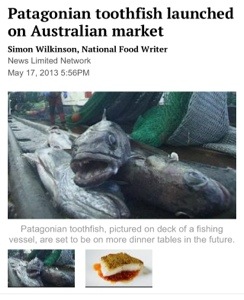
Australia’s most dangerous catch, is ethically sound & delicious!

Its flavour and texture definitely does not match the look of the fish… unless you like eating monster.

I’m so glad it’s reporting that they’ve gained the Marine Stewardship Council certification for sustainability because the Patagonian toothed fish is my favourite fish to eat.

Read more…

20130518-064529.jpg

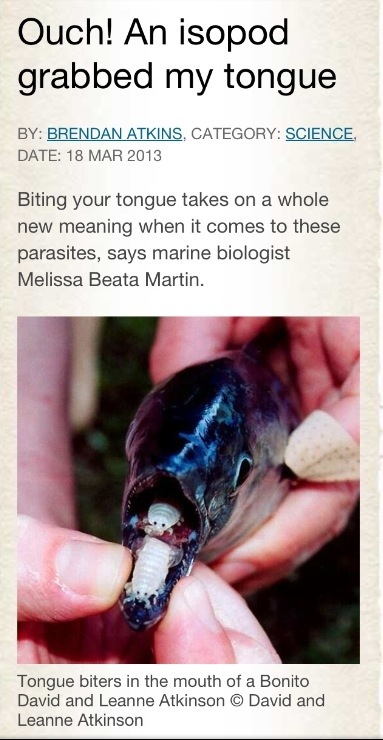
What’s this alien in the fish’s mouth?

Ever landed a fish and found this critter attached to the tongue of your fish? It’s common name is ‘tongue biter’!

20130509-222258.jpg

Tongue biters are isopods (a type of crustacean) belonging to the family Cymothoidae.

Read more here.

Dynamite fishing, destructive.

Interesting documentary on dynamite fishing. See below.

Begin forwarded message:

From: ESAIA e.V.
Date: 16 May 2013 17:50:55 AWST
To: vorstand@esaia.net
Subject: new video: fishing with dynamite

Although dynamite fishing is no applied method in aquarium fisheries in the Philippines, nor elsewhere, we have chosen to include this documentary in our exhibition on Marine Aquarium Fishery and Trade in South East Asia.

Why?

This video unveils the reasoning of poor fishermen in Asia to use destructive fishing methods: They are cheap, they are effective and they provide a relatively high yield at low effort. Forced by the low prices paid for their product and lack of negotiating power, these fishermen will just try to make the most out of nothing.

This is not only true for dynamite fishing, but for cyanide use as well. It confirms the conclusion that any change in respect to environmental awareness and an attitude towards conservation will only develop when fishermen benefit from social justice and development in the same time.

Therefore we invite you to watch this video and apply what you take from it to the aquarium fishery in South East Asia too.

Click here: http://www.youtube.com/watch?v=3j5RXX_Tg-c

SAIA / ESAIA e.V.

Christiane Schmidt
Project Coordinator

Email: fishfood@gmx.net
PH: +49 163 96 55 434
Skype: csonair

http://www.saia-online.eu