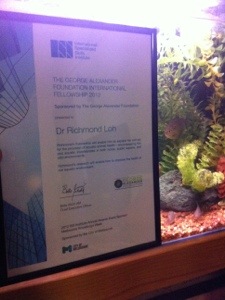
As part of the George Alexander International Fellowship Grant I was awarded, I’m planning on visiting these venues and colleagues. I’ve hired a car and have plugged in all the addresses in my GPS. Driving to my accommodation, I found that turning left is the most challenging when driving on the opposite side of the road!
Fish joke for Monday-itis: Hare and tortoise.
Corpse that looks like mysterious ‘sea monster’ discovered on Pukehina Beach, New Zealand.
STUNNED beachgoers in New Zealand stumbled over what looks like the carcass of a mysterious marine animal.
The Fish Vet’s off on a fact finding mission.
Just a few more minutes before my flight takes off to Hawaii!
As you know, I have been awarded The George Alexander Foundation International Fellowship, officiated by the International Specialised Skills Institute (http://www.issinstitute.org.au/). With that, I’ve registered to attend the Seavet course (http://conference.ifas.ufl.edu/ame/seavet/) during June 2013 in Florida, USA. The 2-week course will cover veterinary aspects of marine megafauna such as sharks, stingrays, fish, pinnipeds, cetaceans, manatees, turtles and penguins.
I will also be visiting Hawaii Dept Agriculture, the University of Hawaii at Hilo and The University of Florida’s Tropical Aquaculture Laboratory in Ruskin, FL, USA.
It is my intention that I gather a list of relevant contacts so that I can disseminate the information upon my return as part of my Fellowship.
I am collating questions from stakeholders for me to ask the experts, so that the information I’ll be disseminating when I return will be relevant to you. I’ve started a Google Document that you may add your questions to, under the respective headings.
The virtual file will be called “Seavet 2013 Questions from ISSI Distribution List” and here is the link.
Note that this file will be available to anyone with the link. So, be careful not delete anyone else’s questions. I’ll be in touch upon my return. Thank you for your interest and support.
Yours sincerely,
Dr Richmond Loh
DipProjMgt, BSc, BVMS, MPhil (Vet Path), MANZCVS (Aquatics), MANZCVS (Pathobiology).
Veterinarian | Adjunct Senior Lecturer Murdoch University | President-elect World Aquatic Vet Med Assoc|
Secretary Aquatic Animal Health Chapter – Australian and New Zealand College of Veterinary Scientists (ANZCVS)
The Fish Vet, Perth, Western Australia, AUSTRALIA. Mobile Veterinary Service for fish and other aquatic creatures.
http://www.thefishvet.com.au
Ph: +61 (0)421 822 383
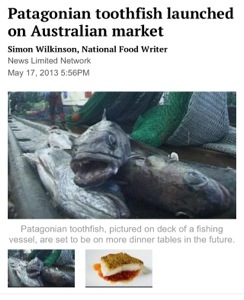
Australia’s most dangerous catch, is ethically sound & delicious!
Its flavour and texture definitely does not match the look of the fish… unless you like eating monster.
I’m so glad it’s reporting that they’ve gained the Marine Stewardship Council certification for sustainability because the Patagonian toothed fish is my favourite fish to eat.
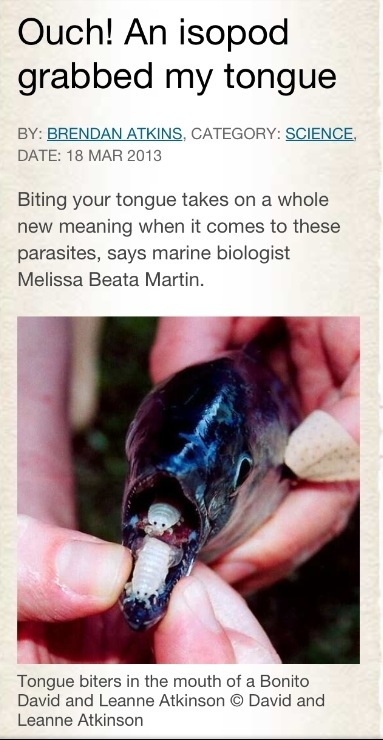
What’s this alien in the fish’s mouth?
Ever landed a fish and found this critter attached to the tongue of your fish? It’s common name is ‘tongue biter’!
Tongue biters are isopods (a type of crustacean) belonging to the family Cymothoidae.
Dynamite fishing, destructive.
Interesting documentary on dynamite fishing. See below.
Begin forwarded message:
From: ESAIA e.V.
Date: 16 May 2013 17:50:55 AWST
To: vorstand@esaia.net
Subject: new video: fishing with dynamite
Although dynamite fishing is no applied method in aquarium fisheries in the Philippines, nor elsewhere, we have chosen to include this documentary in our exhibition on Marine Aquarium Fishery and Trade in South East Asia.
Why?
This video unveils the reasoning of poor fishermen in Asia to use destructive fishing methods: They are cheap, they are effective and they provide a relatively high yield at low effort. Forced by the low prices paid for their product and lack of negotiating power, these fishermen will just try to make the most out of nothing.
This is not only true for dynamite fishing, but for cyanide use as well. It confirms the conclusion that any change in respect to environmental awareness and an attitude towards conservation will only develop when fishermen benefit from social justice and development in the same time.
Therefore we invite you to watch this video and apply what you take from it to the aquarium fishery in South East Asia too.
Click here: http://www.youtube.com/watch?v=3j5RXX_Tg-c
SAIA / ESAIA e.V.
Christiane Schmidt
Project Coordinator
Email: fishfood@gmx.net
PH: +49 163 96 55 434
Skype: csonair
Vaccine for Aeromonas hydrophila.
This was brought to my attention by Miriam – Thank you!
I hope that this technology could trickle down to be used in the ornamental fish industry…
Vaccination strategies to protect goldfish Carassius auratus against Aeromonas hydrophila infection
V. Thanga Viji, K. Deepa, S. Velmurugan, M. Birdilla Selva Donio, J. Adlin Jenifer, M. Michael Babu, T. Citarasu*
ABSTRACT: Ornamental goldfish Carassius auratus were treated with whole cell (WC), extracellular product (ECP), outer membrane protein (OMP) and biofilm (BF) vaccines developed from the virulent Aeromonas hydrophila (AHV1; GenBank HQ331525.1) with and without the immunoadjuvant Asparagus racemosus. On various days post-vaccination (dpv), the treated fish were challenged with virulent A. hydrophila. These fish were monitored for survival, growth, specific bacterial reduction, and biochemical, haematological and immunological parameters. C. auratus attained 100% mortality within 7 d in non-vaccinated groups, whereas the vaccines helped to significantly (p ≤ 0.001) increase survival after 25 and 50 dpv. The vaccines with immunoadjuvant (ECP2, OMP2 and BF2 treatments) helped to reduce the Aeromonas load after the challenge, and serum albumin, globulin and protein levels were significantly (p < 0.01) improved in the OMP2– and BF2-treated groups. Haemoglobin and red blood cell counts were also significantly improved (p < 0.05) in the vaccinated groups compared to the control group. Additionally, haemagglutination occurred at the 1:12 dilution level in the vaccine plus immunoadjuvant-treated groups. Supplementing the vaccines with immunoadjuvant helped to improve phagocytosis to 54.07%, serum bactericidal activity to 14.6% and the albumin:globulin ratio to 7.6% in BF2 after 50 dpv. Its positive effect significantly (p < 0.05) increased in vaccinated groups compared to controls. Based on the results, especially with the OMP and BF vaccines, the immunoadjuvant A. racemosus helped to improve the efficiency of the vaccines. This approach will aid in the development of more efficient vaccines against bacterial infections affecting the aquaculture industry.
KEY WORDS: Ornamental fish · Biofilm · Outer membrane protein · OMP · Herbal immunoadjuvants
Abstract source: http://www.int-res.com/abstracts/dao/v104/n1/p45-57/
Thanga Viji V, Deepa K, Velmurugan S, Donio MBS, Adlin Jenifer J, Babu MM, Citarasu T (2013) Vaccination strategies to protect goldfishCarassius auratus against Aeromonas hydrophila infection. Diseases of Aquatic Organisms 104:45-57

Looking for Fish Vetting paraphernalia?
Check out the most current suite of items available on TheFishVet’s Fanpage’s Shop – (http://tinyurl.com/thefishvetshop).
If it’s not there, drop Dr Loh a line (thefishvet@gmail.com) and he’ll be able to source it for you.
Fish joke for Monday-itis: Girl name.
Q. What name do you give a girl who likes to catch fish?
A. Annette.