Current & New Approaches for Animal Drugs in Feeds: On-line presentations available to view.

This will be useful.

 
———- Forwarded message ———-
From: Dr. David Scarfe <DScarfe@avma.org>
Date: Thu, Jun 6, 2013 at 8:58 PM

Regulations involving how drugs are delivered through medicated feed in the US are undergoing major advances. To convey the information to the widest audience available, the presentations of a 2-day New Animal Drugs for Use in Feeds Workshop (which was on May 22-13, 2013) have now been made available on-line.


Intended to cover the approval process for medicated animal feeds, government agencies involved, on how medicated feeds should be used, different types of medicated feeds, labels and how medicated feeds should be used, changes in veterinary feed directives, judicious use and changes of over-the-counter (OTC) availability of antimicrobial drugs, and a number of other important issues are outlined in the following presentations.


• Medicated Feed Workshop Introduction, Logistics – Bernadette Dunham, FDA-CVM

• Introducing the Center for Veterinary Medicine: Organization and Structure – Sanja Modric, FDA-CVM

• New Animal Drugs for Use in Animal Feeds: Types and Categories – Dragan Momcilovic, FDA-CVM

• Development and Approval of Labeling for Medicated Feeds – Suzanne Sechen, FDA-CVM

• Where to Find Approved Labeling for Medicated Feed – Dragan Momcilovic and Suzanne Sechen, FDA-CVM

• Proposed Changes: Veterinary Feed Directive – Jo Gulley and Sharon Benz, FDA-CVM

• Antimicrobial Drugs in Animal Feeds: Update on FDA’s Judicious Use Strategy – Craig Lewis, FDA-CVM

• Understanding ADAA Combinations – Dan Benz, FDA-CVM

• Generic Approval Process and Biowaiver Requirements – Charli Long, FDA-CVM

• Biomass Drug Substances – Amy Simms, FDA-CVM

• Type A Medicated Articles and CMC Issues – James Nitao, FDA-CVM

• CMC Data to Support Medicated Feeds – Heather Longstaff, FDA-CVM

• Medicated Feed Assay Methods and Limits: Regulatory Perspective – Asif Rasheed, FDA-CVM

• CMC Question & Answer

• What Do Feed Mill Inspections Have to Do with Drug Approvals? – Shannon Jordre, FDA-CVM

• Interactions with CVM – Cory Herr, Elanco, Keith Baker and Paul Duquette

• Round Table Discussion

• Wrap Up and Next Steps


To view one or more of these presentations go to http://tinyurl.com/lsofm7b.

___________________________

AquaVetMed e-News provides information to veterinary and veterinary-allied subscribers concerning aquatic animal medicine, health, welfare, public health and seafood safety, obtained from a variety of sources (largely AquaVetMed subscribers). While provided by the American Veterinary Medical Association’s, Aquatic Veterinary Medicine Committee and are for public distribution, they do not necessarily reflect the opinion of the AVMA or the veterinary profession. See the AVMA Terms of Use (http://tinyurl.com/29h2rf) for further information.


If e-News information is used elsewhere please acknowledge AquaVetMed as the source. Encourage individuals to subscribe rather than distribute through list serves.


Messages may contain attachments that will have been scanned for known viruses.


Subscription and Contributions: Interested veterinarians and veterinary-allied professionals can subscribe, unsubscribe, or contribute pertinent news or information, by sending a message with “For AquaVetMed -” and the topic in the subject line, to dscarfe@avma.org.


Note: Undelivered e-mails will not be resent; Subscribers will be deleted from the list after repeated undelivered or bounced messages and will have to re-subscribe.


Visit our website: www.avma.org


________________________________


Can it really rain fish and frogs?

Tornadoes, when they occur over water and with sufficient velocity, can create a ‘water spout’. This vortex can suck up water and the organisms within the water, carry it up to 100 miles. When the winds for down, the water and fish it carried will then drop from the sky!

I saw this on The Weather Channel.

20130603-010522.jpg

The truth about Animal Planet’s show on Mermaids.

Dr Starling from Aqueterinary Services from the US shared with me this video.

Link to CNN video.

But having visited Disney’s Hollywood, Magic Kingdom and EPCOT recently, there’s something to be said about having an imagination. I still like to hope that there could be such a thing as a mermaid. What about you?

Tricaine Pharmaq (formerly PHARMAQ MS 222) now marketing in the United Kingdom, Ireland, Norway, Iceland, The Faroe Islands, Spain and Italy.

This would have to be one of the safest, most reliable fish anaesthetic available. Hope it’ll become more freely available worldwide.

Begin forwarded message:

From: “Dr. David Scarfe”
Date: 29 May 2013 10:48:03 EDT
Subject: AquaVetMed e-News: Multi-country approval for fish anaesthetic, Tricaine Pharmaq

May 29, 2013
Marketing authorization for fish anaesthetic, Tricaine Pharmaq, in seven different countries

Press Release – In the past few months PHARMAQ has received national marketing authorisations for Tricaine Pharmaq for the United Kingdom, Ireland, Norway, Iceland, The Faroe Islands, Spain and Italy.

“Appropriate anaesthesia can provide benefits for a wide range of fish handling operations, helping to safeguard fish welfare and also improving operator safety during processes such as vaccination”, says Dr. Ben North, Managing Director of PHARMAQ Ltd.

Tricaine Pharmaq will replace the former product PHARMAQ MS 222, a compound well known to the industry and which held marketing authorisations in the UK and Ireland for many years. The formulation of the product remains the same (100% active tricaine methanesulphonate) and is available by prescription. Tricaine Pharmaq is readily soluble in water, making it safe and easy to use, with no requirement for solvents. Tricaine Pharmaq can benefit all sectors of the aquatic industry, from tranquilisation of ornamental fish during transport, through to full anaesthesia for surgical procedures, as well as anaesthesia of food fish at vaccination and egg collection from brood fish.

PHARMAQ UK will be the distribution centre for all of the different markets. Tricaine Pharmaq will be available in four different pack sizes from 25 g to 1000 g, all with separate national labels and inserts. “This is a great opportunity for PHARMAQ to introduce an established, safe and efficacious anaesthetic to support our customers in more of the markets where our fish vaccines are already being used”, added Dr. North

For further information, please contact:
Ben North Managing Director, PHARMAQ Ltd
Email ben.north@pharmaq.no
Tel: +44(0) 1425 651927
Mobile +44(0) 7900 195046

[For more information on this and other Pharmaq products, see http://www.pharmaq.no. ADS-Mod.]
___________________________
AquaVetMed e-News provides information to veterinary and veterinary-allied subscribers concerning aquatic animal medicine, health, welfare, public health and seafood safety, obtained from a variety of sources (largely AquaVetMed subscribers). While provided by the American Veterinary Medical Association’s, Aquatic Veterinary Medicine Committee and are for public distribution, they do not necessarily reflect the opinion of the AVMA or the veterinary profession. See the AVMA Terms of Use (http://tinyurl.com/29h2rf) for further information.

If e-News information is used elsewhere please acknowledge AquaVetMed as the source. Encourage individuals to subscribe rather than distribute through list serves.

Messages may contain attachments that will have been scanned for known viruses.

Subscription and Contributions: Interested veterinarians and veterinary-allied professionals can subscribe, unsubscribe, or contribute pertinent news or information, by sending a message with “For AquaVetMed -” and the topic in the subject line, to dscarfe@avma.org.

Note: Undelivered e-mails will not be resent; Subscribers will be deleted from the list after repeated undelivered or bounced messages and will have to re-subscribe.

Visit our website: http://www.avma.org

________________________________
Aquaponics Webinar: Paradigm Shift with Airlift.

From: Hawaii Aqua
Date: 29 May 2013 5:48:44 EDT
To: undisclosed-recipients:;
Subject: Fwd: June 30 webinar on airlift water pump

———- Forwarded message ———-
From: Ronald Weidenbach
Date: Tue, May 28, 2013 at 11:48 AM
Subject: HAAA Member News to Use: June 30 webinar on airlift water pump
To: Hawaii Aqua

Dear HAAA members,

The eXtension Freshwater Aquaculture Community of Practice (CoP) will
be presenting a webinar on aquaponics. Those that have a background in
aquaponics, please feel free to join the session and discussion.

The title of the webinar is:

Aquaponics: Paradigm Shift with Airlift

Presented by: Tetsuzan Benny Ron
May 30th, 2013 at 4PM Eastern/3PM Central

This will be a 1-hour presentation on aquaponics with a question and
answer session.

With thoughtful design, appropriate maintenance, and effective
management, airlift pumps may allow us to transfer water through an
aquaponics system in a more efficient way compared to that of water
pumps. Understanding the disadvantages and learning how easy it is to
construct an airlift pump can help many to reduce their energy
expenses while avoiding the risk and maintenance resulted from having
electrical pumps in the water.

To connect to the webinar, follow the link below:

https://connect.extension.iastate.edu/freshwater

For more information, please contact Vanessa Weldon at:vmaxwell24@gmail.com

https://learn.extension.org/events/1064

Check out pictures of Dr Loh’s adventures in the USA.

Will this inspire you to look after our aquatic environment even more?
https://www.facebook.com/thefishvetdrloh/photos_albums

Follow me on: Facebook "Fin Page"YouTubeBlogLinkedinTwitter


Yours sincerely,

Dr Richmond Loh DipProjMgt, BSc, BVMS, MPhil (Pathology) Murdoch, MANZCVS (Aquatics & Pathobiology).
Veterinarian | Adjunct Lecturer Murdoch University | President-elect WAVMA |
Secretary Aquatic Animal Health Chapter – ANZCVS.
The Fish Vet, Perth, Western Australia, AUSTRALIA. Mobile Veterinary Medical & Diagnostic Services for fish and other aquatic creatures.
http://www.thefishvet.com.au
Ph: +61 (0)421 822 383

Looking for more books? Check out this site.

Are you an aquariumaniac? Listen to Dr Roy Yanong’s podcasts on PetLifeRadio.

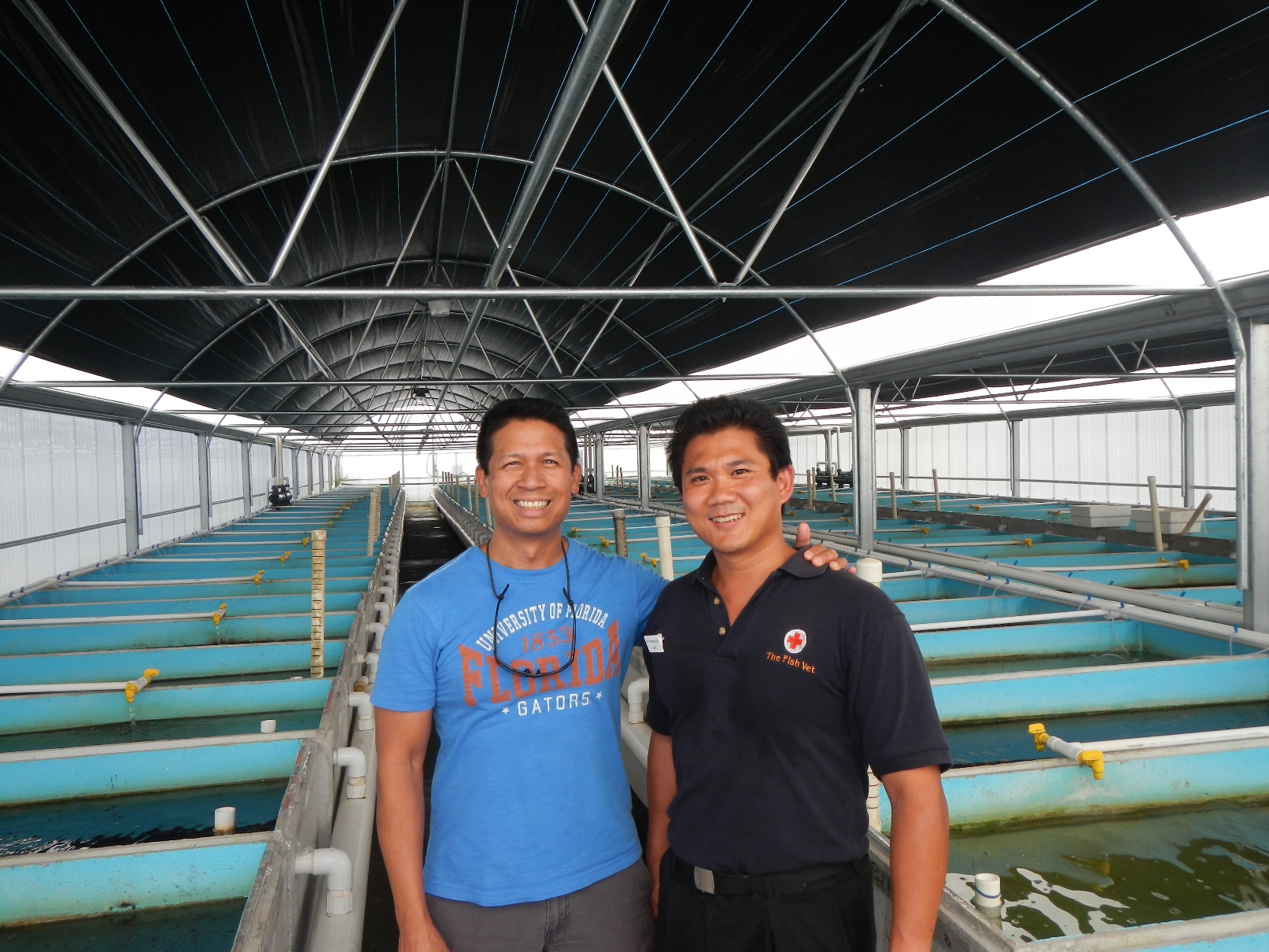
Last week, I was lucky enough to meet with Dr Roy Yanong (pictured with me below), a veterinarian working on the extension aspect of fish health through the University of Florida. We discussed veterinary issues facing the tropical freshwater and marine fish ornamental industries and also the need for protecting and where damaged, rehabilitating the aquatic environment. We also visited the largest freshwater ornamental fish farm in the US (5D) and a couple of others.

DrLoh and DrYanong
An arm of his extension work is to be an audio vet for PetLifeRadio. In these series of podcasts, you’ll learn all about aquarium fish and other aquatic animals, the aquarium industry, and the science and art that surround this fascinating hobby!
Check it out using the link below –


What conclusions were made at the recent Federation of Veterinarians of Europe’s, Fish Health & Welfare Conference?

They concluded that: “Caring for health and welfare of fish is a critical success factor for aquaculture”

Read more below.

Begin forwarded message:

From: “Dr. David Scarfe”
Date: 31 May 2013 7:05:38 EDT
Subject: AquaVetMed e-News: Outcomes of FVE Fish Health & Welfare Conference

May 31, 2013
FVE Seminar Conclusions: “Caring for health and welfare of fish: A critical success factor for aquaculture”

Brussels – Emphasized at this 16-17 May 2013 conference: “Fish, as other food producing animals, get sick, their welfare can be compromised and the food they produce has to be healthy. Veterinarians, through education and experience, have a holistic view on how health, welfare and the environment interlinks and therefore have a key role to play within aquaculture“ suggested FVE President Dr. Christophe Buhot at the conference the Federation of Veterinarians of Europe organized on aquaculture. “Vets care for people and animals, including fish. It is essential to ensure that sufficient veterinary expertise is available to the aquaculture sector.”

The event attracted more than 150 people from European Institutions, National Authorities, veterinarians, fish producers, scientists and many other stakeholders as well. This large number of participants underlined the enormous interest our society takes in aquaculture, which is a fast growing sector. The EU is not self-sufficient in fish products and requires imports from third countries. There is a significant potential in EU for increasing production in aquaculture, both in terms of capacity and exploitation of new species. This growth should be encouraged and supported at national and EU levels.

The large diversity of fish species being kept, each with their own specific needs, should be taken into consideration when regulating the sector. Close collaboration between the aquaculture industry and the veterinary profession should be ensured, in order to guarantee optimal health management of fish farms at all stages of production and to put in place sustainable and viable solutions for the future. Lack of availability of veterinary medicines specific to fish is a problem in the EU. The medicines legislation review should try to ensure incentives to encourage the development of these medicines.

FVE organized this conference in association with the Irish Presidency of the Council and the support of European Commission, Directorate-General for Health and Consumers and Directorate-General for Maritime Affairs and Fisheries. The Federation of Veterinarians of Europe (FVE) is an umbrella organisation of 44 veterinary organisations from 38 European countries, representing a total of around 200 000 veterinarians.
______________
[Conference presentation, and FVE conclusions and recommendation for future action are accessible at http://www.fve.org/news/presentations.php. ADS-Mod.]
___________________________
AquaVetMed e-News provides information to veterinary and veterinary-allied subscribers concerning aquatic animal medicine, health, welfare, public health and seafood safety, obtained from a variety of sources (largely AquaVetMed subscribers). While provided by the American Veterinary Medical Association’s, Aquatic Veterinary Medicine Committee and are for public distribution, they do not necessarily reflect the opinion of the AVMA or the veterinary profession. See the AVMA Terms of Use (http://tinyurl.com/29h2rf) for further information.

If e-News information is used elsewhere please acknowledge AquaVetMed as the source. Encourage individuals to subscribe rather than distribute through list serves.

Messages may contain attachments that will have been scanned for known viruses.

Subscription and Contributions: Interested veterinarians and veterinary-allied professionals can subscribe, unsubscribe, or contribute pertinent news or information, by sending a message with “For AquaVetMed -” and the topic in the subject line, to dscarfe@avma.org.

Note: Undelivered e-mails will not be resent; Subscribers will be deleted from the list after repeated undelivered or bounced messages and will have to re-subscribe.

Visit our website: http://www.avma.org

________________________________
Aquaponics in Hawaii Conference presentations downloadable now.

There is this saying among the aquaponics fraternity,”No soil, no toil.” Find out for yourself whether this is true.

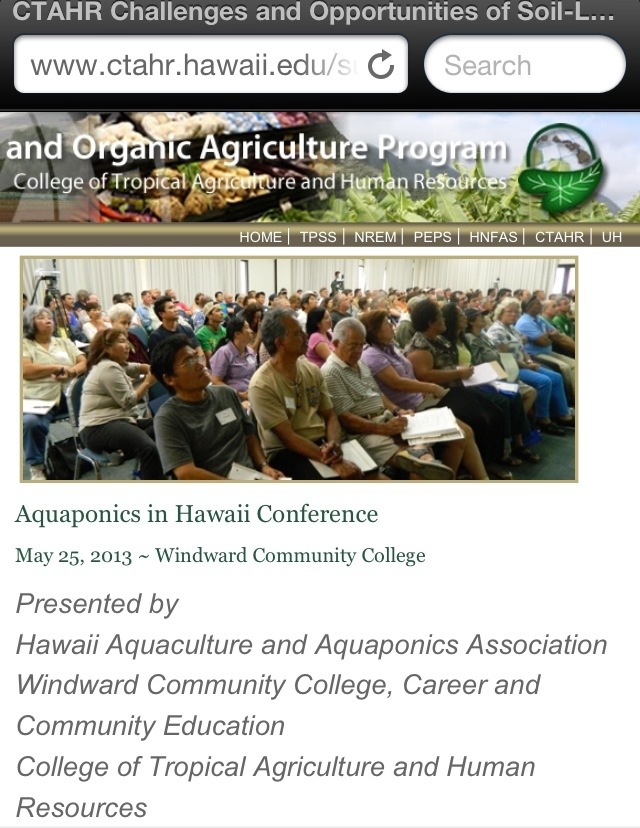
The conference website with the presentations from the recent conference on Aquaponics in Hawaii is now available to download from this site – http://www.ctahr.hawaii.edu/sustainag/workshop/Aquaponics-May2013.html

Can you spot The Fish Vet in the crowd?

20130611-165534.jpg