HUMANS are not the only species to suffer from a diet of junk food.
An aquarium has warned fish owners not to feed food meant for humans to their pets after it had to wean a giant gourami off a diet of prawn cocktail-flavoured chips.
All about Fish Vetting – Dr Richmond Loh
HUMANS are not the only species to suffer from a diet of junk food.
An aquarium has warned fish owners not to feed food meant for humans to their pets after it had to wean a giant gourami off a diet of prawn cocktail-flavoured chips.
At the beginning of this month, I attended the Annual ANZ Zebrafish Workshop at the Garvan Institute, Sydney, as an invited speaker. There were many fish health personnel there and aquatic veterinarians.
One of the presentations spoke of a parasitic disease of the nervous system, which although have been reported to be not uncommon in the literature, none of us had diagnose it here in Australia.
One of the veterinary pathologists at the private labs was seeking material as a positive control, and perhaps try to run a special histology stain called the ‘Luna stain’ to help with parasite detection.
I was just discarding old formalin-fixed fish specimens from my store and came across two leopard danios with scoliosis and in very thin condition. These fish were sampled back in April 2013, from one of my client’s tanks, but no further testing was done.
Of course, with these sorts of clinical signs, I expected to see the fish riddled with Mycobacteria and granulomas (because common things happen commonly). Anyway, I prepared them for histology processing and wallah! The little critters are present throughout the spinal cord (pictured below). You can be privileged to share with me, the excitement of being among the first to see this parasite from an Australian specimen!
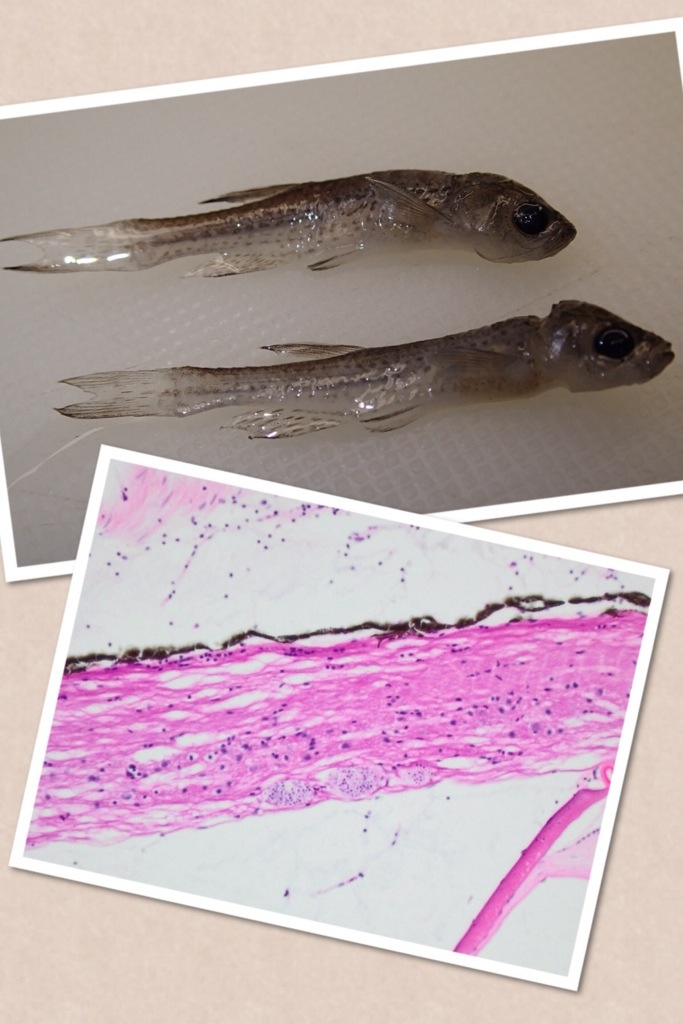
Could this be the first diagnosis of such in Australia? It’s not the purist thing to do, but it’s a pathologist thing to do. I based it on organism morphology, host species, neural location and clinical signs of emaciation and spinal curvature (a paper described the prevalence of infection in skinny fish with bent spines is 97% and those in normal fish, is 30%).
From a ‘lab rat’ point of view, we should get multiple lines of evidence to confirm it to a species level. I’m going to get the Luna stain to light up the organisms and am sending some wax scrolls for DNA testing.
For more information about this disease, go to:
Transmission, Diagnosis & Control of Pseudoloma in Lab Zebrafish.
Are you a pet fish keeper, ornamental fish breeder, retailer or fish farmer? Are you running public aquaria? Do you use fish in your educational/research institution? Are you an aquaponics or a food fish aquaculture farmer?
Do you use the services of an aquatic veterinarian? Is there one close by?
Did you know that you can access The Fish Vet’s services right where you are?
1. Locally, I provide site visits to my clients. I service clients as far south as Mandurah (and Bremer Bay!) as far north as Yanchep and as far east as Ellenbrook and Armadale. Here, I perform field diagnostics, and I bring along my portable pharmacy to treat your fish’s ailments, or refer you back to fish shops for medicines that they stock.

2. If you are not exactly local, we can schedule a visit, by flight, to any state in Australia (e.g. WA, NSW, Victoria, Tasmania), or overseas (e.g. Singapore, Malaysia, New Zealand, Hong Kong).

3. I can work through your local veterinarian to achieve a suitable outcome. See picture below.

4. If you wish to proceed with a direct phone or email consultation, please select the appropriate item from the shopping cart at http://www.thefishvet.com.au/shop/shopping.html
Saw this doing the rounds on Facebook a while back; thought I’d share.

Over the years, I had read up about this and also met quite a few Oscar breeders. The short answer is that it’s virtually impossible to tell, without using an endoscope.
The long answer is, that there are many theories.
Males :
– have longer dorsal fins that over lap with the tail.
– have three dark spots at the base of their dorsal fin.
– have more red colouration.
– have longer vent that does not protrude as much.
– have longer faces/head.
– exhibit greater aggression.
All this really relies on you having several fish, with one of each gender, for comparison.
Some swear by these methodical and some say they’re fallacy.
I think sometimes even the oscars get it wrong because it’s quite common for females to pair up with other females! Unless it’s because there’s a high incidence of homosexuality in this species.
For me, I won’t actually know until I see them lay eggs.
Recently, I was at a client’s to diagnose the reason for unusual faeces produced by their fish. Generally speaking, normal faeces should have a uniform, thick, sausage-like appearance. But when fish develop enteritis, faeces may be empty casts, appear thin, or contain bubbles.
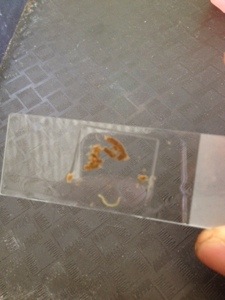
Most fish keepers would instantly jump to needing metronidazole because they suspect Hexamita ( intestinal protozoal parasitism) infection. But did you know that there are more than reason for this.
With proper microscopic exams of faeces, I managed to find the reason was in fact due to the Capillaria worm, evidenced by the presence of worm eggs! The treatment for this is a course of levamisole; and metronidazole or dimetridazole would have been a waste of effort, money and time.
The take home message is, don’t guess, ask a vet.

Q: What do you call a really good fisherman?
A: A Master Baiter!
Check this one out in today’s papers.

Check out some of my recently uploaded pictures at this link – http://tinyurl.com/k8x5nlv