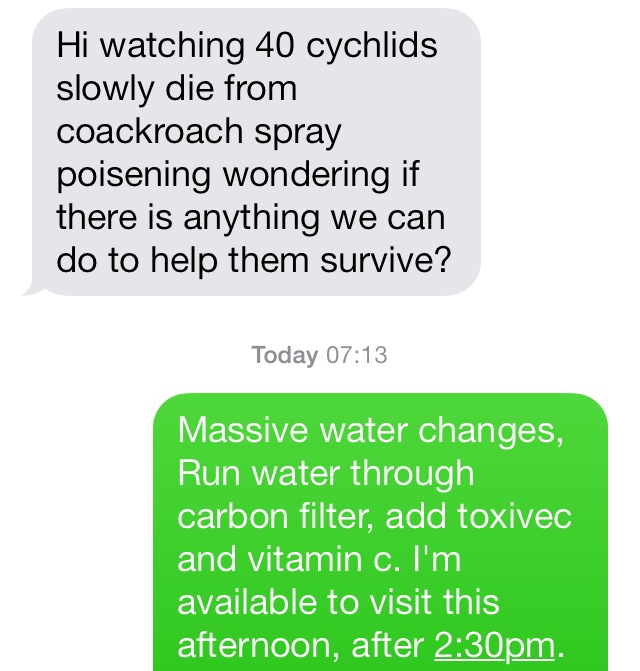
What to do if your fish are dying from fly spray?

Check out the dialogue pictured below.


Yours sincerely,

Dr Richmond Loh
DipProjMgt, BSc, BVMS, MPhil (Pathology) Murdoch, MANZCVS (Aquatics& Pathobiology), CertAqV, NATA Signatory.
THE FISH VET, Perth, Western Australia.
Veterinary Medicine for fish.
W: http://www.thefishvet.com.au
E: thefishvet
P: +61 (0)421 822 383

Fisheries sector may have fishing licenses, but do they have the social license to fish?

Interesting article:
http://theconversation.com/why-dont-we-believe-australias-fisheries-are-sustainable-23617

Outbreak of rare skin infection that comes from handling raw seafood.

Below is a post from ProMED (a program of the International Society for Infectious Diseases <http://www.isid.org>)

MYCOBACTERIUM MARINUM – USA: (NEW YORK CITY) CHINATOWN, RAW FISH EXPOSURE

*************************************************************************

Date: Wed 5 Mar 2014

Source: NBC/New York [edited]

<http://www.nbcnewyork.com/news/local/Raw-Fish-Skin-Infection-Chinatowns-NYC-Health-Department-248567651.html>

New York City is seeing an outbreak of a rare skin infection that comes from handling raw seafood, causing skin lesions, pain, and swelling to the hands and arms and even difficulty moving fingers, officials said.

Health officials are warning those who purchase raw fish and seafood at Chinatowns in Manhattan, Queens, or Brooklyn to wear waterproof gloves when handling those items, and to seek medical care if they discover red bumps on hands or arms.

The bacteria causing the infection are called _Mycobacterium marinum_ and they get into the body through a cut or other injury, the Health Department said. If the infection goes deep enough, surgery may be necessary.

Officials say 30 cases have been identified, and all of those report handling live or raw fish bought at markets in Manhattan, Brooklyn, or Queens.

The infections, which are treated with antibiotics, were reported to the Health Department by doctors, officials said. The Health Department said those who eat seafood from these markets are not at risk.

_M. marinum_ infection occurs following skin and soft-tissue injuries that are exposed to an aquatic environment or fish. First described as “swimming-pool granuloma”, when swimming pools were not routinely chlorinated, _M. marinum_ skin infections are now most often acquired from aquarium maintenance and called “fish tank granuloma”. The infection usually presents as indolent, localized nodular or ulcerating skin lesions on mainly the upper limb of otherwise healthy people, but can evolve into an ascending lymphangitis that resembles sporotrichosis or can spread to deeper tissues, resulting in tenosynovitis, arthritis, and osteomyelitis.

Rifampin and ethambutol in combination has been reported to be the antibiotics used most often to treat _M. marinum_ infection. Other antibiotic options with reliable activity include clarithromycin, doxycycline, and minocycline. The duration of therapy is at least 3 months and is significantly longer for patients with deeper structure infections than for patients with infections limited to the skin and soft tissue. Most cases of invasive _M. marinum_ infection will also require surgical debridement as an adjunct to antimicrobial treatment.

– Mod.ML

What it could mean for you, and your fishes? Read about it in an excerpt from my publication by clicking this link:

Mycobacteria (Fish Vetting Essentials)


Follow me on: Facebook “Fin Page”YouTube  – BlogLinkedinTwitter
— Yours sincerely,
Dr Richmond Loh

DipProjMgt, BSc, BVMS, MPhil (Pathology) Murdoch, MANZCVS (Aquatics & Pathobiology), CertAqV, NATA Signatory. Aquatic Veterinarian | Adjunct Lecturer Murdoch University | President WAVMA | Secretary Aquatic Animal Health Chapter – ANZCVS. THE FISH VET, Perth, Western Australia, AUSTRALIA.

Mobile Aquatic Veterinary Medical & Diagnostic Services. http://www.thefishvet.com.au Ph: +61 (0)421 822 383
Skype: thefishvet
Looking for more books? Check out this site.
  The Fish Vet - Perth, WA

The veterinary degree is listed as the worst return on investment. But why do vets charge so much?

Not a good promo item, but this is reality.

If you’re considering a career in veterinary science, then you must really have a passion for it.

Read more here.

What licences do you need to set up an aquaculture business?

Below is a link to the Dept of Fisheries’ website about the requirements to get a licence:

http://www.fish.wa.gov.au/Fishing-and-Aquaculture/Aquaculture/Aquaculture-Management/Pages/Licence-Forms.aspx

There are also forms for permits to translocate the different species.

Bindi Irwin in hot water over SeaWorld gig.

What are your thoughts on this issue? Is it an issue? Is it an opportunity to improve practices and to allow humans to bond with animals?

Read the article here-

http://mobile.news.com.au/world/breaking-news/bindi-irwin-slammed-for-seaworld-support/story-e6frfkui-1226847585681


Yours sincerely,

Dr Richmond Loh
DipProjMgt, BSc, BVMS, MPhil (Pathology) Murdoch, MANZCVS (Aquatics& Pathobiology), CertAqV, NATA Signatory.
THE FISH VET, Perth, Western Australia.
Veterinary Medicine for fish.
W: http://www.thefishvet.com.au
E: thefishvet
P: +61 (0)421 822 383

A very acrobatic stingray was captured on camera flying through the air at the Quiksilver and Roxy Pro on the Gold Coast.

http://mobile.news.com.au/national/stingray-leaps-out-of-the-water-at-quiksilver-roxy-pro-just-missing-stephanie-gilmores-jet-ski/story-e6frfkp9-1226847072626


Yours sincerely,

Dr Richmond Loh
DipProjMgt, BSc, BVMS, MPhil (Pathology) Murdoch, MANZCVS (Aquatics& Pathobiology), CertAqV, NATA Signatory.
THE FISH VET, Perth, Western Australia.
Veterinary Medicine for fish.
W: http://www.thefishvet.com.au
E: thefishvet
P: +61 (0)421 822 383

American Association of Fish Veterinarians, 1st Annual Continuing Education Meeting

This conferences looks like a very interesting and practical mix for aquatic veterinarians to attend and exchange ideas.

From: “Dr. David Scarfe”
Date: 1 March 2014 2:43:02 AWST
Subject: AquaVetMed e-News: AAFV First Annual CE Meeting – April 2014 (Shepherdstown, WV, USA)

February 28, 2014
American Association of Fish Veterinarians, 1st Annual Continuing Education Meeting

Clarion Hotel and Conference Center, Shepherdstown, West Virginia (www.clarionhotel.com/hotel-shepherdstown-west_virginia-WV012). April 28, 2014. 8 am to 4 pm (Preceding the Eastern Fish Health Workshop)

7 hours of RACE approved, clinically relevant, FISH ONLY Veterinary CE, including presentations on:
• Clinical Pathology
Pathologic Findings on Fish Wet Mount Cytology – Dr. Roy Yanong
Non-parasitic Beneficial Microorganisms & Freshwater Ecosystem Evaluation – Dr. Julius Tepper
CBC, Biochemistry and Acid/Base Balance in Fish – Dr. Kat Hadfield
Non-Wet Mount Cytology (Impression Smears, Fluid Analysis etc.) – Dr. Drury Reavill

• Business & Economics of Fish Practice
Keys to Success in Fish Practice: Economics with a Focus on Production Medicine – Dr. Hugh Mitchell
Staying Afloat, The Business End of Pet Fish Medicine – Dr. Brian Palmeiro
What Poultry Can Teach Us About Fish – Dr. Myron Kebus
Roundtable Discussion on Fish Practice – Drs. Mitchell, Palmeiro, Kebus, Roberts-Sweeney, Tepper

• Fish Radiology:
Fish Radiology Including Clinical Case Examples – Dr. Shane Boylan
Reproductive Ultrasound in Fish – Dr. Lori Campbell

• Emerging Pathogens
Emerging Viral Pathogens in Fish – Dr. Tom Waltzek
Franciscellosis in Ornamental and Production Fish – Dr. Esteban Soto

• Surgery and Anesthesia in Pet Fish – Dr. Helen Roberts-Sweeney

• Clinical Cases – Drs. Scott Weber, Kathy Heym and Mike Hyatt

Early registration including meals (deadline March 15th 2014):
$100 for AAFV Members ($150 after March 15th)
$175 for non-AAFV Members ($225 after March 15th)
$50 for students ($100 after March 15th)

___________________________
AquaVetMed e-News provides information to veterinary and veterinary-allied subscribers concerning aquatic animal medicine, health, welfare, public health and seafood safety, obtained from a variety of sources (largely AquaVetMed subscribers). While provided by the American Veterinary Medical Association’s, Aquatic Veterinary Medicine Committee and are for public distribution, they do not necessarily reflect the opinion of the AVMA or the veterinary profession. See the AVMA Terms of Use (http://tinyurl.com/29h2rf) for further information.

Subscription and Contributions: Interested veterinarians and veterinary-allied professionals can subscribe, unsubscribe, or contribute pertinent news or information, by sending a message with “For AquaVetMed -” and the topic in the subject line, to dscarfe@avma.org. If e-News information is used elsewhere please acknowledge AquaVetMed as the source. Encourage individuals to subscribe rather than distribute through list serves.

Note: Undelivered e-mails will not be resent; Subscribers will be deleted from the list after repeated undelivered or bounced messages and will have to re-subscribe. Messages may contain attachments that will have been scanned for known viruses.

Visit our website: http://www.avma.org
_______________________________