Just dropped off the hire car & on my way home.

I’ll be back in the office on Monday. Business as usual.


Yours sincerely,

Dr Richmond Loh
DipProjMgt, BSc, BVMS, MPhil (Pathology) Murdoch, MANZCVS (Aquatics& Pathobiology), CertAqV, NATA Signatory.
THE FISH VET, Perth, Western Australia.
Veterinary Medicine for fish.
W: http://www.thefishvet.com.au
E: thefishvet
P: +61 (0)421 822 383

Happy World Veterinary Day!

On Saturday 26th April 2014, the veterinary profession will celebrate the World Veterinary Day 2014 with numerous events around the world.

The aim of the World Veterinary Day (WVD) is to promote the veterinary profession to a large audience, including the general public and to attract the attention of mass media to the important contribution of the veterinary profession to the benefit of society and all animals (Animal Health, Animal Welfare and Public Health).

The theme for the World Veterinary Day 2014 is Animal Welfare. The WVD celebrations events are organized by WVA member associations alone, or in cooperation with any other selected veterinary body through different activities such as concerts, parades, seminars, education sessions for public and children, media events etc.

The WVA wishes to all veterinarians around the world a Happy World Veterinary Day 2014.

Source: WVA website: http://www.worldvet.org/news.php?item=109


Yours sincerely,

Dr Richmond Loh
DipProjMgt, BSc, BVMS, MPhil (Pathology) Murdoch, MANZCVS (Aquatics& Pathobiology), CertAqV, NATA Signatory.
THE FISH VET, Perth, Western Australia.
Veterinary Medicine for fish.
W: http://www.thefishvet.com.au
E: thefishvet
P: +61 (0)421 822 383

Free Webinar: “Issues Facing Fish & Aquatic Animal Welfare” – in Celebration of World Veterinary Day & the Beginnings of a Global Dialogue

———- Forwarded message ———-
From: Palic, Dusan <d.palic@fisch.vetmed.uni-muenchen.de>
Date: Wed, Apr 23, 2014 at 5:20 PM
Subject: WAVMA Members-L: Fish Welfare Dialogue Webinar announcement
To: WAVMA_Members-L@wavma.org
Dear All,


If you have an interest in aquatic animal welfare, this is a great opportunity to share facts & opinions, and discuss multiple topics in the forthcoming dialogue. The announced webinar is a kick-off event for the fish welfare dialogue project spearheaded by WAVMA, LMU and supported by WVA and FVE.


Also, please share with forums and colleagues that you think may be interested.


Best regards,
Dusan


Free Webinar: “Issues Facing Fish & Aquatic Animal Welfare” – in Celebration of World Veterinary Day & the Beginnings of a Global Dialogue

When: Saturday, April 26, 2013 – 13:00 GMT/UTC (click http://tinyurl.com/ktgvpnc for your local time)

Register now ! Click on https://attendee.gotowebinar.com/register/2387014812762073858
If you are unable to participate, be sure to register to receive information on accessing a recording of this webinar, information on future webinars, how to participate in the Fish Welfare Dialogue, and the September 2014 International Fish Welfare Conference

Speaker: Chris Walster, BVMS, MVPH, CertAqV, MRCVS
The Island Veterinary Associates, Stafford, UK

Moderator: Dusan Palic, DVM, PhD, CertAqV
Ludwig-Maximilians University, Tierärztliche Fakultät, Munich Germany

About the Webinar & the Dialogue:

The Webinar
This webinar is in celebration of World Veterinary Day and the beginning of a 6-month international conversation (the “Fish Welfare Dialogue”) on numerous issues concerning the human-animal relationship with aquatic animals. It will introduce some of the important issues (from science to philosophy) that affect how non-governmental organizations, governments, animal owners and society at large, might address the welfare of aquatic animals (particularly finfish and invertebrates).

Post-webinar Dialogue & Conference
As part of the Fish Welfare Dialogue, all webinar participants will have the opportunity to discuss these and other issues through web-based discussion forums. With the hopes of developing realistic, practical and optimal approaches for the welfare of all aquatic animals, and the benefit of mankind, these discussions will serve as the basis for refining how aquatic animal welfare should be addressed at an International Conference on Fish Welfare in Munich, Germany in September 2014.

Organizers & Supporters
This webinar has been organized and coordinated by Ludwig-Maximillians University & the World Aquatic Veterinary Medical Association. Other organisations are invited to participate in and distribute information on the Fish Welfare Dialogue, future Fish Welfare webinars and the 2014 International Fish Welfare Conference. For more information contact admin@fishwelfare.org.
After registering, you will receive a confirmation email containing information about joining the webinar.

GoToWebinar View System Requirements


__________________________________________________________
Dušan Palić, D.V.M., MVSc, Ph.D.
Professor and Chair of Fish Diseases and Fisheries Biology
Faculty of Veterinary Medicine, Ludwig-Maximilians University Munich

Prof. Dr. Dušan Palić
Lehrstuhl für Fischkrankheiten und Fischereibiologie
Tierärztliche Fakultät, Ludwig-Maximilians-Universität München

Kaulbachstraße 37
80539 München
Deutschland
Email: d.palic@lmu.de
Tel: +49 (0)89 2180 2282

26-April-2014_Fish-Welfare-Dialogue-Webinar(Flier).pdf

Would you like to know the science behind the evidence for, or lack of, regarding fish welfare?

Visibility of fish is ever increasing. The husbandry practices applied to these animals — and the welfare states associated with their use — are emerging issues in national and international science programs, organisations concerned with the treatment of animals, and amongst consumers.

The Diseases of Aquatic Organisms (DAO) journal has a Special Edition that brings together a range of perspectives on aquatic animal welfare, from pragmatic empirical science to ethics, philosophy, and animal rights activism.

Click here for the link to the Open Access articles.


Dr Loh, The Fish Vet, in Perth, Western Australia is unavailable until 28 April 2014… But still checking out all the fishies along the way.


Yours sincerely,

Dr Richmond Loh
DipProjMgt, BSc, BVMS, MPhil (Pathology) Murdoch, MANZCVS (Aquatics& Pathobiology), CertAqV, NATA Signatory.
THE FISH VET, Perth, Western Australia.
Veterinary Medicine for fish.
W: http://www.thefishvet.com.au
E: thefishvet
P: +61 (0)421 822 383

How do you mark fish, so you can tell them apart?

All fish look the same? Not all. But some do…

My clients and I certainly tell you that we can tell our pet fishes apart from one another. But how can you tell the difference in fishes that you don’t get to know and rarely see? For example, for research purposes.

I found a great site that offers all the different options available to researchers and things that need to be taken into consideration include the welfare of the fish, practicality and cost.

  • Biological (Natural Methods)
    -Parasitic Marks
    -Morphological Marks
    -Genetic Marks
  • Chemical (immersion, injecting, tattooing, or feeding; of alizarin, oxytetracycline, calcein)
  • Physical Internal
    -Body Cavity tags
    -Subcutaneous tags
    -Coded Wire tags
    -Microtags
    -Passive Integrated Transponder tags (PIT)
    -Thermal Tags
    -Radio tags
    -Sonar tags
    -DST GPS Fish Tag, Fish Positioning Sounder and Simrad GPS Sonar
  • Physical External
    -Mutilation
    -Branding
    -Visable Implant Elastomer (VIE)
    -Petersen discs
    -Paper fasteners
    -Strap tags
    -Dangler tags
    -Carlin tag
    -Spaghetti tag
    -Dart tags
    -Anchor tag (Floy tags)

The link to the full article can be found here – http://www.azgfd.gov/w_c/Fish_Tagging_Marking_Techniques.shtml


Fish joke for Monday-itis: taking a fish’s temperature

To take your own body temperature, you stick a thermometer under your tongue.

To take a dog’s temperature, you stick the thermometer up its bum.

So, how do you take the temperature of a fish?

The answer is…
🙂

You stick the thermometer in 😐

… the water 😛

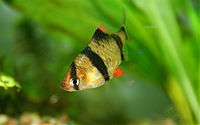
That’s right, most fish a poikilotherms (cold blooded), and so their body temperature is the same as the surrounding water. So, their metabolic rate and activity levels are highly dependent on the temperature of its environment. Some can cope with seasonal changes, whereas most tropical fish (including the Siamese fighting fish) require you to maintain water at a tropical temperature of 25-28 degrees Celsius.

How much should I feed my fish?

Recently, I’ve been asked this question on numerous occasions,”How much food do I feed my fish?”

Thinking back on several necropsies I had done, I’ve found goldfish, koi, and aquaponically grown fish to be rather high in abdominal fat content (similar to those adverts by the government about ‘toxic fat’. Bit why is this the case?

Goldfish and koi are a bit of a guts when it comes to food. And many owners are too nice to their fish…and feed them too much… Inadvertently, killing them with kindness.

Fish on average, eat about 1% of their body weight daily. Mature fish that are no longer growing will eat 0.5%, and young rapidly growing fish will eat as much as 2%. Does this vary depending on the seasons? Yes it does, and see a previous post (https://thefishvet.com/2011/06/23/how-often-should-i-feed-my-fishes/)

Aquaponically grown fish tend to be on a diet that enables them to grow at an accelerated rate and such foods tend to contain a lot of fat and protein. And this explains why they are so fatty.

The excess fat is stored by the fish in its abdomen. It occupies space in a cavity that’s rather rigid and non-distendable. There is no health implications for the fish cultured for food since they will be harvested relatively young, but what impact will it have for the pet fish who are to live for years?’

Do fish drink water?

You’ve heard of the saying, “To drink like a fish!” But do they drink? This is a question posted on my Facebook Fanpage today.

I’m going to give you a ‘yes’ and a ‘no’ answer. Let me explain.

Marine fish do drink large amounts of water to maintain hydration. They produce small amounts of minimally concentrated urine. Much of the excess salts are removed instead, through their gills.

Fish that live in freshwater don’t exactly drink water, but they absorb it from their environment through their skin and gills; in a process called osmosis. They then have to expend energy to get rid of the excess water by producing lots of dilute urine.

This is why when freshwater fish get sick, they start to bloat and present with dropsy (see previous post – https://thefishvet.com/2013/10/22/is-there-a-cure-for-dropsy-in-fish-thefishvets-secrets-revealed/). This is the reason for altering the salinity of the fish’s environment when they get sick.


Yours sincerely,

Dr Richmond Loh
DipProjMgt, BSc, BVMS, MPhil (Pathology) Murdoch, MANZCVS (Aquatics& Pathobiology), CertAqV, NATA Signatory.
THE FISH VET, Perth, Western Australia.
Veterinary Medicine for fish.
W: http://www.thefishvet.com.au
E: thefishvet
P: +61 (0)421 822 383