What is a pregnant koi called?

The question on "what’s a pregnant goldfish called" has been rather popular on my blog.

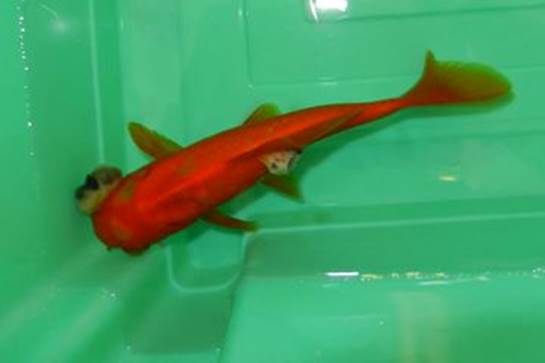
How about koi? The answer is the same. There’s no term for a pregnant koi since they can’t become pregnant. Their eggs are fertilised externally.

Next Wednesday, one of my students will be delivering a lecture about very fat, gravid koi that won’t spawn. What are the dangers of egg retention? What are other things that might present in this way… and how to fix it?

For more information, visit – A presentation about egg-binding (egg-retention) in koi fish.

Follow me on: Facebook "Fin Page"YouTubeBlogLinkedinTwitter


Yours sincerely,

Dr Richmond Loh DipProjMgt, BSc, BVMS, MPhil (Pathology), MANZCVS (Aquatics & Pathobiology), CertAqV, CMAVA, NATA Signatory.
THE FISH VET, Perth, Western Australia, AUSTRALIA.
Mobile Aquatic Veterinary Medical & Diagnostic Services.
http://www.thefishvet.com.au
Ph: +61 (0)421 822 383
thefishvet_logo_medical-20130107.jpg
Skype: thefishvet

President WAVMA 2014

wavma.jpg?w=780

Adjunct Lecturer Murdoch University | Secretary Aquatic Animal Health Chapter – ANZCVS.

Looking for more books? Check out this site.

Four (4) top tips to help your pond fish survive through winter.

As winter approaches, the water temperature will decrease. Many biological processes in fish are dependent on the water temperature, and resistance to diseases is one of the major challenges faced by outdoor fish.

What you can do during this time of the year is to:

1. dose your pond with vitamin C on a weekly basis (1-10mg/L),

2. make sure you are giving your fish the best fish foods and

3. check your water quality is optimal (pH 6.5-7.5, alkalinity 4-6 dKH, ammonia 0mg/L, nitrite 0mg/L and nitrate <50mg/L).

4. If you have introduced new fish, aquatic plants or shared pond equipment from a friend, it would be worthwhile to get your fish vet-checked to make sure you have not introduced any nasty diseases. It’s easier to treat fish while the weather is still warm, and their immune system is strong, than during the cold winter months. 

Go to http://thefishvet.com.au/

Two Pet Goldfish Get Surgeries Totaling $750

Two Pet Goldfish Get Surgeries Totaling $750

For some people, the price of a pet’s health is never too high: A team of veterinarians in Scotland performed a set of operations on pet goldfish that cost nearly $750.

The team — from Inglis Veterinary Hospital in Fife, Scotland — removed the blind, cancerous eye of a goldfish named "Star." They also operated on another fish named "Nemo" to remove a lump. The complex operations, which cost $747 U.S. (500 British pounds), involved an exotic consultant surgeon, a vet to keep the fish anesthetized and a nurse to monitor their heart rates, hospital staff wrote in a Facebook post.

"This is a highly specialist field — using anesthetic on a goldfish carries a very high risk —and I’m delighted for the owner that everything went OK and the owners are happy," said exotic-animals expert Brigitte Lord, according to the post. "The financial value of a goldfish may be quite small, but I think the fact that someone should have paid that much for an operation reflects the true value of the bond between pets and humans."

Abby Gordon, 21, a student in Glasgow, won the fish, named Star, at a fairground stall 12 years ago, by throwing a Ping-Pong ball into a goldfish bowl. (Goldfish have an average lifespan of several decades with the proper diet and living conditions; the world’s oldest goldfish lived a whopping 43 years, according to Guinness World Records.) Abby’s mother, Jane Gordon, "didn’t want Star to be lonely," the hospital staff said, so she bought another fish, Nemo.

When a cancerous growth developed on Star’s eye, the owners sought to have it surgically removed.
During the operation, the vets listened to the fish’s blood flow by pulsing it using Doppler ultrasound equipment. They kept the animal asleep by spraying it with a syringe containing oxygenated water and an anesthetic.

After the procedure, the doctors kept Star in a bucket of oxygenated water. They held the fish’s mouth open and gently moved it around for 8 minutes to mimic a swimming action, before the animal regained consciousness.

Nemo, the fish that shares a tank with Star, had a relatively easy surgery to remove a lump.

This isn’t the first time a goldfish has gone under the knife. Last year, a goldfish named George underwent an operation to remove a life-threatening tumor from his head at the Lort Smith Animal Hospital in Melbourne, Australia.

As for Star and Nemo, both fish are now "happily reunited," according to the veterinary hospital’s Facebook post. Star is swimming around happily and is getting antibiotics, Jane Gordon said.

"I know it seems like a lot of money to spend on an operation for a goldfish, but what was the alternative?" Gordon said, according to hospital staff. "I think [we have] a social responsibility to look after our pets, and I know my daughter would have been distraught if anything had happened to the goldfish," she added


A presentation about egg-binding (egg-retention) in koi fish.

This month, I’ve invited a final year veterinary student who’s doing work placement with me, to make a presentation to the Koi Society of WA, about egg-bound koi fish.

Presentation summary: This talk will briefly outline the differential diagnoses for abdominal swelling (and asymmetry), and some of the common reproductive problems of female koi, with an emphasis on egg-binding or dystocia. The husbandry and physiology of this condition will be discussed, as well as treatment methods. If time permits, other topics, such as artificial spawning, may be discussed.

The presentation will be held at this month’s Southern Branch Koi Society of WA (KSWA) meeting.

Time: 7:30pm, Wednesday 25 March, 2015.

Venue: South Perth Rotary Hall, Sandgate Street, South Perth (cnr Renwick St).

Speaker Biography:

Ellen Rasidi is a final-year veterinary student at the University of Sydney, with an interest in all ‘exotics’ – fish, amphibians, reptiles, birds, rodents, ferrets, wildlife… She has had a wide variety of experience within the field, including nursing in exotics practice in Melbourne, working in a chimpanzee sanctuary in West Africa, an externship in falcon medicine in Abu Dhabi, and research into canine dementia in Sydney. She is the founding president of the Sydney student chapter of the World Aquatic Veterinary Medicine Association, board member of Australian Raptor Care and Conservation Inc., and a veterinary nurse at the Animal Emergency Centre, Canberra. Ellen currently has a paper in publication on the topic of fish welfare, co-written with the past, current and future presidents of WAVMA.

Follow me on: Facebook "Fin Page"YouTubeBlogLinkedinTwitter


Yours sincerely,

Dr Richmond Loh DipProjMgt, BSc, BVMS, MPhil (Pathology), MANZCVS (Aquatics & Pathobiology), CertAqV, CMAVA, NATA Signatory.
THE FISH VET, Perth, Western Australia, AUSTRALIA.
Mobile Aquatic Veterinary Medical & Diagnostic Services.
http://www.thefishvet.com.au
Ph: +61 (0)421 822 383
thefishvet_logo_medical-20130107.jpg
Skype: thefishvet

President WAVMA 2014

2015 AQUAVET(R) I & II & III

The College of Veterinary Medicine at Cornell University is pleased to announce the 2015 AQUAVET® I, II & III course offerings. They are aquatic veterinary medicine education programs that currently consist of two courses that will be presented at Roger Williams University in Bristol, RI in June 2015 and one on aquarium medicine held in three venues.

AQUAVET®I: An Introduction to Aquatic Veterinary Medicine is a 4-week course (24 May – 20 June 2015) intended primarily for veterinary students.

AQUAVET®II: Comparative Pathology of Aquatic Animals is a 2-week course (24 May – 6 June 2015) that is oriented toward the pathology of diseases of aquatic invertebrates and fish that are used in biomedical research, encountered in display aquaria and are of importance in commercial aquaculture.

AQUAVET®III: Clinical Aspects of Captive Aquatic Animal Medicine is a 5 week course (following AQUAVET® I) and is limited to a small number of students. The venues include GA Aquarium, U of GA and Dolphinaris, Cancún, México.

Veterinary students can receive credits for the courses and graduate veterinarians can receive CE credits.

More detailed information and applications for admission (due by January 15, of each year) are available on the web site www.aquavet.info

Follow me on: Facebook "Fin Page"YouTubeBlogLinkedinTwitter


Yours sincerely,

Dr Richmond Loh DipProjMgt, BSc, BVMS, MPhil (Pathology), MANZCVS (Aquatics & Pathobiology), CertAqV, CMAVA, NATA Signatory.
THE FISH VET, Perth, Western Australia, AUSTRALIA.
Mobile Aquatic Veterinary Medical & Diagnostic Services.
http://www.thefishvet.com.au
Ph: +61 (0)421 822 383
Skype: thefishvet
The Fish Vet - Perth, WA

Enrollments now open for SeaVet Clinical Training Course

I attended this course a couple of years ago and I can recommend it as having some very good breadth and depth of information for aquatic veterinarians.

Read more below:

SeaVet Clinical Training Course (June 15-25, 2015), University of Florida, College of Veterinary Medicine

SeaVet Clinical Training is an intensive nine day course designed to teach veterinary medical students and veterinarians through didactic lecture, case-based problem-solving and practical experience. The program also features an educational and interactive hands-on training. This is a three credit professional class through the University of Florida. Academic credit will only be granted to University of Florida veterinary students.

Continuing education credits may be earned by veterinarians. This course has a maximum of 25 allowed by the state of Florida. If requested, a form will be provided at start of the course to keep track of your hours. If you are not in Florida, your state has the right to refuse the credits. However, the University of Florida, College of Veterinary Medicine is accredited with NAVC and out-of-state veterinarians have not been denied credits after attending past SeaVet courses.

IMPORTANT NOTICE: This course is being offered exclusively for Veterinary Students and Licensed Veterinarians. Registrations will not be accepted otherwise.

For more information and to register, go to www.conference.ifas.ufl.edu/seavet/index.html.

For other information contact Rachael Dailey

Course Organizer

University of Florida, College of Veterinary Medicine

PO Box 100136 / Gainesville, FL 32610-0136

Phone: 352-294-4312 / Fax: 352-392-8289

Email: rachael.dailey@ufl.edu

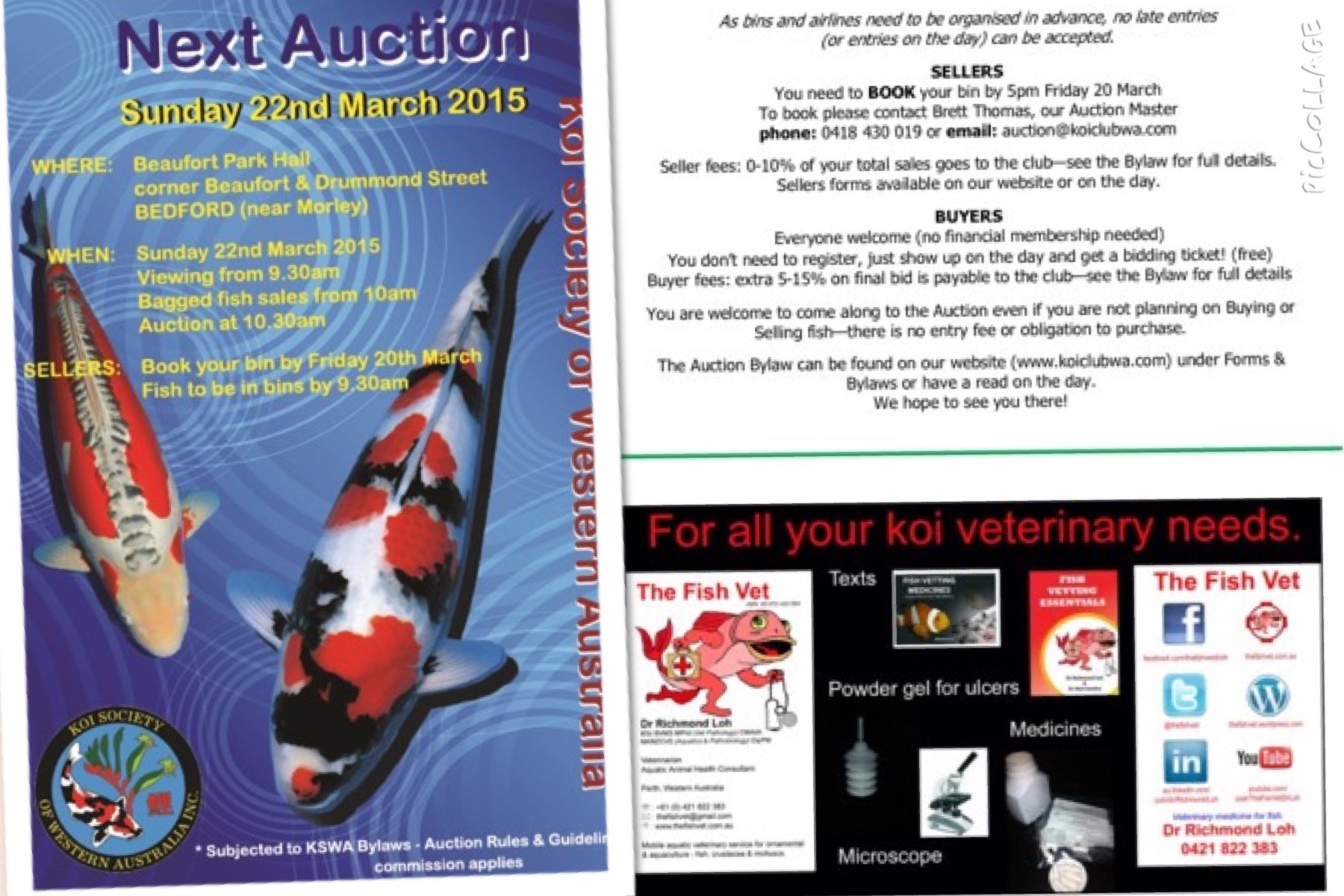
Koi Auction

Who’ll join me at this event?
See picture for details.


Yours sincerely,

Dr Richmond Loh
DipProjMgt, BSc, BVMS, MPhil (Pathology) Murdoch, MANZCVS (Aquatics& Pathobiology), CertAqV, CMAVA, NATA Signatory.
THE FISH VET, Perth, Western Australia.
Veterinary Medicine for fish.
W: http://www.thefishvet.com.au
E: thefishvet
P: +61 (0)421 822 383

2014 President WAVMA.org