You’re all wrong, dog and cat-lovers. Goldfish are the best pets of all! By Lettecha Johnson.

"Pet debates are dominated by cat lovers and dogs lovers both trying to assert their pet is best. But they’re all wrong, because there is a pet world beyond wagging tails, barking and whiskers.

Goldfish are the pet that brighten my life and home."

Read more here.
http://gu.com/p/4ceph/sbl

My response to people who ask me for medicines without a consult…

Dear Sir / Madam,

I and my colleagues would not want to lose our veterinary registration for supplying medicines without having examined your fish.

For rules regarding medicines, I refer you to a recent blog post – https://thefishvet.com/2015/09/18/can-veterinarians-fill-another-veterinarians-prescriptions“>https://thefishvet.com/2015/09/18/can-veterinarians-fill-another-veterinarians-prescriptions/


Yours sincerely,

Dr Richmond Loh 

DipProjMgt, BSc, BVMS, MPhil (Pathology), MANZCVS (Aquatics& Pathobiology), CertAqV, NATA Signatory.
THE FISH VET, Perth, Western Australia, AUSTRALIA. 

Mobile Aquatic Veterinary Medical & Diagnostic Services.
http://www.thefishvet.com.au
Ph: +61 (0)421 822 383

Knowledge is power.

Get empowered with knowledge at
http://www.wavma.org/WebCEPD


Yours sincerely,

Dr Richmond Loh 

DipProjMgt, BSc, BVMS, MPhil (Pathology), MANZCVS (Aquatics& Pathobiology), CertAqV, NATA Signatory.
THE FISH VET, Perth, Western Australia, AUSTRALIA. 

Mobile Aquatic Veterinary Medical & Diagnostic Services.
http://www.thefishvet.com.au
Ph: +61 (0)421 822 383

Can veterinarians fill another veterinarian’s prescriptions?

I often receive requests to dispense medicines by potential clients.

The short answer to the question is, YES, as a registered veterinarian, I can obtain, possess, administer, supply, or prescribe medicines including antibiotics for your fish or other aquatic animals, provided I have examined them personally.

However, a veterinarian is unable to dispense medicines. That is, we are not allowed to fill prescriptions created by another veterinarian. Only the veterinarians who have examined your animals can prescribe/dispense in each case. This was in the latest newsletter by the Veterinary Surgeons Board WA.

I do provide remote consultancy (via phone or Skype), and so any advice given can only be general, and medicines cannot be dispensed or prescribed.

To arrange a remote (phone or Skype) consultation, please select the item from the shopping cart at http://thefishvet.com.au/shop/shopping.html ;

If medicines are needed, and there’s no fish vet in your area, it’s best to work through your local general veterinary practitioner. They can collect diagnostic samples to send to me for testing. Once I’ve made the diagnosis, I can advise your veterinarian on the course of action. In this way, I will be able help you, your fish, or farm.
 

Yours sincerely,

Dr Richmond Loh 

DipProjMgt, BSc, BVMS, MPhil (Pathology), MANZCVS (Aquatics& Pathobiology), CertAqV, NATA Signatory.
THE FISH VET, Perth, Western Australia, AUSTRALIA. 

Mobile Aquatic Veterinary Medical & Diagnostic Services.
http://www.thefishvet.com.au
Ph: +61 (0)421 822 383

Facepalm moments: Things not to say in an aquatic store! | Practical Fishkeeping

I particularly like this line,
"My last goldfish was fine, he lived happily for two years"
If the goldfish was maybe 18 years when purchased, then I might have time for this oft-touted line… A goldie when kept correctly should be reaching a good 20 years or so at the least. For a goldfish to be dying within two years, or sometimes earlier than this, is indicative of a major problem that needs to be addressed before yet another fish goes of to die in its infancy.

Read more here –
http://www.practicalfishkeeping.co.uk/content.php?sid=3880

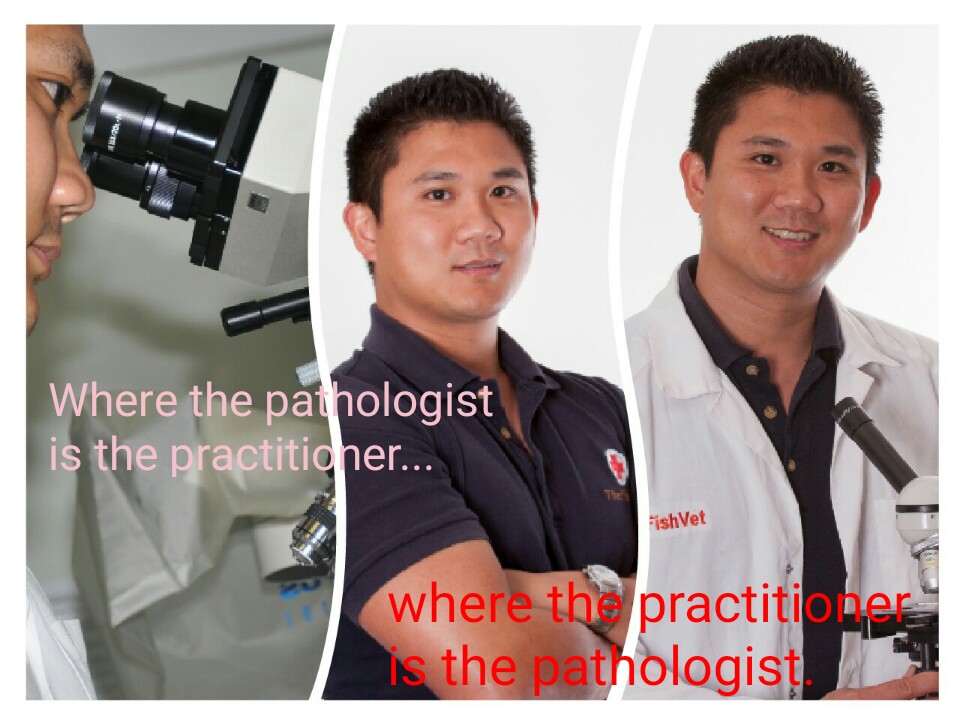
Did you know The Fish Vet, is also a qualified veterinary pathologist?

Laboratory processing can take time, and is difficult to access for private fish owners and aquaculturists.

We have the tools to make a diagnosis on the spot, and this allows you to start targeted treatment instantly. As a Certified Aquatic Veterinarian, this is the part The Fish Vet does best.

For cases that might be a little more complex, The Fish Vet can collect relevant samples for laboratory testing. Dr Richmond Loh has gained Memberships in the subject of Veterinary Pathology by examination, and is therefore qualified to do his own histopathology examinations and reporting. The Fish Vet pretty much brings the lab to the field!

With the right diagnosis, we’re on to a solution!

How good is that?

Follow me on: Facebook "Fin Page"YouTubeBlogLinkedinTwitter


Yours sincerely,

Dr Richmond Loh DipProjMgt, BSc, BVMS, MPhil (Pathology), MANZCVS (Aquatics & Pathobiology), CertAqV, CMAVA, NATA Signatory.
Aquatic Veterinarian & Veterinary Pathologist
THE FISH VET, Perth, Western Australia, AUSTRALIA.
Mobile Aquatic Veterinary Medical & Diagnostic Services.
http://www.thefishvet.com.au
Ph: +61 (0)421 822 383
thefishvet_logo_medical-20130107.jpg
Skype: thefishvet

President WAVMA 2014

wavma.jpg?w=780

Adjunct Lecturer Murdoch University | Secretary Aquatic Animal Health Chapter – ANZCVS | 2014 President WAVMA

See advert on YouTube.

Biosecurity risks of new fish introductions, and re-introduction of resident fish.

Fish keepers are reminded to minimise the biosecurity risks when introducing new fish (from a retailer, breeder or friend), or returning fish to their ponds.

The Fish Vet, Dr Richmond Loh said, “Fish keepers should ensure they have as much information as possible before buying new fish.”

“The chief tool for managing biosecurity risks when buying new fish is to have them vet-checked as part of a pre-purchase exam.” Dr Loh said. This is so important if you are buying valuable fish, or have irreplaceable fish at home.

“This is designed for early detection of disease before they become a problem, as a way to mitigate the risk of introducing common bacterial and parasitic infections.”

Dr Loh noted that biosecurity risks could also come from show-koi, or unsold koi from auctions returning to the property.

“The risk from returning koi is best managed by medicated baths prior to re-entry to your ponds,” Dr Loh said.

“In particular, check the health of other fish at the show. Also consider isolating the returning fish for at least two to three weeks, and perform pre-emptive treatment baths.”

Dr Loh said koi keepers and discus owners in particular often treated fish purchased from other owners, differently from fish purchased at retail outlets. But all fish can carry all the same diseases as all other fish.

For more information on aquatic animal biosecurity, see TheFishVet.com.au

Follow me on: Facebook "Fin Page" YouTube Blog Linkedin Twitter


Yours sincerely,

Dr Richmond Loh
DipProjMgt, BSc, BVMS, MPhil (Pathology), MANZCVS (Aquatics & Pathobiology), CertAqV, CMAVA, NATA Signatory.
THE FISH VET, Perth, Western Australia, AUSTRALIA.
Mobile Aquatic Veterinary Medical & Diagnostic Services.
http://www.thefishvet.com.au
Ph: +61 (0)421 822 383
Skype: thefishvet

President WAVMA 2014

Adjunct Lecturer Murdoch University | Secretary Aquatic Animal Health Chapter – ANZCVS.

Looking for more books? Check out this site.
See advert on YouTube.

Anti-depression diet is highly fishy | Health+Medicine

"A high fish diet lowers the risk of becoming depressed by around 17 per cent, studies show. For men it is even higher, cutting the likelihood by 20 per cent…

Studies involving more than 150,000 people have suggested the omega 3 fatty acids in fish may alter the production of the brain chemicals dopamine and serotonin, both of which are thought to be involved in depression."

Read more here – http://health.thewest.com.au/news/2256/antidepression-diet-is-highly-fishy

FREE Webinar on “Aquatic Veterinary Conservation Medicine.”

Join us for a webinar Join us for a webinar on Friday, 25 Sept. 2015 11:59 PM – Saturday, 26 Sept. 2015 1:30 AM AWST (+8 GMT).
Click on http://tinyurl.com/oc6p356 for the correct time in your time zone.

Register HERE now!

Speaker: Mohamed Faisal, DVM, PhD, CertAqV (Professor, Depts. Pathobiology & Diagnostic Investigation / Fisheries and Wildlife, College of Veterinary Medicine & College of Agriculture and Natural Resources, Michigan State University.

About this webinar

In their hostile aquatic habitat, fish are subjected to a multitude of stressors. As a result, many fish species have extirpated or at the brink of extinction. Over the last three decades, bacterial and viral pathogens have decimated fish populations throughout the world and the sight of miles-wide mats of dead fish became very common in marine and freshwater environments alike. This presentation gives an overview of conservation medicine as an emerging veterinary discipline with an emphasis on the role played by aquatic veterinarians in rehabilitating wild fish stocks and managing fish health issues.

Learning Objectives

Participants will understand:
1. the discipline of Conservation Medicine.
2. the role played by pathogens in causing serious fish kills.
3. the role played by aquatic veterinarians in saving fish species from extinction…

About the Speaker

Professor Faisal started his aquatic veterinary professional career in 1977, when his doctoral thesis at the Veterinary School of the University of Munich, Germany, focused on the Spring Viremia of Carp Virus. Since then he practiced aquatic veterinary medicine in academia where he combined field observation, clinical examination, and laboratory studies harmoniously. His clinical experience included teleosts, molluscs, and amphipods. His research focused on understanding the host-pathogen interactions. Currently he directs the Aquatic Animal Medicine Program at Medicine, Michigan State University and oversees fish health issues for Michigan, including fishery rehabilitation programs. He is proud to have served as WAVMA President in 2013.

This webinar is suitable for veterinarians, vet techs/nurses, vet students and veterinary practice staff. Feel free to forward this announcement to colleagues.

Interested but can’t join the live webinar? If you register for the live webinar and are unable to attend, you will be e-mailed a link to view the webinar at a later time.

Want CEPD credit? (Registration is required)
Information on how to access the recorded webinar (at no cost), and a short knowledge & skills assessment (KSA or quiz) covering the webinar’s principle learning objectives, in order to earn veterinary Continuing Educational & Professional Development (CEPD) credit will be e-mailed to all registrants in 1-2 weeks after the webinar.

As CEPD credit can be used towards re-licensing or registration requirements to practice veterinary medicine, and requirements for becoming a WAVMA Certified Aquatic Veterinarian. We provide WAVMA Members a discount off the US$25.00 fee for earning CEPD credit ($5 for student members, $15 for all others).

Register now for this free live WAVMA WebCEPD webinar at https://attendee.gotowebinar.com/register/7725893643494691586. After registering, you will receive a confirmation email containing information about joining the webinar.

View webinar System Requirements

WAVMA WebCEPD Program Coordinator

administrators

Discover more about the World Aquatic Veterinary Medical Association at www.WAVMA.org.

Follow me on: Facebook "Fin Page" YouTube Blog Linkedin Twitter


Yours sincerely,

Dr Richmond Loh
DipProjMgt, BSc, BVMS, MPhil (Pathology), MANZCVS (Aquatics & Pathobiology), CertAqV, CMAVA, NATA Signatory.
THE FISH VET, Perth, Western Australia, AUSTRALIA.
Mobile Aquatic Veterinary Medical & Diagnostic Services.
http://www.thefishvet.com.au
Ph: +61 (0)421 822 383
Skype: thefishvet

President WAVMA 2014

Adjunct Lecturer Murdoch University | Secretary Aquatic Animal Health Chapter – ANZCVS.

Looking for more books? Check out this site.
See advert on YouTube.