Super terrible! Turtle gets final revenge on man after being chopped in half.

Serves him right. Such atrocity!

https://au.news.yahoo.com/a/31608362/turtle-gets-final-revenge-on-man-after-being-chopped-in-half/

—
Yours sincerely,

Dr Richmond Loh 

DipProjMgt, BSc, BVMS, MPhil (Pathology), MANZCVS (Aquatics& Pathobiology), CertAqV, NATA Signatory.

PERTH | MELBOURNE | TOWNSVILLE
THE FISH VET – AUSTRALIA. 

Mobile Aquatic Veterinary Medical & Diagnostic Services.
http://www.thefishvet.com.au
Ph: +61 (0)421 822 383

FREE Webinar on “Veterinarian’s Role in prescribing and supplying medicines for Aquaculture farmers” – hosted by the World Aquatic Veterinary Medical Association.

WebCEPD B-1024 – Veterinarian’s Role in Issuing Veterinary Feed Directives for Aquaculture Producers

Join us on May 31, 2016 at 5:00 pm (US-CDT; 22:00 GMT) for this free webinar. Click on http://tinyurl.com/zlpzpqo to see the time in your time zone anywhere around the world.

Register now! Click on https://attendee.gotowebinar.com/register/5975380978020050433

About this webinar: This presentation will discuss the impact of the regulations concerning a veterinarian’s role and the use of veterinary feed directive (VFD) drugs in aquaculture. A VFD is a written statement issued by a licensed veterinarian that authorizes the use of a VFD drug in animal feed, as required by the U.S. FDA for all medicated animal feeds. The FDA developed initial regulations for VFD drugs in 2000, and Aquaflor® became the first VFD aquaculture drug in 2005. From concern about resistance in antimicrobial drugs used in food animals, the FDA revised these regulations in 2015 to stipulate that all antimicrobial drugs used in aquaculture feed will transition from over-the-counter, to requiring a VFD, effective January 2017. After this date all medicated feeds used in aquatic animals produced for human consumption will require a veterinarian (who fully understands VFD regulations) to issue a VFD.

Learning Objectives – participants will understand:

1. Why FDA developed the VFD regulations;
2. What major provisions are contained in the revised FDA VFD regulations;
3. What information is required, and what is optional, in issuing a VFD Order;
4. What records must be retained after issuing VFD Orders.

About the speaker: Dr. Gaunt is a professor of Aquatic Animal Health at the MSU CVM Fish Diagnostic Laboratory in Stoneville, MS where she has worked for 16 years. Her research is focused on fish health, toxicology and pharmacology. She performed pivotal studies with Aquaflor® (the first VFD aquaculture drug approved by FDA). She has served as an associate editor for Journal of Aquatic Animal Health since 2006, the AVMA Clinical Practitioners Advisory Committee (representing Aquaculture and Seafood Medicine – 2010-2013), and currently serves on AVMA’s Aquatic Veterinary Medicine Committee.

This webinar is suitable for veterinarians, vet techs/nurses, vet students and shrimp farmers.

Feel free to forward this announcement to colleagues.

Interested but can’t join the live webinar? If you register for the live webinar and are unable to attend, you will be e-mailed a link to view the webinar at a later time.

Register now! Click on https://attendee.gotowebinar.com/register/5975380978020050433.

After registering, you will receive a confirmation email containing information about joining the webinar.

View webinar System Requirements

Four (4) things you can do before your fish veterinarian arrives.

So your fish are sick and they’re crying out to you for help. What do you do?

(a) Get onto the internet and get a diagnosis from “Dr Google”, and then treat?

(b) Get onto fish forums to ask for advice and treat?

(c) Get onto pet/fish stores to ask for advice and treat?

(d) Get a fish vet out?

(e) All of the above?

Very commonly, (e) is what most of our first-time clients do. And if a disease event occurs again, all our clients jump straight to (d).

But what do you do, if you can’t get a fish veterinarian to attend to your sick fish immediately?

It is vital that we get to have a full picture of what was happening during the initial phases of treatment. It becomes impossible to work out if it’s a water quality issue if you’ve already done multiple water changes. The toxin/s would have gone. It’s like "shutting the gates after the horse has bolted."

Also, many may have tried multiple treatments. While some may hit luck by choosing the right medication for the condition, many may exacerbate the condition, or make diagnostics difficult. Most commonly, clients would have used Pimafix, Melafix, Multicure and the like. Such medicines may knock back the level of pathogens, but may not be a cure. The reduction of levels of pathogens will make diagnosis more difficult for us. If you want a definitive diagnosis for a treatment that works, we’d need patients that haven’t been interfered with.

But as you know, you can’t just do nothing. Fish may continue to die as a result of inaction. So here are four (4) things you can do in the interim:

  1. Immediately take ~100ml of water sample to store in the fridge (this can be tested by your fish vet when they arrive).
  2. Then perform 30-50% partial water changes (this will improve water quality conditions immediately, and dissolve any dissolved toxins).
  3. If treatment cannot be delayed, before attempting any kind of treatment, take a cohort of 2-3 untreated, affected fish to keep in a separate tank (it is crucial for the veterinarian to examine unmedicated fish).
  4. The remainder fish in the main tank could be treated, depending on the circumstances.

Help us to help you.

Follow me on: Facebook "Fin Page" – YouTube – Blog – Linkedin – Twitter

—
Yours sincerely,

Dr Richmond Loh DipProjMgt, BSc, BVMS, MPh (Pathology), MANZCVS (Aquatics & Pathobiology), CertAqV, CMAVA, NATA Signatory.
Aquatic Veterinarian & Veterinary Pathologist
THE FISH VET, AUSTRALIA – PERTH | MELBOURNE | TOWNSVILLE

Mobile Aquatic Veterinary Medical & Diagnostic Services.
http://www.thefishvet.com.au
Ph: +61 (0)421 822 383
thefishvet_logo_medical-20130107.jpg
Skype: thefishvet

President WAVMA 2014

wavma.jpg?w=780

Adjunct Lecturer Murdoch University

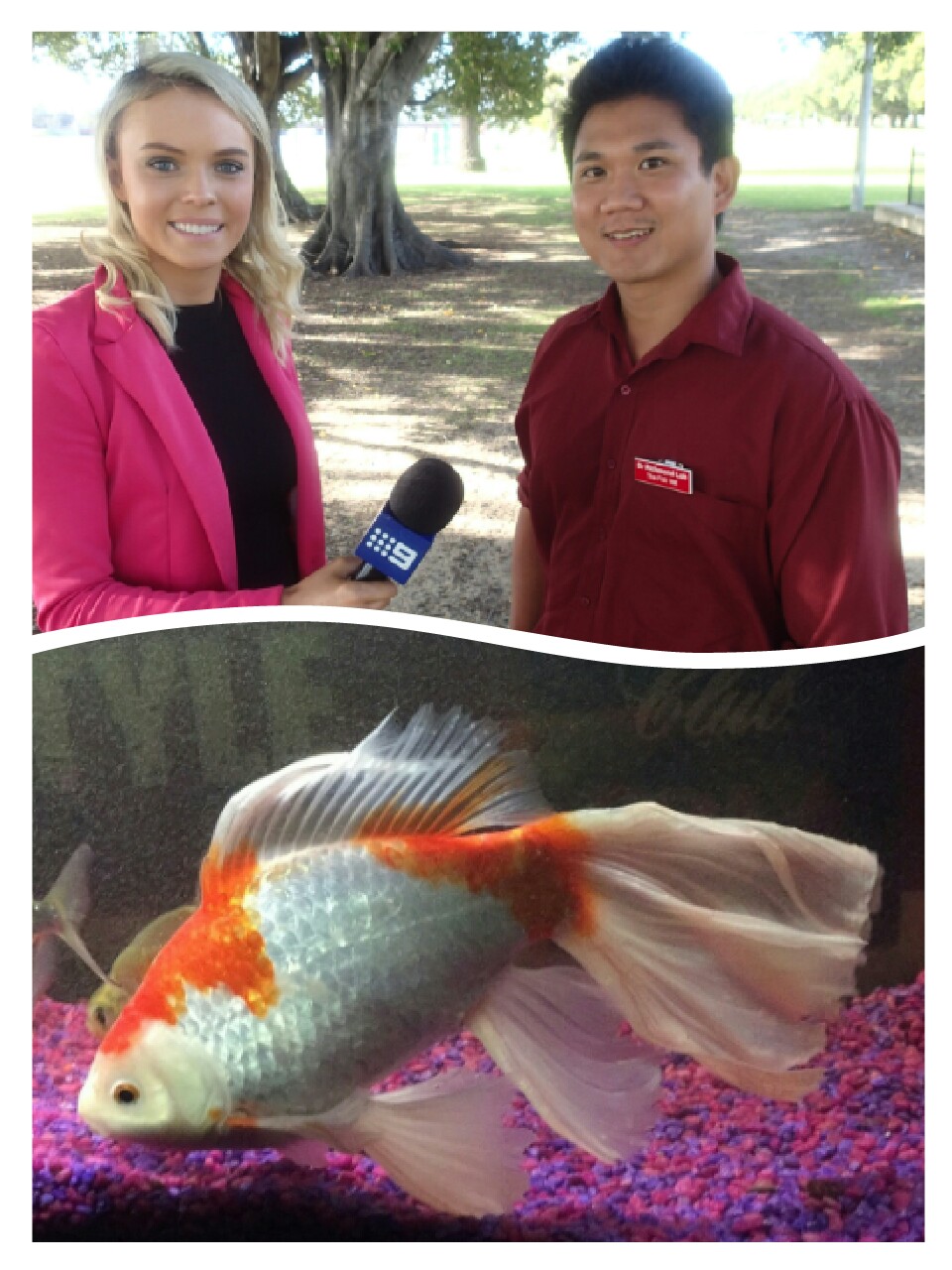
The world’s longest goldfish!

This week I was contacted by a client who believes they have the world’s longest goldfish.

We’ve had a flurry of interest from the media for this very special story.

I said to the reporter from Channel Nine News, Ms Sinclair, "We’d love to promote that fish are long-lived, and long-loved pets, and Goldie just happens to be well, long!"

The Koi Society of WA have been kind enough to allow us to partake in the official (potentially) record-breaking measurements at their Annual Koi Show. This will be held on Sunday 12 June, at Ramon’s at Willow Pond, Canning Vale.

It’s free entry. Come show your support for pet fish at the KSWA show.

Watch Channel 9 News tonight to see our interview!

—
Yours sincerely,

Dr Richmond Loh

DipProjMgt, BSc, BVMS, MPhil (Pathology), MANZCVS (Aquatics& Pathobiology), CertAqV, NATA Signatory.

PERTH | MELBOURNE | TOWNSVILLE
THE FISH VET – AUSTRALIA.

Aquatic Veterinary Medical & Diagnostic Services.
http://www.thefishvet.com.au
Ph: +61 (0)421 822 383

Contender for the world’s longest goldfish – to beat the Guinness Book of Records!

This week I was contacted by a client who believes they have the world’s longest goldfish.

We’ve had a flurry of interest from the media for this very special story from from Goldie’s owner, Candice.

I said to the reporter from Channel Nine News, Ms Sinclair, "We’d love to promote that fish are long-lived, and long-loved pets, and Goldie just happens to be well, long!"

The Koi Society of WA have been kind enough to allow us to partake in the official (potentially) record-breaking measurements at their Annual Koi Show. This will be held on Sunday 12 June, at Ramon’s at Willow Pond, Canning Vale.

It’s free entry. Come show your support for pet fish at the KSWA show.

Watch Channel 9 News tonight to see our interview!

—
Yours sincerely,

Dr Richmond Loh

DipProjMgt, BSc, BVMS, MPhil (Pathology), MANZCVS (Aquatics& Pathobiology), CertAqV, NATA Signatory.

PERTH | MELBOURNE | TOWNSVILLE
THE FISH VET – AUSTRALIA.

Aquatic Veterinary Medical & Diagnostic Services.
http://www.thefishvet.com.au
Ph: +61 (0)421 822 383

Fishes Have Feelings, Too!

From The New York Times:

Fishes Have Feelings, Too

If we understood how sophisticated and sentient these marine creatures were, we might treat them better…

… indicates self-awareness, a mental attribute previously known only among creatures of noted intelligence like great apes, dolphins, elephants and magpies…

http://www.nytimes.com/2016/05/15/opinion/fishes-have-feelings-too.html

—
Yours sincerely,

Dr Richmond Loh 

DipProjMgt, BSc, BVMS, MPhil (Pathology), MANZCVS (Aquatics& Pathobiology), CertAqV, NATA Signatory.

PERTH | MELBOURNE | TOWNSVILLE
THE FISH VET – AUSTRALIA. 

Mobile Aquatic Veterinary Medical & Diagnostic Services.
http://www.thefishvet.com.au
Ph: +61 (0)421 822 383

Guinness crowns 30-year-old world’s oldest living cat, but did you know that pet fish can live far longer?

Guinness World Records has named a 30-year-old male Siamese cat called Scooter the oldest living cat in the world. Scooter was born on March 26, 1986, and still lives with the same owner in Texas. Scooter’s veterinarians say the cat has a "strong will to live," and his owner says she has worked to keep him active, to which she credits his longevity.

Source:

But did you know that the average pet koi can live to well beyond 30 years? They can achieve greater than 50 years! I’ve clients with pet koi that’ve been passed down a generation, that are now the only living memory of their parent/s that had passed on. I’ve treated populations of fish where some were as old as me!

And, “How old am I,” you might ask? I’ll let you take a guess 🙂

Follow me on: Facebook "Fin Page" – YouTube – Blog – Linkedin – Twitter

—
Yours sincerely,

Dr Richmond Loh
DipProjMgt, BSc, BVMS, MPh (Pathology), MANZCVS (Aquatics & Pathobiology), CertAqV, CMAVA, NATA Signatory.
Aquatic Veterinarian & Veterinary Pathologist
THE FISH VET, AUSTRALIA – PERTH | MELBOURNE | TOWNSVILLE
Mobile Aquatic Veterinary Medical & Diagnostic Services.
http://www.thefishvet.com.au
Ph: +61 (0)421 822 383
Skype: thefishvet

President WAVMA 2014

Adjunct Lecturer Murdoch University

Looking for more books? Check out this site.

See advert on YouTube.

This has been a week of interviews!

This week I had an interview with a writer for "The Veterinarian", Clinical Zoo section. They wanted to profile the work life of a fish vet. What do fish vets do? Who are their clients? How do they do it?

I was stoked to be given the opportunity to increase awareness that fish need vets, and that vets can help. The main theme is, "Do fish, or refer it."

I briefed her about The Fish Vet’s team located in different parts of Australia, and expanding. I spoke of the types of clients we get, ranging from pet goldfish, to breeders of koi, and people with backyard aquaponics. I spoke of our aquaculture clients with barramundi, silver perch, abalone and shrimp. I spoke of servicing public aquariums, and clients at research institutions dealing with zebrafish and sharks. How we also provide health certification for live fish exports. We also have the capacity to provide Aquatic Veterinary Pathology Laboratory services, research and training. If you’re dealing with TheFishVet’s Team, then you’ve pretty much got it all.

I am so passionate about the subject, that I think I chewed the ear off the reporter, or kept them way past their bedtime over east.

The reporter remarks, "You have such a fascinating job and it was really great to talk to you, and I love the advocacy work you do for fish!"

Look out for the article in "The Veterinarian."

—
Yours sincerely,

Dr Richmond Loh

DipProjMgt, BSc, BVMS, MPhil (Pathology), MANZCVS (Aquatics& Pathobiology), CertAqV, NATA Signatory.

PERTH | MELBOURNE | TOWNSVILLE
THE FISH VET – AUSTRALIA.

Aquatic Veterinary Medical & Diagnostic Services.
http://www.thefishvet.com.au
Ph: +61 (0)421 822 383

How do you do operation on fish?

Fish surgery is not uncommon with many clients. Removal of skin tumours, and deflating swimbladders are the most common surgical procedure in fish.

The patient is first anaesthetised, and then removed from the water. Gills and skin are irrigated to maintain moisture, and to deliver oxygenated water and anaesthetics.

It’s done with fish out of water to preserve an aseptic surgical field.

Check out the video my client put together on surgery of their goldfish –

https://facebook.com/story.php?story_fbid=1229584153725972&substory_index=0&id=100000231978462

—
Yours sincerely,

Dr Richmond Loh

DipProjMgt, BSc, BVMS, MPhil (Pathology), MANZCVS (Aquatics& Pathobiology), CertAqV, NATA Signatory.

PERTH | MELBOURNE | TOWNSVILLE
THE FISH VET – AUSTRALIA.

Aquatic Veterinary Medical & Diagnostic Services.
http://www.thefishvet.com.au
Ph: +61 (0)421 822 383