Plastics never really breakdown completely, and can accumulate.
Swedish researchers report their findings on how it affects fish health and behaviour, and possible effects higher up the food chain.
How will it affect us?
All about Fish Vetting – Dr Richmond Loh
Plastics never really breakdown completely, and can accumulate.
Swedish researchers report their findings on how it affects fish health and behaviour, and possible effects higher up the food chain.
How will it affect us?
Many people have asked me what is the best method for “putting fish to sleep”. As veterinarians, we have access to anaesthetics.
But for the general public this will not be the case. Members of the public may be able to access clove oil from their local pharmacy or chemist. The active ingredient is eugenol. Being an oily liquid, this will need to be pre-dissolved by shaking several drops of the oil in a bottle of water. This solution can then be added to the aquarium that is holding the fish to be euthanased. The final dose rate is approximately more than 10 drops per litre of water.
A fish’s heart will continue to beat for a relatively long time, and so, your fish will need to remain in this solution for an additional of at least 30 minutes after signs of last opercular movements, to ensure the anaesthetic has resulted in death. A secondary method of euthanasia may be used, provided your fish is fully anaesthetised (and cannot feel pain).
Leaving fish in the aquarium to die slowly without medical attention is inhumane.
Most first-time fish keepers are amazed when they discover there’s a way to vacuum the crud from aquariums without having to empty their entire tank of its contents. Watch video – 1. With the new-found tool to make cleaning aquariums a quick and simple task, fish health improves and the number of tanks, and their sizes increase in their homes. In another video, we show you other ways you can get your siphon working, without getting a mouthful of muck! Watch video -2. 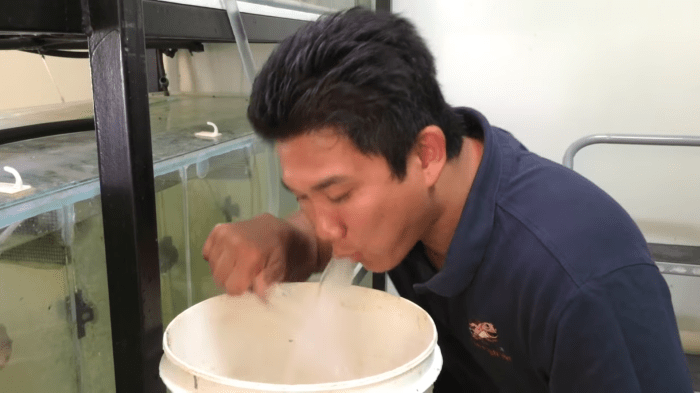
Q: What’s a good name for a female crab?
A: Claw-dia
Have a FINtastic week! R <+>{
We’d like to congratulate our Brazilian-trained veterinarian on being awarded her doctorate degree last month. Now what do you call a veterinarian with a PhD? A Doctor Doctor! 
Q: Why can’t you hear Pseudanthias when they go to the toilet?
A: Because the P is silent.
With thanks to Den.
Have a FINtastic week! R <+>{

Consider attending or giving a presentation, with 5 days of aquatic veterinary lectures, wet labs and farm visits.
Important Deadlines
December 15, 2017: Early-Bird Discount On-line Registration Closes
February 15, 2018: Regular On-line Registration Closes
March 1, 2018: Speaker/Poster Abstract Submission Closes
April 1, 2018: Discount Hotel Reservations End
April 5, 2018: Late On-line Registration Closes (on-site only)
… and cancers… Do they have something in common?
A report found “chemicals may be a contributing factor in some of the events that were investigated.”
Your thoughts?
Interested in aquatic veterinary medicine?
Watch and subscribe to – http://tinyurl.com/thefishdoctor
—
Yours sincerely,
Dr Richmond Loh
DipProjMgt, BSc, BVMS, MPhil (Pathology), MANZCVS (Aquatics& Pathobiology), CertAqV, NATA Signatory.
Aquatic Veterinarian & Veterinary Pathologist.
PERTH | MELBOURNE | SYDNEY | TOWNSVILLE | BRIBIE ISLAND.
THE FISH VET – AUSTRALIA.
Aquatic Veterinary Medical & Diagnostic Services.
Web: http://www.thefishvet.com.au
Ph: +61 421 822 383
Mail: PO Box 5164, East Victoria Park, WA 6981, Australia.

Q: What is the best way to communicate with a fish?
A: Drop him a line!
With thanks to Spike.
Have a FINtastic week! R <+>{