Q: What do you call someone who’s obsessed with fish?
A: A FINatic!
All about Fish Vetting – Dr Richmond Loh
Q: What do you call someone who’s obsessed with fish?
A: A FINatic!
Are you tired of dealing with a fish disease issue that you just can’t get to the bottom of? You can save an enormous amount of time if you can get it lab tested.
You can now access Dr Loh’s diagnostic services even if you’re not a local. With a lab sampling kit of formalin and bacterial transport swabs, The Fish Vet is sure to get a diagnosis for you. With a correct diagnosis, we can then set up a treatment or management plan.
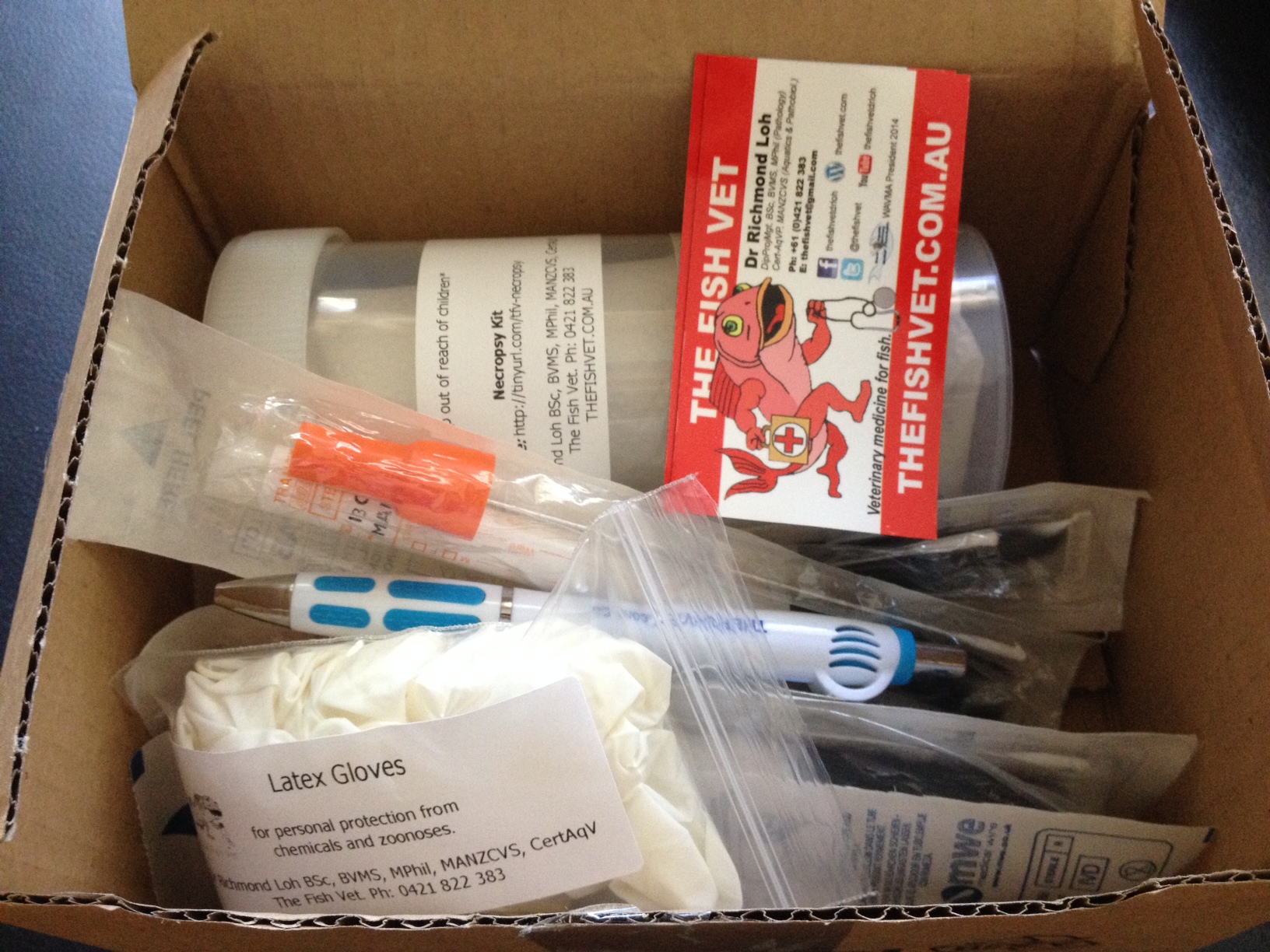
You can order your kit here:
http://thefishvet.com.au/shop/shopping.html
—
Yours sincerely,
Dr Richmond Loh
DipProjMgt, BSc, BVMS, MPhil (Pathology) Murdoch, MANZCVS (Aquatics& Pathobiology), CertAqV WAVMA.
The Fish Vet, Perth, Western Australia.
Veterinary Medicine for fish.
W: http://www.thefishvet.com.au
E: thefishvet
P: +61 (0)421 822 383
One of my colleagues has asked me to circulate this short survey with the hope of developing training courses that are better suited to aquatic animal health personnel.
Thank you in advance for taking the time to complete this survey comprising 12 short questions.
You may contact Dr Susan Gibson-Kueh for further information on: S.Kueh@murdoch.edu.au
Please use this link to the survey: https://www.surveymonkey.com/s/ShortCrsAquaticHealth_MurdochU5
In his Presidential address, he says,”The discipline of aquatic veterinary medicine can be described as both a niche, and the fastest growth area in veterinary science. The WAVMA is dedicated to reinvent veterinary science by bringing aquatic veterinary medicine to the forefront, creating new opportunities, positioning ourselves for the future, by building a competitive advantage and harnessing the skills of its members.”
“The vision for this year is to promote and fine tune our existing programs, and to create more opportunities for aquatic veterinarians. We need to enhance market access of aquatic veterinarians and improve, not only the awareness of aquatic veterinarians, but also client perception of our area of expertise. By doing these things, we can really grow the World Aquatic Veterinary Medical Association.”
“So what have we for the year ahead? My challenge for this year is to promote and fine tune our existing programs, and to create more opportunities for aquatic veterinarians. We need to enhance market access of aquatic veterinarians and improve, not only the awareness of aquatic veterinarians, but also client perception of our area of expertise. By doing these things, we can really grow the World Aquatic Veterinary Medical Association.”
“Three areas we will concentrate on in the year ahead are:
1. Relevance: to satisfy the needs and wants of its members, through support, CEPD, recognition of prior experience and defending the aquatic area for the veterinary profession.
2. Pre-eminence: about growing the WAVMA brand within our profession (to our colleagues) and outside our profession (to our clients) by promoting the value and utilisation of suitably qualified aquatic veterinarians to our clients.
3. Reach: through the internet (social media) and engaging in open dialogue with other organisations.”
“To increase our presence and visibility, we need to be present in our clients’ forums, such as at aquaculture conferences, ornamental fish shows and on line. After attending some of the presentations by our members, I realise that we are sitting on a gold mine of practical experiences that are not taught at university or at any other educational institution. I would like to show case our members’ skills and knowledge by ramping up the WebCEPD, and open it up to the world. This will not only help increase visibility of the presenters, but will increase the public’s appreciation for aquatic veterinarians. So, I look forward to receiving requests for topics, and offers to present webinars.”
“We are also looking at fostering more inter-organisational collaborations. Because, the more people we have working together to achieve a common goal, the faster we can arrive. Join our cause to unleash your potential and to seek new possibilities. Enquire now about taking up some leadership roles, to help develop programs & set future directions.”

When a fish is out of water for a significant period, their tissues will be exposed to the air and desiccation is a real issue.
In addition to putting the fish back in the water as soon as possible, treatment and recovery will need to address a few things:
1. Damaged skin needs healing.
2. Damaged skin is leakier.
3. Secondary bacterial infection might set in.
4. Pain management needs to be addressed.
To address these, provide:
1. Vitamin C to promote wound repair and immunity.
2. Reduce the osmoregulatory stress by bringing the water 1-5ppt closer to its body (i.e. Raise salinity for freshwater fish, and reduce salinity in marine fish).
3. Broad spectrum antibiotics to fend off secondary bacterial infection.
4. Meloxicam or flunixin as anti-inflammatory.
—
Yours sincerely,
Dr Richmond Loh
DipProjMgt, BSc, BVMS, MPhil (Pathology) Murdoch, MANZCVS (Aquatics& Pathobiology), CertAqV WAVMA.
The Fish Vet, Perth, Western Australia.
Veterinary Medicine for fish.
W: http://www.thefishvet.com.au
E: thefishvet
P: +61 (0)421 822 383
Q: where do sea slugs (nudibranchs) go for a good time?
A: To the ‘nudie’ bar.
Adapted from a joke shared by Mr Leingang via LinkedIn.
Follow me on: Facebook “Fin Page” – YouTube – Blog – Linkedin – Twitter
—
Yours sincerely,
Dr Richmond Loh


Tomorrow, I’ll be doing some filming with Mr Chris Rout (store owner and manager) on location to create some instructional videos.
With our combined expertise, we will address all the FAQs to do with aquariums and fish keeping, in one day of filming. We will upload them to YouTube as soon as they’re available.
Why not drop in, or email me, with some ideas on what you’d like us to address.
—
Yours sincerely,
Dr Richmond Loh
DipProjMgt, BSc, BVMS, MPhil (Pathology) Murdoch, MANZCVS (Aquatics& Pathobiology), CertAqV WAVMA.
The Fish Vet, Perth, Western Australia.
Veterinary Medicine for fish.
W: http://www.thefishvet.com.au
E: thefishvet
P: +61 (0)421 822 383
What’s your verdict?
From: “Dr. David Scarfe”
Date: 25 November 2013 7:05:04 AWST
Subject: AquaVetMed e-News: Do Lobsters Feel Pain?
November 24, 2013
Do Lobsters Feel Pain?
Whether lobsters feel pain or not has fueled a sharp debate with lobster fishermen, animal rights activists, and scientists all weighing in. Determining whether lobsters feel pain is a key point in the animal cruelty-lobster cooking debate and scientists have weighed in with arguments of their own.
Scientist Says Lobsters Do Not Feel Pain – In the 2005 study “Sentience and Pain in Invertebrates”, published for the Norwegian Scientific Committee for Food Safety, biology professor Lauritz Somme from the University of Oslo concluded that “it is unlikely they [lobsters] can feel pain”. The professor argues that what may look like pain – a lobster thrashing about in a boiling pot – is actually a reflex to stimuli. This is different from pain which requires sentience or a sense of self-awareness. In essence, a lobster does not have the mental capacity to process pain and know it is feeling pain. This is an opinion shared heartily by those in the lobster industry. Bob Bayer, the Director of Maine’s Lobster Institute, is quoted as saying in the Institute’s Spring 2005 The Lobster Bulletin, “We’ve maintained all along that the lobster doesn’t have the ability to process pain….Neither insects nor lobsters have brains”.
Recent Studies Show Lobsters Feel Pain – Although proving sentience is difficult, recent studies may help prove that lobsters feel pain. Jennifer Viegas writes … … .
See the source (http://suite101.com/a/do-lobsters-feel-pain-a220490) for the full story.
[Recent press attention to pain and welfare of lobsters and other invertebrates was stimulated by a recent PETA “undercover” video of a lobster process facility – http://tinyurl.com/kwqnlbv. Some early attempts to objectively discuss invertebrate pain and welfare is available at http://www.vkm.no/dav/413af9502e.pdf and http://www.oie.int/doc/ged/D2217.PDF. ADS-Mod]
___________________________
AquaVetMed e-News provides information to veterinary and veterinary-allied subscribers concerning aquatic animal medicine, health, welfare, public health and seafood safety, obtained from a variety of sources (largely AquaVetMed subscribers). While provided by the American Veterinary Medical Association’s, Aquatic Veterinary Medicine Committee and are for public distribution, they do not necessarily reflect the opinion of the AVMA or the veterinary profession. See the AVMA Terms of Use (http://tinyurl.com/29h2rf) for further information.
If e-News information is used elsewhere please acknowledge AquaVetMed as the source. Encourage individuals to subscribe rather than distribute through list serves.
Messages may contain attachments that will have been scanned for known viruses.
Subscription and Contributions: Interested veterinarians and veterinary-allied professionals can subscribe, unsubscribe, or contribute pertinent news or information, by sending a message with “For AquaVetMed -” and the topic in the subject line, to dscarfe@avma.org.
Note: Undelivered e-mails will not be resent; Subscribers will be deleted from the list after repeated undelivered or bounced messages and will have to re-subscribe.
Visit our website: http://www.avma.org
________________________________
Scotland, UK: Inverness-based Fish Vet Group (FVG) today announced further consolidation of its position as the largest international aquaculture health provider with the merging of Ireland-based Vet Aqua International into the growing FVG business.
The integration of the two practices brings additional capacity and expertise to Fish Vet Group… with 9 specialist veterinary surgeons working alongside a multi-disciplinary team of diagnosticians, biologists and environmental scientists.
