Bindi Irwin in hot water over SeaWorld gig.

What are your thoughts on this issue? Is it an issue? Is it an opportunity to improve practices and to allow humans to bond with animals?

Read the article here-

http://mobile.news.com.au/world/breaking-news/bindi-irwin-slammed-for-seaworld-support/story-e6frfkui-1226847585681

—
Yours sincerely,

Dr Richmond Loh
DipProjMgt, BSc, BVMS, MPhil (Pathology) Murdoch, MANZCVS (Aquatics& Pathobiology), CertAqV, NATA Signatory.
THE FISH VET, Perth, Western Australia.
Veterinary Medicine for fish.
W: http://www.thefishvet.com.au
E: thefishvet
P: +61 (0)421 822 383

A very acrobatic stingray was captured on camera flying through the air at the Quiksilver and Roxy Pro on the Gold Coast.

http://mobile.news.com.au/national/stingray-leaps-out-of-the-water-at-quiksilver-roxy-pro-just-missing-stephanie-gilmores-jet-ski/story-e6frfkp9-1226847072626

—
Yours sincerely,

Dr Richmond Loh
DipProjMgt, BSc, BVMS, MPhil (Pathology) Murdoch, MANZCVS (Aquatics& Pathobiology), CertAqV, NATA Signatory.
THE FISH VET, Perth, Western Australia.
Veterinary Medicine for fish.
W: http://www.thefishvet.com.au
E: thefishvet
P: +61 (0)421 822 383

American Association of Fish Veterinarians, 1st Annual Continuing Education Meeting

This conferences looks like a very interesting and practical mix for aquatic veterinarians to attend and exchange ideas.

From: “Dr. David Scarfe”
Date: 1 March 2014 2:43:02 AWST
Subject: AquaVetMed e-News: AAFV First Annual CE Meeting – April 2014 (Shepherdstown, WV, USA)

February 28, 2014
American Association of Fish Veterinarians, 1st Annual Continuing Education Meeting

Clarion Hotel and Conference Center, Shepherdstown, West Virginia (www.clarionhotel.com/hotel-shepherdstown-west_virginia-WV012). April 28, 2014. 8 am to 4 pm (Preceding the Eastern Fish Health Workshop)

7 hours of RACE approved, clinically relevant, FISH ONLY Veterinary CE, including presentations on:
• Clinical Pathology
Pathologic Findings on Fish Wet Mount Cytology – Dr. Roy Yanong
Non-parasitic Beneficial Microorganisms & Freshwater Ecosystem Evaluation – Dr. Julius Tepper
CBC, Biochemistry and Acid/Base Balance in Fish – Dr. Kat Hadfield
Non-Wet Mount Cytology (Impression Smears, Fluid Analysis etc.) – Dr. Drury Reavill

• Business & Economics of Fish Practice
Keys to Success in Fish Practice: Economics with a Focus on Production Medicine – Dr. Hugh Mitchell
Staying Afloat, The Business End of Pet Fish Medicine – Dr. Brian Palmeiro
What Poultry Can Teach Us About Fish – Dr. Myron Kebus
Roundtable Discussion on Fish Practice – Drs. Mitchell, Palmeiro, Kebus, Roberts-Sweeney, Tepper

• Fish Radiology:
Fish Radiology Including Clinical Case Examples – Dr. Shane Boylan
Reproductive Ultrasound in Fish – Dr. Lori Campbell

• Emerging Pathogens
Emerging Viral Pathogens in Fish – Dr. Tom Waltzek
Franciscellosis in Ornamental and Production Fish – Dr. Esteban Soto

• Surgery and Anesthesia in Pet Fish – Dr. Helen Roberts-Sweeney

• Clinical Cases – Drs. Scott Weber, Kathy Heym and Mike Hyatt

Early registration including meals (deadline March 15th 2014):
$100 for AAFV Members ($150 after March 15th)
$175 for non-AAFV Members ($225 after March 15th)
$50 for students ($100 after March 15th)

___________________________
AquaVetMed e-News provides information to veterinary and veterinary-allied subscribers concerning aquatic animal medicine, health, welfare, public health and seafood safety, obtained from a variety of sources (largely AquaVetMed subscribers). While provided by the American Veterinary Medical Association’s, Aquatic Veterinary Medicine Committee and are for public distribution, they do not necessarily reflect the opinion of the AVMA or the veterinary profession. See the AVMA Terms of Use (http://tinyurl.com/29h2rf) for further information.

Subscription and Contributions: Interested veterinarians and veterinary-allied professionals can subscribe, unsubscribe, or contribute pertinent news or information, by sending a message with “For AquaVetMed -” and the topic in the subject line, to dscarfe@avma.org. If e-News information is used elsewhere please acknowledge AquaVetMed as the source. Encourage individuals to subscribe rather than distribute through list serves.

Note: Undelivered e-mails will not be resent; Subscribers will be deleted from the list after repeated undelivered or bounced messages and will have to re-subscribe. Messages may contain attachments that will have been scanned for known viruses.

Visit our website: http://www.avma.org
_______________________________

What can I treat leeches with?

That’s a common question of late. Leeches can be a pest, sucking blood and creating sores by which other diseases can get in and cause severe disease and death in fish.

What are some chemicals that would work, to kill the parasites that are still safe for the fish? Organophosphates like trichlorfon and fenthion would work. Copper sulphate works against all invertebrates. Flubendazole would work, but it’s not available in Australia.

Dr Ypelaan added a non-chemical way.
Set a trap using a container with raw meat, and nail holes to allow leeches in but not out.

Have I left anything out?

How do you get your first fish vet job, when all employers want is someone with experience?

I often receive request from junior colleagues on how they could get their foot in the door to advance themselves in this aspect of their veterinary career.

Getting the first job is the most difficult part. It’s a bit of the chicken and the egg thing. Employers want someone with experience, and as the potential employee, you can’t get experience if you don’t get the job. Aaargh!

For most aquatic vets, there’s some form of luck involved. So, how did we get lucky? Luck was once explained as ‘preparation meeting opportunity.’

This ‘experience’ that employers are after is the ‘preparation’ part. You can begin fish keeping if you’ve not already done so. Volunteer at public aquaria and get in amongst the curatorial part of things. Attend seminars, workshops, conferences. Read texts, journals and news. Do an Honours, Masters or PhD on an aquatic-related topic. Look for jobs in aquatic related fields and more.

Wow! That’s a lot of effort. Yes it is. Only the passionate make it. All this effort is to gain knowledge and to form networks. At a seminar I attended, I live this quote,”In the past it was ‘It’s not what you know, but who you know.’ Now it’s not who you know, but who knows you!'”

In Australia, most aquatic veterinarians found their first fish job through government agencies, often as fish pathologists at the laboratories. This was a great training ground for most of us, and we were able to make many connections in the industry, and had access to a wide variety of resources (training, conferences and people).

Some stay in government, and some branch off to work for themselves as aquaculture veterinary consultants, and may have enough work to start employing others.

Those veterinarians who work with pet fishes and public aquaria tend to do so as a supplement to their normal day job. Receiving patients in their clinics, or make site visits. Some are lucky enough to be employed full time by very large public aquaria.

As a new graduate veterinarian, you can try to get a traditional job close to a public aquarium, or get a job where the boss is interested in allowing you to pursue this aspect of veterinary science. From there, start approaching all fish related businesses and let them know you’re here, to be of service.

To fast track your knowledge on aquatic Veterianry aspects, I encourage you to obtain copies of the Fish Vetting series of resources. They’re available at this link
http://thefishvet.com.au/
—
Yours sincerely,

Dr Richmond Loh
DipProjMgt, BSc, BVMS, MPhil (Pathology) Murdoch, MANZCVS (Aquatics& Pathobiology), CertAqV, NATA Signatory.
THE FISH VET, Perth, Western Australia.
Veterinary Medicine for fish.
W: http://www.thefishvet.com.au
E: thefishvet@gmail.com
P: +61 (0)421 822 383

Fish owners warned ‘no junk food’

HUMANS are not the only species to suffer from a diet of junk food.

An aquarium has warned fish owners not to feed food meant for humans to their pets after it had to wean a giant gourami off a diet of prawn cocktail-flavoured chips.

Read more here.

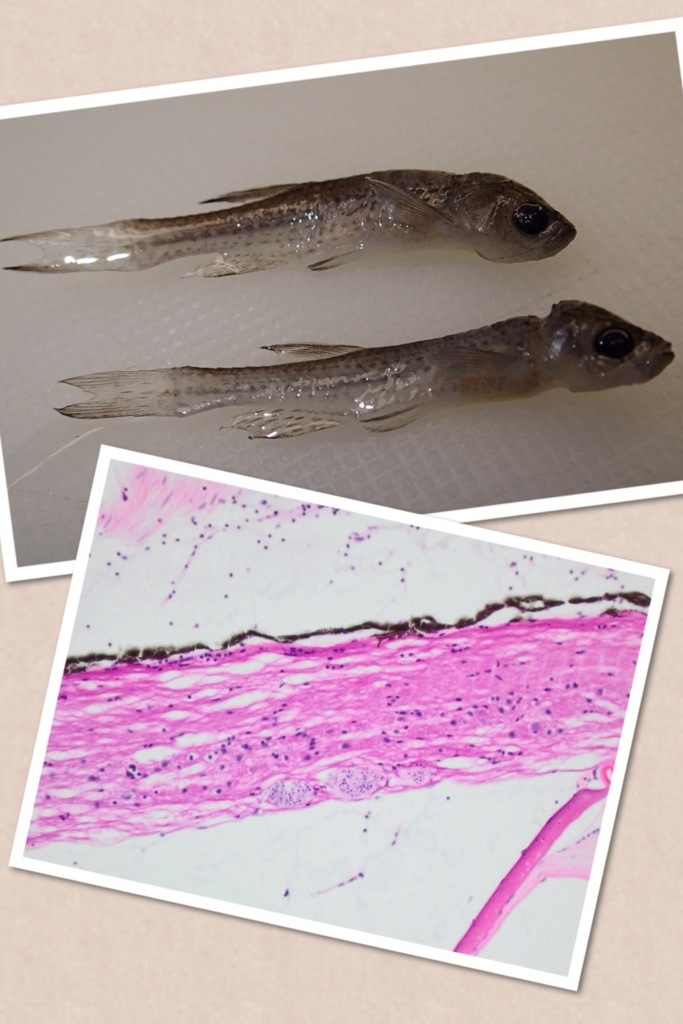
Pseudoloma neurophila causing scoliosis and wasting in Zebrafish.

At the beginning of this month, I attended the Annual ANZ Zebrafish Workshop at the Garvan Institute, Sydney, as an invited speaker. There were many fish health personnel there and aquatic veterinarians.

One of the presentations spoke of a parasitic disease of the nervous system, which although have been reported to be not uncommon in the literature, none of us had diagnose it here in Australia.

One of the veterinary pathologists at the private labs was seeking material as a positive control, and perhaps try to run a special histology stain called the ‘Luna stain’ to help with parasite detection.

I was just discarding old formalin-fixed fish specimens from my store and came across two leopard danios with scoliosis and in very thin condition. These fish were sampled back in April 2013, from one of my client’s tanks, but no further testing was done.

Of course, with these sorts of clinical signs, I expected to see the fish riddled with Mycobacteria and granulomas (because common things happen commonly). Anyway, I prepared them for histology processing and wallah! The little critters are present throughout the spinal cord (pictured below). You can be privileged to share with me, the excitement of being among the first to see this parasite from an Australian specimen!

20140226-145843.jpg

Could this be the first diagnosis of such in Australia? It’s not the purist thing to do, but it’s a pathologist thing to do. I based it on organism morphology, host species, neural location and clinical signs of emaciation and spinal curvature (a paper described the prevalence of infection in skinny fish with bent spines is 97% and those in normal fish, is 30%).

From a ‘lab rat’ point of view, we should get multiple lines of evidence to confirm it to a species level. I’m going to get the Luna stain to light up the organisms and am sending some wax scrolls for DNA testing.

For more information about this disease, go to:

Transmission, Diagnosis & Control of Pseudoloma in Lab Zebrafish.

Did you know you have access to The Fish Vet’s expertise, no matter where you are in the world?

Are you a pet fish keeper, ornamental fish breeder, retailer or fish farmer? Are you running public aquaria? Do you use fish in your educational/research institution? Are you an aquaponics or a food fish aquaculture farmer?

Do you use the services of an aquatic veterinarian? Is there one close by?

Did you know that you can access The Fish Vet’s services right where you are?

1. Locally, I provide site visits to my clients. I service clients as far south as Mandurah (and Bremer Bay!) as far north as Yanchep and as far east as Ellenbrook and Armadale. Here, I perform field diagnostics, and I bring along my portable pharmacy to treat your fish’s ailments, or refer you back to fish shops for medicines that they stock.

20140218-140551.jpg

2. If you are not exactly local, we can schedule a visit, by flight, to any state in Australia (e.g. WA, NSW, Victoria, Tasmania), or overseas (e.g. Singapore, Malaysia, New Zealand, Hong Kong).

20140218-140423.jpg

3. I can work through your local veterinarian to achieve a suitable outcome. See picture below.

20140218-135647.jpg

4. If you wish to proceed with a direct phone or email consultation, please select the appropriate item from the shopping cart at http://www.thefishvet.com.au/shop/shopping.html

 5. Alternatively, feel free to search for free information on my blog (thefishvet.com).
(Quick link to this post – http://tinyurl.com/fishvetconsult)