2015 AQUAVET(R) I & II & III

The College of Veterinary Medicine at Cornell University is pleased to announce the 2015 AQUAVET® I, II & III course offerings. They are aquatic veterinary medicine education programs that currently consist of two courses that will be presented at Roger Williams University in Bristol, RI in June 2015 and one on aquarium medicine held in three venues.

AQUAVET®I: An Introduction to Aquatic Veterinary Medicine is a 4-week course (24 May – 20 June 2015) intended primarily for veterinary students.

AQUAVET®II: Comparative Pathology of Aquatic Animals is a 2-week course (24 May – 6 June 2015) that is oriented toward the pathology of diseases of aquatic invertebrates and fish that are used in biomedical research, encountered in display aquaria and are of importance in commercial aquaculture.

AQUAVET®III: Clinical Aspects of Captive Aquatic Animal Medicine is a 5 week course (following AQUAVET® I) and is limited to a small number of students. The venues include GA Aquarium, U of GA and Dolphinaris, Cancún, México.

Veterinary students can receive credits for the courses and graduate veterinarians can receive CE credits.

More detailed information and applications for admission (due by January 15, of each year) are available on the web site www.aquavet.info

Follow me on: Facebook "Fin Page" – YouTube – Blog – Linkedin – Twitter

—
Yours sincerely,

Dr Richmond Loh DipProjMgt, BSc, BVMS, MPhil (Pathology), MANZCVS (Aquatics & Pathobiology), CertAqV, CMAVA, NATA Signatory.
THE FISH VET, Perth, Western Australia, AUSTRALIA.
Mobile Aquatic Veterinary Medical & Diagnostic Services.
http://www.thefishvet.com.au
Ph: +61 (0)421 822 383
Skype: thefishvet
The Fish Vet - Perth, WA

Enrollments now open for SeaVet Clinical Training Course

I attended this course a couple of years ago and I can recommend it as having some very good breadth and depth of information for aquatic veterinarians.

Read more below:

SeaVet Clinical Training Course (June 15-25, 2015), University of Florida, College of Veterinary Medicine

SeaVet Clinical Training is an intensive nine day course designed to teach veterinary medical students and veterinarians through didactic lecture, case-based problem-solving and practical experience. The program also features an educational and interactive hands-on training. This is a three credit professional class through the University of Florida. Academic credit will only be granted to University of Florida veterinary students.

Continuing education credits may be earned by veterinarians. This course has a maximum of 25 allowed by the state of Florida. If requested, a form will be provided at start of the course to keep track of your hours. If you are not in Florida, your state has the right to refuse the credits. However, the University of Florida, College of Veterinary Medicine is accredited with NAVC and out-of-state veterinarians have not been denied credits after attending past SeaVet courses.

IMPORTANT NOTICE: This course is being offered exclusively for Veterinary Students and Licensed Veterinarians. Registrations will not be accepted otherwise.

For more information and to register, go to www.conference.ifas.ufl.edu/seavet/index.html.

For other information contact Rachael Dailey

Course Organizer

University of Florida, College of Veterinary Medicine

PO Box 100136 / Gainesville, FL 32610-0136

Phone: 352-294-4312 / Fax: 352-392-8289

Email: rachael.dailey@ufl.edu

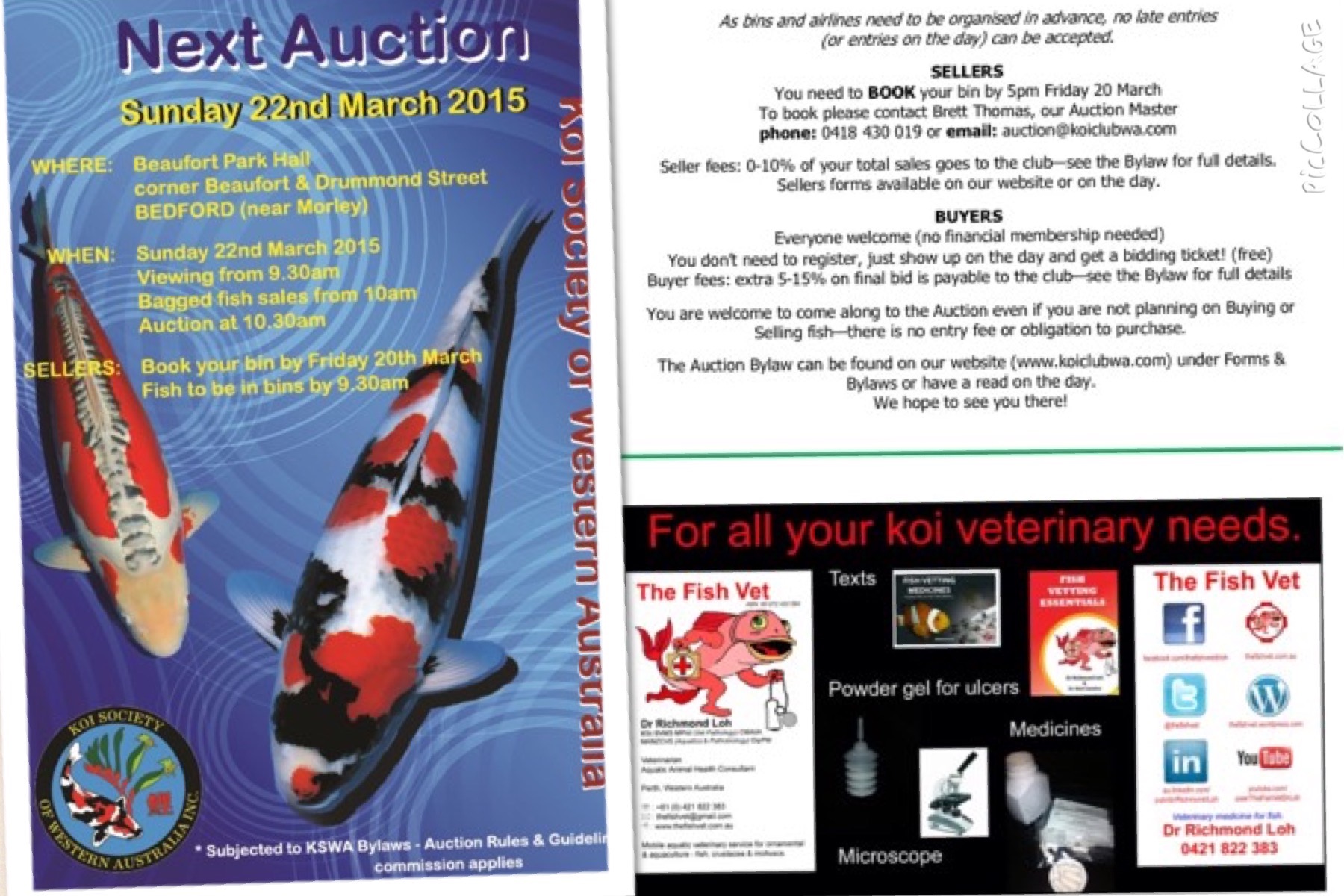
Koi Auction

Who’ll join me at this event?
See picture for details.

—
Yours sincerely,

Dr Richmond Loh
DipProjMgt, BSc, BVMS, MPhil (Pathology) Murdoch, MANZCVS (Aquatics& Pathobiology), CertAqV, CMAVA, NATA Signatory.
THE FISH VET, Perth, Western Australia.
Veterinary Medicine for fish.
W: http://www.thefishvet.com.au
E: thefishvet
P: +61 (0)421 822 383

2014 President WAVMA.org

Free WAVMA Webinar on Aquatic Bacteriology by Dr Nicky Buller.

B-1009: Techniques for collection, culture and identification of bacteria from aquatic animals.

Date: March 20, 2015 Time: 9.00 PM Perth, Western Australian time (+8 GMT). NB: if you cannot make the live event, a recording will be made available to registrants.

 
Duration: 1 hour 

  About this event

This presentation will cover culture techniques and identification of bacteria from fish and other aquatic animals. Topics covered include collection of samples, collection and transport with an emphasis for remote areas; culture requirements for bacteria from freshwater, brackish and marine sources including use of NaCl, sea salts and incubation temperature; the advantages and disadvantages of different bacterial identification systems including conventional biochemical identification methods, use of the API systems and Vitek from Biomerieux, Biolog, and MALDI-TOF (matrix-assisted laser desorption ionisation time of flight mass spectrometry. Molecular techniques for identification of particular bacteria will be discussed briefly.


About the speaker: 

 Dr Nicky Buller BSc, PG Dip Bus, PD Dip Mol Biol, PhD 

Dr Buller is senior microbiologist at Animal Health Laboratories, Department of Agriculture and Food Western Australia where she has worked for over 20 years. Prior to this she worked in medical laboratories. She has a post-graduate qualification in molecular biology, a PhD involving molecular typing techniques, and is the author of Bacteria and Fungi from Fish and Other Aquatic Animals; a practical identification manual. Samples received at AHL include those from aquatic and terrestrial sources


REGISTER NOW – http://www.wavma.org/Webinars/B-1009-Techniques-for-collection-culture-and-identification-of-bacteria-from-aquatic-animals 

 Follow me on: Facebook “Fin Page” – YouTube – Blog – Linkedin – Twitter

— 

Yours sincerely, 

 Dr Richmond Loh DipProjMgt, BSc, BVMS, MPhil (Pathology), MANZCVS (Aquatics & Pathobiology), CertAqV, CMAVA, NATA Signatory.

THE FISH VET, Perth, Western Australia, AUSTRALIA.
Mobile Aquatic Veterinary Medical & Diagnostic Services.
http://www.thefishvet.com.au 

Ph: +61 (0)421 822 383
thefishvet_logo_medical-20130107.jpg
Skype: thefishvet

President WAVMA 2014

Adjunct Lecturer Murdoch University | Secretary Aquatic Animal Health Chapter – ANZCVS.

Not just a Fish Doctor, but The Fish Vet.

What makes Doctor Richmond Loh more than just a mere Fish Doctor? Apart from being able to prescribe and dispense veterinary drugs, what expertise and experience does he bring to the table?

See http://tinyurl.com/qhnvt3p


The welfare implications of fin clipping in fish.

I was recently asked by a member of the Animal Ethics Committee on whether I considered fin clipping a painful procedure in fish. There’s no simple yes/no answer and as veterinarians/scientists, we need to qualify our answers with logical reasoning.

The short answer is that YES, it is a PAINFUL procedure, but the pain is only TRANSIENT.

The tail fin in carp has been documented to contain A-δ and C-type axons (these transmit nociceptive [pain] signals in [higher] vertebrates).This said, it would be difficult to discriminate between the pain from clipping procedure and the handling stress.

Provided that the biopsy is not substantial (no more than 50% of the fin should be resected), the pain would only be transient, and there should be no bleeding. And provided that the procedure is conducted aseptically, and the water quality, nutrition and immunity of fish are optimal, the fin should heal quickly and will regrow. Topical anaesthetic like lidocaine may be beneficial.

One thing that needs consideration is how it would affect the swimming ability of the fish after fin-clipping. In more sedentary fish, it should not be an issue. But if it were the zebrafish that swims at speeds continuously, they rely heavily on the caudal and pectoral fins for swimming. So I would argue that these fins should be avoided for clipping. On another note, the fins that show fastest regeneration times in salmon are the anal fin and the pectoral fins. Conversely, the adipose fin (in species that have them) and pelvic fins show slowest regeneration times in salmon.

So if fin-clips are for collecting genetic material from individual fish for the purpose of genotyping, I’d suggest sampling the anal fin. However, if fin clipping is used for marking/identifying individuals, the pelvic fins might be more suitable because it means fewer repeats are needed for longer studies.

—
Yours sincerely,

Doctor Richmond Loh

DipProjMgt, BSc, BVMS, MPhil (Pathology), MANZCVS (Aquatics & Pathobiology), CertAqV, CMAVA, NATA Signatory.
THE FISH VET, Perth, Western Australia, AUSTRALIA.
Mobile Aquatic Veterinary Medical & Diagnostic Services.
http://www.thefishvet.com.au
Ph: +61 (0)421 822 383
thefishvet_logo_medical-20130107.jpg

Podcast on fish and pain.

This podcast below from Ben Diggles on the controversial area of fish and pain is interesting and relevant.
View it here – http://www.humananimalscience.com.au/fish-pain-welfare/

Dr Ben Diggles lead the iki jime project supported by the Australian Animal Welfare Strategy in the aquatic animal health working group at http://www.australiananimalwelfare.com.au/aquatic-animals ………..This work has been praised in Europe and elsewhere in the world.

Publications:
Rose, J. D., Arlinghaus, R., Cooke, S. J., Diggles, B. K., Sawynok, W., Stevens, E. D., & Wynne, C. D. L. (2014). Can fish really feel pain?. Fish and Fisheries, 15(1), 97-133

Diggles, B. K., Cooke, S. J., Rose, J. D., & Sawynok, W. (2011). Ecology and welfare of aquatic animals in wild capture fisheries. Reviews in Fish Biology and Fisheries, 21(4), 739-765.

Diggles, B. K. (2013). Historical epidemiology indicates water quality decline drives loss of oyster (Saccostrea glomerata) reefs in Moreton Bay, Australia. New Zealand Journal of Marine and Freshwater Research, 47(4), 561-581.

Don’t dump that fish!

Please do take heed. If we want to keep keeping fish, then we ought to act responsibly.

Watch this excellent clip – https://www.youtube.com/watch?v=UhYR5uNa4Bg

—
Yours sincerely,

Dr Richmond Loh
DipProjMgt, BSc, BVMS, MPhil (Pathology) Murdoch, MANZCVS (Aquatics& Pathobiology), CertAqV, CMAVA, NATA Signatory.
THE FISH VET, Perth, Western Australia.
Veterinary Medicine for fish.
W: http://www.thefishvet.com.au
E: thefishvet
P: +61 (0)421 822 383

2014 President WAVMA.org