Does the tank size or water volume affect their growth rate? Last year, I attended the Aquavet II course in the USA. I learnt that the most recent research finding for recirculating aquaculture system (RAS) is that the “partitioned aquaculture system” (PAS) may improve yield per unit total volume or area. The PAS works by dividing the pond to allow 2/3 for the biofilter and only 1/3 for the cultured fish to occupy. The reason for the increased efficiency is not yet understood and this could be investigated further in Australian conditions.
So, I did a short semi-scientific experiment of a different kind with four goldfish. Two fish were in Group A, and they spent their time in a 95L aquarium. Two fish were in Group B, and they spent 3 months in a 4500L set up which was compartmentalised to have a similar amount of swimming space as Group A. Pictured below are two goldfish of the same age.
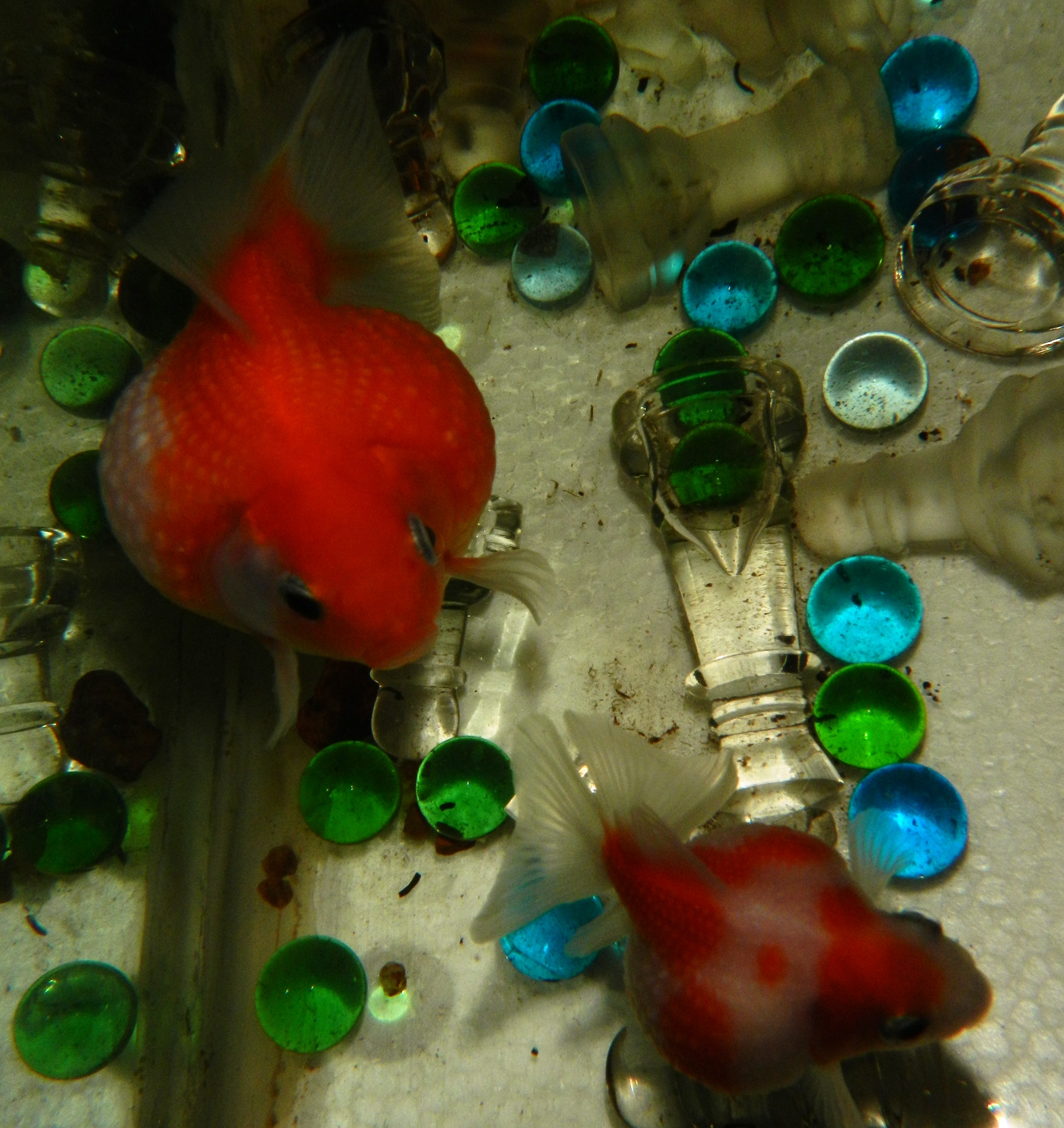
The smaller one belongs to Group A. The larger fish belongs to Group B. Look at the difference in size. At the completion of the experiment, body weights of the small fish were 14g and 16g and the body weights of the large fish were 50g and 59g! That’s a whopping 4x heavier!
What implications does this have for fish breeders and farmers? This experiment shows that water volume, rather than swimming space, plays an important role in goldfish growth rates. This may be to do with better water quality? Maybe production of the growth inhibiting hormone was suppressed (link to previous post). Maybe we could get even better results with a flow through system.
