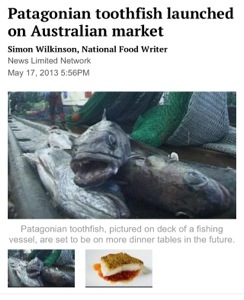
Australia’s most dangerous catch, is ethically sound & delicious!

Its flavour and texture definitely does not match the look of the fish… unless you like eating monster.

I’m so glad it’s reporting that they’ve gained the Marine Stewardship Council certification for sustainability because the Patagonian toothed fish is my favourite fish to eat.

Read more…

20130518-064529.jpg

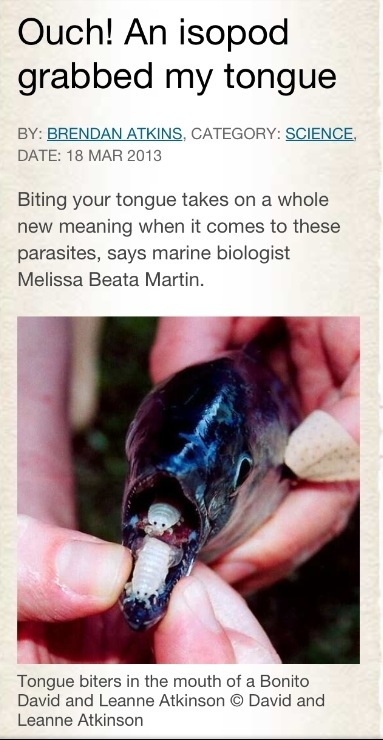
What’s this alien in the fish’s mouth?

Ever landed a fish and found this critter attached to the tongue of your fish? It’s common name is ‘tongue biter’!

20130509-222258.jpg

Tongue biters are isopods (a type of crustacean) belonging to the family Cymothoidae.

Read more here.

Dynamite fishing, destructive.

Interesting documentary on dynamite fishing. See below.

Begin forwarded message:

From: ESAIA e.V.
Date: 16 May 2013 17:50:55 AWST
To: vorstand@esaia.net
Subject: new video: fishing with dynamite

Although dynamite fishing is no applied method in aquarium fisheries in the Philippines, nor elsewhere, we have chosen to include this documentary in our exhibition on Marine Aquarium Fishery and Trade in South East Asia.

Why?

This video unveils the reasoning of poor fishermen in Asia to use destructive fishing methods: They are cheap, they are effective and they provide a relatively high yield at low effort. Forced by the low prices paid for their product and lack of negotiating power, these fishermen will just try to make the most out of nothing.

This is not only true for dynamite fishing, but for cyanide use as well. It confirms the conclusion that any change in respect to environmental awareness and an attitude towards conservation will only develop when fishermen benefit from social justice and development in the same time.

Therefore we invite you to watch this video and apply what you take from it to the aquarium fishery in South East Asia too.

Click here: http://www.youtube.com/watch?v=3j5RXX_Tg-c

SAIA / ESAIA e.V.

Christiane Schmidt
Project Coordinator

Email: fishfood@gmx.net
PH: +49 163 96 55 434
Skype: csonair

http://www.saia-online.eu

Vaccine for Aeromonas hydrophila.

This was brought to my attention by Miriam – Thank you!

I hope that this technology could trickle down to be used in the ornamental fish industry…

Vaccination strategies to protect goldfish Carassius auratus against Aeromonas hydrophila infection

V. Thanga Viji, K. Deepa, S. Velmurugan, M. Birdilla Selva Donio, J. Adlin Jenifer, M. Michael Babu, T. Citarasu*

Centre for Marine Science and Technology, Manonmaniam Sundaranar University Rajakkamangalam, Kanyakumari District, Tamilnadu 629502, India
*Corresponding author. Email: citarasu@gmail.com

ABSTRACT: Ornamental goldfish Carassius auratus were treated with whole cell (WC), extracellular product (ECP), outer membrane protein (OMP) and biofilm (BF) vaccines developed from the virulent Aeromonas hydrophila (AHV1; GenBank HQ331525.1) with and without the immunoadjuvant Asparagus racemosus. On various days post-vaccination (dpv), the treated fish were challenged with virulent A. hydrophila. These fish were monitored for survival, growth, specific bacterial reduction, and biochemical, haematological and immunological parameters. C. auratus attained 100% mortality within 7 d in non-vaccinated groups, whereas the vaccines helped to significantly (p ≤ 0.001) increase survival after 25 and 50 dpv. The vaccines with immunoadjuvant (ECP2, OMP2 and BF2 treatments) helped to reduce the Aeromonas load after the challenge, and serum albumin, globulin and protein levels were significantly (p < 0.01) improved in the OMP2– and BF2-treated groups. Haemoglobin and red blood cell counts were also significantly improved (p < 0.05) in the vaccinated groups compared to the control group. Additionally, haemagglutination occurred at the 1:12 dilution level in the vaccine plus immunoadjuvant-treated groups. Supplementing the vaccines with immunoadjuvant helped to improve phagocytosis to 54.07%, serum bactericidal activity to 14.6% and the albumin:globulin ratio to 7.6% in BF2 after 50 dpv. Its positive effect significantly (p < 0.05) increased in vaccinated groups compared to controls. Based on the results, especially with the OMP and BF vaccines, the immunoadjuvant A. racemosus helped to improve the efficiency of the vaccines. This approach will aid in the development of more efficient vaccines against bacterial infections affecting the aquaculture industry.

KEY WORDS: Ornamental fish · Biofilm · Outer membrane protein · OMP · Herbal immunoadjuvants

Abstract source: http://www.int-res.com/abstracts/dao/v104/n1/p45-57/

Thanga Viji V, Deepa K, Velmurugan S, Donio MBS, Adlin Jenifer J, Babu MM, Citarasu T (2013) Vaccination strategies to protect goldfishCarassius auratus against Aeromonas hydrophila infection. Diseases of Aquatic Organisms 104:45-57

Looking for Fish Vetting paraphernalia?

Check out the most current suite of items available on TheFishVet’s Fanpage’s Shop – (http://tinyurl.com/thefishvetshop).

If it’s not there, drop Dr Loh a line (thefishvet@gmail.com) and he’ll be able to source it for you.

Fish to feed billions!

From: “Dr. David Scarfe”
Date: 9 May 2013 4:47:20 AWST
Subject: AquaVetMed e-News: Aquaculture feeding 9 billion

May 8, 2013
The Importance of Fish for Feeding Nine Billion

Fish has become a regular part of people’s diets across the world with both developed and less developed countries eating fish for a source of protein. As the world’s population becomes more affluent there will also be an increase in per capita protein needs. In meeting this, fish stands out as a protein source which has the ability to manage the resources and environmental issues well, said Dr Sibbel.

The importance of fish for food in the future also circles around its conversion capacity. Fish has one of the best conversion capacities meaning it can convert nutrients to protein much better than other animals. With the prospect that by 2050 the world will have nine billion mouths to feed, the aquaculture industry is expected to play a big role.

In line with this, Rick Sibbel DVM, Director, Merck Animal Health, discusses the utilization of protein sources to feed the world – http://www.youtube.com/watch?feature=player_embedded&v=BLjzXIAkZ3s#!.

___________________________
AquaVetMed e-News provides information to veterinary and veterinary-allied subscribers concerning aquatic animal medicine, health, welfare, public health and seafood safety, obtained from a variety of sources (largely AquaVetMed subscribers). While provided by the American Veterinary Medical Association’s, Aquatic Veterinary Medicine Committee and are for public distribution, they do not necessarily reflect the opinion of the AVMA or the veterinary profession. See the AVMA Terms of Use (http://tinyurl.com/29h2rf) for further information.

If e-News information is used elsewhere please acknowledge AquaVetMed as the source. Encourage individuals to subscribe rather than distribute through list serves.

Messages may contain attachments that will have been scanned for known viruses.

Subscription and Contributions: Interested veterinarians and veterinary-allied professionals can subscribe, unsubscribe, or contribute pertinent news or information, by sending a message with “For AquaVetMed -” and the topic in the subject line, to dscarfe@avma.org.

Note: Undelivered e-mails will not be resent; Subscribers will be deleted from the list after repeated undelivered or bounced messages and will have to re-subscribe.

Visit our website: http://www.avma.org

________________________________
Scholarships available for budding fish vets. Closing date in 4 days!

———- Forwarded message ———-
From: Dr. David Scarfe <DScarfe>
Date: Tue, Apr 30, 2013 at 7:39 AM
Subject: WAVMA Members-L: 2013 Veterinary Student/New Graduate Scholarship Program (May 15 Application Deadline)
To: WAVMA_Members-L

2013 Veterinary Student/New Graduate Scholarship Program

Applications for 2013 Scholarships are now open.

ALL application materials must be submitted by May 15, 2013.

Scholarship Award Intent & Criteria

Awards will be made to WAVMA/SAVMA Members in good standing based on academic merit, past involvement in aquatic veterinary medicine, and the likelihood that the applicant will continue a career in private veterinary practice and provide aquatic veterinary services to clients. Awardees will provide a written report for possible publication in the WAVMA Newsletter within 30 days after completion of the meeting or project and, when possible, awardees are expected to give a presentation about their scholarship experience to veterinary students.

Awards are intended to support involvement and aquatic veterinary education of:

  • · Students enrolled in a recognized academic program leading to a veterinary degree;
  • · Graduate veterinarians enrolled in recognized post-graduate veterinary education programs; or,
  • · Veterinarians who have graduated within the previous 24 months and are in private practice.

Scholarships may be used to offset personal costs for:

  • · Travel, accommodation or registration at aquatic veterinary conferences, symposia and other continuing education and professional development (CEPD) meetings, including on-line aquatic CEPD;
  • · Travel, accommodation and other activities directly associated with externships that expose veterinary students to clinical aquatic veterinary medicine;
  • · Equipment and supplies needed for aquatic veterinary research projects not funded by other financial sources.

For more information and to apply, go to http://www.wavma.org/scholarships.

On a WAVMA Skype meeting at the moment.

Talking about websites, on how to make it more user friendly and how to publicise about the great work we’re doing to recruit more members.

http://www.wavma.org


Yours sincerely,

Dr Richmond Loh
DipProjMgt, BSc, BVMS, MPhil (Pathology) Murdoch, MANZCVS (Aquatics& Pathobiology).
The Fish Vet, Perth, Western Australia.
Veterinary Medicine for fish.
W: http://www.thefishvet.com.au
E: thefishvet
P: +61 (0)421 822 383

Dietary green tea extract improves growth performance, body composition, and stress recovery in the juvenile black rockfish.

The ‘immuno-booster ‘benefits of green tea in fish have been demonstrated in this article. Looks like we’d better get green tea into our diets too.

Aquaculture International: Journal of the European Aquaculture Society
  Volume 21, Number 3 (June 2013)
     Dietary green tea extract improves growth performance, body composition, and stress recovery in the juvenile black rockfish, Sebastes schlegeli
   Authors: Jae-Ho Hwang 1, Si-Woo Lee 1, Sung-Ju Rha 1, Ho-Seop Yoon 1, Eun-Sik Park 2, Kyeong-Ho Han 1, Seon-Jae Kim 1
   Author Affiliations:
 1: Division of Food Science & Nutrition and Marine TechnologyChonnam National UniversityYeosu550-749Korea
 2: Department of StatisticsChonnam National UniversityGwangju500-757Korea
   Source: Aquaculture International: Journal of the European Aquaculture Society, Volume 21, Number 3 (June 2013)
   Page Numbers: 525 – 538
   Available Full Text:
Full Text: Subscription Required to view full text
Format: PDF
Size: unknown
Location: Publisher’s Site
Authentication: EBSCOhost EJS
   Abstract: In this study, we evaluated the effects of dietary green tea ethanol extract (GTE) supplementation on growth performance, body composition, and stress recovery of the juvenile black rockfish, Sebastes schlegeli. The fish (mean body weight, 8.1 ± 2.0 g) were fed fish meal diets that included 0 % (control), 1, 3, and 5 % GTE for 8 weeks. Weight gain, specific growth rate, feed efficiency, and protein efficiency rate were measured and compared among the fish in the different groups. The whole body and liver lipid compositions of fish fed the control diet were higher than those of the fish fed the GTE diets. Lysozyme activity in the plasma samples of fish fed the GTE diet showed an increasing trend in a dose-dependent manner. After administrating anesthesia (2-phenoxyethanol), the stress recovery time differed significantly between the control and the 3 and 5 % GTE diet groups and the mortality of fish fed on the GTE diet was significantly lower than that of the control group. In addition, plasma glucose levels in the fish fed the 3 % GTE diet showed a rapid recovery. Our results showed that the addition of GTE to the fish diet improved lipid utilization, lysozyme activity and stress recovery, and reduced total cholesterol levels in a dose-dependent manner.In this study, we evaluated the effects of dietary green tea ethanol extract (GTE) supplementation on growth performance, body composition, and stress recovery of the juvenile black rockfish, Sebastes schlegeli. The fish (mean body weight, 8.1 ± 2.0 g) were fed fish meal diets that included 0 % (control), 1, 3, and 5 % GTE for 8 weeks. Weight gain, specific growth rate, feed efficiency, and protein efficiency rate were measured and compared among the fish in the different groups. The whole body and liver lipid compositions of fish fed the control diet were higher than those of the fish fed the GTE diets. Lysozyme activity in the plasma samples of fish fed the GTE diet showed an increasing trend in a dose-dependent manner. After administrating anesthesia (2-phenoxyethanol), the stress recovery time differed significantly between the control and the 3 and 5 % GTE diet groups and the mortality of fish fed on the GTE diet was significantly lower than that of the control group. In addition, plasma glucose levels in the fish fed the 3 % GTE diet showed a rapid recovery. Our results showed that the addition of GTE to the fish diet improved lipid utilization, lysozyme activity and stress recovery, and reduced total cholesterol levels in a dose-dependent manner.
   Citation: Jae-Ho Hwang, Si-Woo Lee, Sung-Ju Rha, Ho-Seop Yoon, Eun-Sik Park, Kyeong-Ho Han, Seon-Jae Kim . Dietary green tea extract improves growth performance, body composition, and stress recovery in the juvenile black rockfish, Sebastes schlegeli. Aquaculture International: Journal of the European Aquaculture Society, Volume 21, Number 3 (June 2013), pp. 525-538, <http://ejournals.ebsco.com/direct.asp?ArticleID=44219168901B388145F9&gt;
   URL: http://ejournals.ebsco.com/direct.asp?ArticleID=44219168901B388145F9