Aquatic Veterinary Program at the World Veterinary Congress – Sept. 2013.

Come and join in with my colleagues and I in Prague!

Download the flyer below –

2013_WVC-Aqua-Pgm_Flyer

———- Forwarded message ———-
From: Dr. David Scarfe <DScarfe@avma.org>
Date: Sun, May 26, 2013 at 8:06 PM
Subject: AquaVetMed e-News: 2013 World Veterinary Congress Aquatic Vet Sessions – Prague, Czech Republic (Sept 17-20)
To:

May 26, 2013

World Veterinary Congress – Aquatic Veterinary Program (Prague, Czech Republic; September 17-20, 2013)


Don’t miss out on an Aquatic Veterinary Program to beat all others. Earn up to 30 hours of Veterinary Continuing Education & Professional Development Credit for participating in the 31st World Veterinary Congress.


WAVMA-Organized Aquatic Veterinary Medicine Sessions


Full Congress Program


On-line Registration & Accommodation


Social Events


Questions or Queries?

For any queries, questions or requests do not hesitate to contact the appropriate person.

www.wvc2013.com


[See attached flyer for more information – ADS-Mod.]


___________________________

AquaVetMed e-News provides information to veterinary and veterinary-allied subscribers concerning aquatic animal medicine, health, welfare, public health and seafood safety, obtained from a variety of sources (largely AquaVetMed subscribers). While provided by the American Veterinary Medical Association’s, Aquatic Veterinary Medicine Committee and are for public distribution, they do not necessarily reflect the opinion of the AVMA or the veterinary profession. See the AVMA Terms of Use (http://tinyurl.com/29h2rf) for further information.


If e-News information is used elsewhere please acknowledge AquaVetMed as the source.  Encourage individuals to subscribe rather than distribute through list serves.


Messages may contain attachments that will have been scanned for known viruses.


Subscription and Contributions: Interested veterinarians and veterinary-allied professionals can subscribe, unsubscribe, or contribute pertinent news or information, by sending a message with “For AquaVetMed -” and the topic in the subject line, to dscarfe@avma.org.


Note: Undelivered e-mails will not be resent; Subscribers will be deleted from the list after repeated undelivered or bounced messages and will have to re-subscribe.


Visit our website: www.avma.org


________________________________


Fish Joke for Monday-itis: pitch perfect.

Q: What fish makes sure musical instruments are pitch perfect?


A: A tuna.

Whoops, tis not Monday today! But make sure you keep your feelers out for more like these on Mondays!

Downloadable presentations on fish welfare from the Federation of Veterinarians of Europe Conference, May 2013.

Some very good and current information on the status of fish welfare
in the various sectors. Check out the email below from AquaVetMed.

Begin forwarded message:

From: “Dr. David Scarfe”
Date: 24 May 2013 5:29:49 HST
Subject: AquaVetMed e-News: FVE Fish Welfare Conference Presentations Now Available

May 24, 2013
FVE Conference presentations now available: ‘Caring for Health and Welfare of fish: A critical success factor for aquaculture’

This Federation of Veterinarians of Europe Conference, held in Brussels (May 16-17, 2013), was aimed at bringing together the different stakeholders in the field of aquaculture. The objective of the Conference was to review the current situation in the EU and identify animal health and welfare issues that need to be addressed, and examine the role of the veterinary profession in assuring these matters.

The following presentation are available at http://www.fve.org/news/presentations.php:

Session I – Aquaculture and aquatic animal health in Europe: Current and emerging diseases
• Overview of Aquaculture sector (Courtney Hough)
• Mediterranean fish farming (Panos Christofilogiannis)
• Cold water fish farming (Brit Hjeltnes)
• Fresh water farming (Baska Ferenc)
• Shellfish (Tristan Renault)

Session II – Ensuring best practices in aquaculture
• Fish health: prevention is better than cure (Sunil Kadri)
• Fish welfare: a critical success factor for aquaculture (John Avizienius)
• Sustainable fish farming: working at the human-animal-ecosystem interaction (Armand Lautraite)

Session III – The role of Veterinarian in Aquatic business sector
• Veterinary medicinal products in aquaculture (Klaus Hellmann)
• Role and responsibilities of the veterinarian – OIE perspective (Etienne Bonbon)
• EU Animal health law: focus on aquatic sector (Barbara Logar)
• FVE’s roadmap (Christophe Buhot)

___________________________
AquaVetMed e-News provides information to veterinary and veterinary-allied subscribers concerning aquatic animal medicine, health, welfare, public health and seafood safety, obtained from a variety of sources (largely AquaVetMed subscribers). While provided by the American Veterinary Medical Association’s, Aquatic Veterinary Medicine Committee and are for public distribution, they do not necessarily reflect the opinion of the AVMA or the veterinary profession. See the AVMA Terms of Use (http://tinyurl.com/29h2rf) for further information.

If e-News information is used elsewhere please acknowledge AquaVetMed as the source. Encourage individuals to subscribe rather than distribute through list serves.

Messages may contain attachments that will have been scanned for known viruses.

Subscription and Contributions: Interested veterinarians and veterinary-allied professionals can subscribe, unsubscribe, or contribute pertinent news or information, by sending a message with “For AquaVetMed -” and the topic in the subject line, to dscarfe@avma.org.

Note: Undelivered e-mails will not be resent; Subscribers will be deleted from the list after repeated undelivered or bounced messages and will have to re-subscribe.

Visit our website: http://www.avma.org

________________________________
Mermaids. The New Evidence – Animal Planet.

Just watching this show on TV at the moment. Do you think they’re for real?
A mock-umentary more likely.

Check this video out – http://animal.discovery.com/tv-shows/mermaids/videos/mermaids.htm —
Yours sincerely,

Dr Richmond Loh
DipProjMgt, BSc, BVMS, MPhil (Pathology) Murdoch, MANZCVS (Aquatics& Pathobiology).
The Fish Vet, Perth, Western Australia.
Veterinary Medicine for fish.
W: http://www.thefishvet.com.au
E: thefishvet
P: +61 (0)421 822 383


Yours sincerely,

Dr Richmond Loh
DipProjMgt, BSc, BVMS, MPhil (Pathology) Murdoch, MANZCVS (Aquatics& Pathobiology).
The Fish Vet, Perth, Western Australia.
Veterinary Medicine for fish.
W: http://www.thefishvet.com.au
E: thefishvet
P: +61 (0)421 822 383

Aquaponics Webinar by Freshwater Aquaculture CoP.

From: Jing.Xu@hawaii.gov
Subject: eXtension Freshwater Aquaculture CoP to host Aquaponics webinar May 30

On the Freshwater Aquaculture CoP will be presenting on aquaponics. Please forward this information to anyone you think might be interested. Also if you have any background in aquaponics please fell free to join the session. At our last aquaponics webinar it was very helpful to have those with expertise helping as questions came up. Thank you

Aquaponics: Paradigm Shift with Airlift presented by Tetsuzan Benny Ron
May 30th, 2013 at 4PM Eastern/3PM Central
https://connect.extension.iastate.edu/freshwater

With thoughtful design, appropriate maintenance, and effective management airlift pumps may allow us to transfer water through an aquaponics system in a more efficient way compare to that of water pumps. Understanding the disadvantages and learning how easy it is to construct an airlift pump can help many to reduce their energy expenses while avoiding the risk and maintenance resulted from having electrical pumps in the water.

This will be a 1 hour presentation on aquaponics with a question and answer session.

For more information please contact Vanessa Weldon at vmaxwell24@gmail.com

https://learn.extension.org/events/1064

Sincerely,
Vanessa Weldon

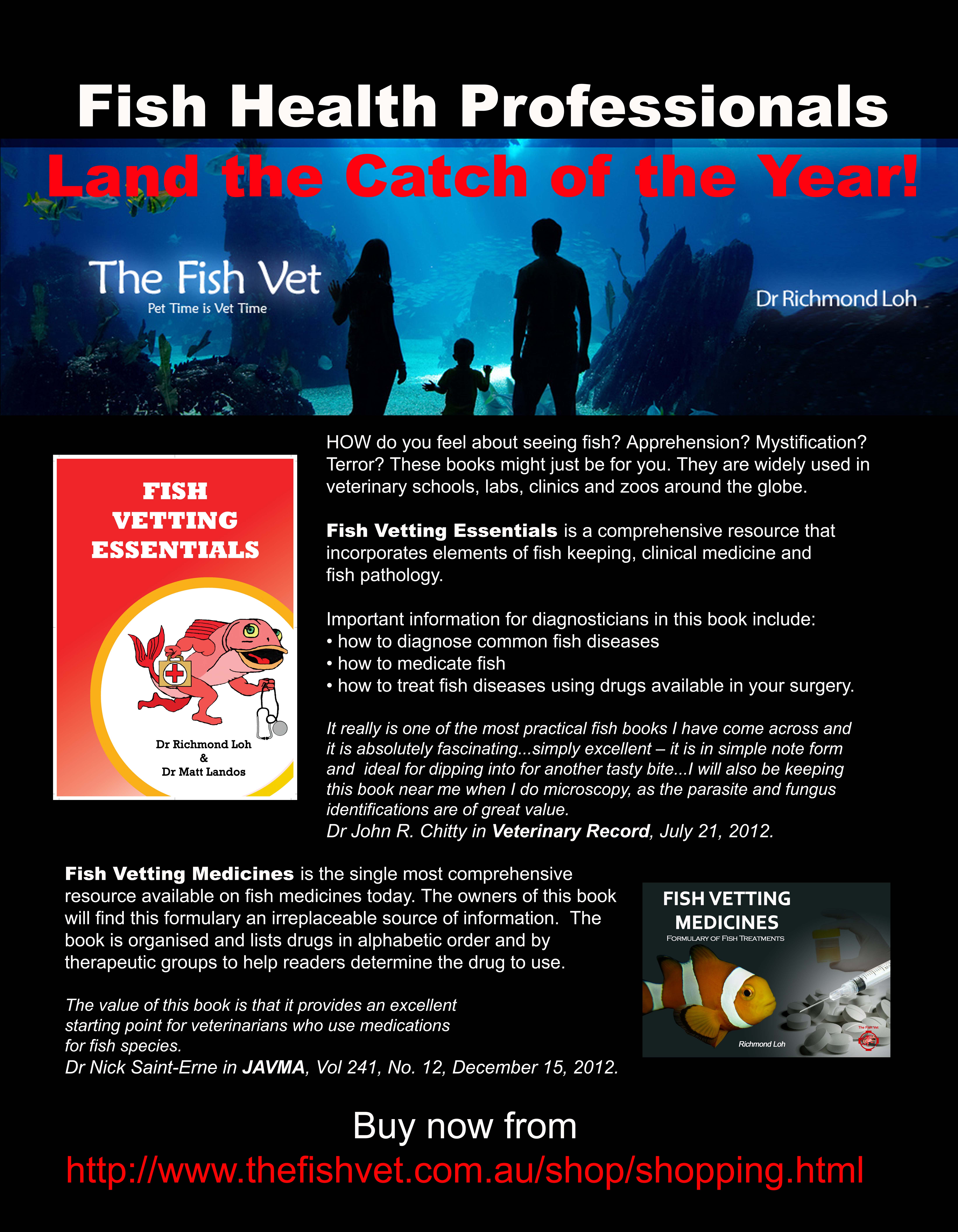
What’s so good about The Fish Vet’s series of books?

What’s so good about The Fish Vetting series of books?

The information contained in these books are well researched. They are essential tools veterinarians use to obtain answers to difficult cases. A lot of the information provided here can’t be found from other publications because it’s data, based on real-life experiences.

On top of that, unlike other text books that go out of date even before they’re published, these are ‘living’ documents with regular updates posted at – http://tinyurl.com/FishVettingSeriesUpdates

Put in your order now.


Land the catch of the day!

Unintentional sea lion bycatch associated with shark fishing.

A sad report. Read more at this link – http://mobile.news.com.au/national-news/secret-images-reveal-grisly-sea-lion-deaths-in-fishing-nets/story-fncynjr2-1226641479744

Welfare considerations for fasting fish.

This is an interesting read. I often get questioned by fish owners about how long can you go on holidays without getting someone in to feed your fish. It’s a very good question and is difficult to answer. The greatest issue with getting someone in to feed your fish is that very often, they are overfed. The uneaten food will pollute the water and you get mass mortalities. This would be a disaster!

On the other hand, if you don’t get someone in to feed your fish, how long can you do this for? This experiment shows that, in rainbow trout at least, there are no welfare issues with fasting for up to 3 days (58.0°C days).

Aquaculture
  Volume 401, Number 24 (June 2013)
     Short-term fasting and welfare prior to slaughter in rainbow trout, Oncorhynchus mykiss
   Authors: J. López-Luna, L. Vásquez, F. Torrent, M. Villarroel
   Author Affiliations:
no affiliations available
   Source: Aquaculture, Volume 401, Number 24 (June 2013)
   Page Numbers: 142 – 147
   Available Full Text:
Full Text: Subscription Required to view full text
Format: PDF
Size: Unknown
Location: Publisher’s Site
Authentication: Publisher’s Site
   Abstract: Fasting fish before slaughter is a common practice in aquaculture but it is not clear how long rainbow trout can be starved before suffering unnecessary stress, nor at what moment of the day slaughter is least stressful. We fasted 90 rainbow trout (Oncorhynchus mykiss; initial average weight 215.0±22.6g) for 24, 48 and 72h (19.5, 38.8 and 58.0°Cdays) and slaughtered them in the morning (08h00), afternoon (14h00) and night (20h00) to observe the effect of fasting duration and slaughter time on welfare indicators, including plasma cortisol, glucose and lactate concentrations as well as hematocrit and leucocyte count. The values of the fasted fish were compared with 90 control fish kept under similar conditions but not fasted. Body weight was not significantly different between fasted fish and controls during the trial but the relative weight of the gut was higher in control trout. Cortisol levels were similar between fasted and control fish and among the treatment groups. Similar results were found for glucose and lactate concentrations in plasma. Hematocrit values were also normal and similar between fasted fish and controls throughout the experiment, but leucocyte count was slightly lower in fasted fish by day three. There were no clear differences in any of the stress parameters in the morning, afternoon and night in either treatment. These results suggest that rainbow trout can cope with fasting up to three days (58.0°Cdays) prior to slaughter and that their welfare is therefore not seriously compromised.
   Citation: J. López-Luna, L. Vásquez, F. Torrent, M. Villarroel . Short-term fasting and welfare prior to slaughter in rainbow trout, Oncorhynchus mykiss. Aquaculture, Volume 401, Number 24 (June 2013), pp. 142-147, <http://ejournals.ebsco.com/direct.asp?ArticleID=43908152186A7DB49505&gt;
   URL: http://ejournals.ebsco.com/direct.asp?ArticleID=43908152186A7DB49505

Fish Joke for Monday-itis: mermaids

At the recent manta ray night dive trip at Kona, Hawaii, the dive master told us a joke. I thought of share it with you.

Q: Why do mermaids wear seashells?

A: Because B-shells are too small, and D-shells are too big!

20130531-014334.jpg

How was it discovered that the cultured puffer fish is not poisonous?

This was such an interesting story shared by Professor Teruo Miyazaki during his round Australia presentations.

Traditionally, fugu (literal translation means ‘river pig’) was only allowed to be served by the certified Japanese chefs who were trained to remove the poisonous parts of the fish. The tetradotoxin is normally present in high amounts in the liver, skin and gonads of the fish; where 1g of liver is sufficient to kill two adult humans! Why would people knowingly eat such a fish? I guess the flesh is delicious and it’s the thrill of playing ‘Russian roulette’, Japanese style!

So this is how the story goes… One day, a tiger puffer fish farmer brought home some of the fish and some of the fish that had died were tossed out in his yard. Then a neighbours dog came by and ate the fish! The fish farmer became distressed and was extremely apologetic to his neighbour, that his dog would die from the poisonous meal. But the next day, the farmer couldn’t believe his eyes when he saw the dog was waking around, unharmed and ‘undead’! That’s very strange because the number of fish it ate would have killed the dog 10 times over. So the farmer fed the dog the fish on two other occasions and the dog survived! He then took it upon himself to eat the fish. He thought that the flesh and liver of the fish were delicious, and did not suffer intoxication. He then brought some of the cultured fish to the university to examine for the presence of toxin and it was found to be negative!

The scientists were puzzled over this finding. The wild caught puffers contained the toxin, whereas those that were cultured did not. How and why can this be so?

Further investigation revealed that the puffer fish do not manufacture their own toxins, but they obtain their toxin from grazing on benthic organisms, absorbing and concentrating it in their liver, gonad and skin!

And so, this is how it was discovered that the aquacultured fugu fish is non-toxic. Interesting huh?