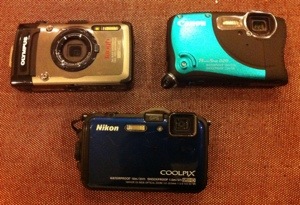
I’ve now managed to have a play with these three makes.
The new cameras are great I that you don’t have to switch between modes to take a picture or a video. They have ready to go, single push buttons to trigger a photo shoot or a video.
Now on to the comparisons. I would not normally recommend Olympus after having drowned two of the tough cameras, both times at a depth of only 4m while checking out the sharks at AQWA when it was built to survive 10m. But I was drawn to this one because of its quick reaction time. It also boasts a 12m water resist and 2m ‘drop proof-ability’ when other tough cameras tend to have a 10m water resist and 1.5m ‘drop proof-ability.’ I won’t be putting these to the test though because I don’t want to drown yet another (unless if Olympus will sponsor me another camera ;P). I really like its ability to shoot in low lighting which is particularly advantageous when shooting underwater if there is an amount of suspended solids or sand, since using flash photography will create distracting specks as the light bounces back. It is also good for users who are accustomed to holding the camera with both hands because the central location of the lenses means no dodgy fingers getting in the way of a great picture. But with this central location, it leant that the flash is placed in the top corner. Users with ‘two left hands’ may block the flash or cause the picture to be over-exposed. The downside of this camera is that it is relatively heavy, weighing in at 231g. The other minor inconvenience is that you have to scroll through each individual special scene selection rather than use the arrow keys to navigate to the selection more quickly on a grid system. The other minor hassle you’ll have with the Olympus is that you need to recharge the battery by connecting the camera to the power. This means that the camera is out of action until the charging is done. The other issue I have with this model is that when using the zoom while in video mode, you can really hear the noise when zooming in and out.
In terms of being user-friendly, the Canon camera is a real dud. There are three buttons on the top right part of almost equal size, shape and texture – the buttons are the on/off, photo taking and the photo review. All too often, an unaquainted user will be pressing all the wrong buttons and miss the perfect photo opportunity and become rather frustrated or feel a little less than smart. It might not be a problem after a while but it’ll get you every time you ask someone to take a picture of you/your group. And even more frustrating, is the 5 step method to delete a photo you’ve just taken. It’s not quick off the mark in terms of reaction time and not ideal for taking photos in low lighting. It is also rather bulky.
With the Nikon, it doesn’t have the advantages of the Olympus but at the same it doesn’t have the disadvantages of the Olympus or the Canon. It is easy to use, light (weighs 178g) and compact. It comes with a brush so you can brush off dirt to keep the seals clean each time you open and shut the battery/memory card compartment. This camera is great for taking panoramic photos because it takes the picture as you pan through rather than the Olympus where you have to try and match up the targets and them end up with horrible lighting differences after the pictures are stitched together by the camera program. The other pro about this make is that you can charge the battery in a charger, without connecting it to the power source. This means you can have several batteries on the go and the only thing limiting your happy snapping is the size of your memory card. The zoom on the Nikon is greater at 5x optical, plus it has a digital zoom too.
All in all, I’d recommend this model of Olympus for a better user experience and good quality photos. A close second is the Nikon. I’d avoid the Canon.