;
;
| Reviews in Fisheries Science | |||||||||||||||||
| Volume 20, Number 4 (October 2012) | |||||||||||||||||
 |
Coping with the Lionfish Invasion: Can Targeted Removals Yield Beneficial Effects? | ||||||||||||||||
| Authors: | ThomasK. Frazer 1, CharlesA. Jacoby 2, MorganA. Edwards 1, SavannaC. Barry 1, CarrieM. Manfrino 3 | ||||||||||||||||
| Author Affiliations: |
|
||||||||||||||||
| Source: | Reviews in Fisheries Science, Volume 20, Number 4 (October 2012) | ||||||||||||||||
| Page Numbers: | 185 – 191 | ||||||||||||||||
| Available Full Text: |
|
||||||||||||||||
| Abstract: | Invasive species generate significant environmental and economic costs, with maintenance management constituting a major expenditure. Such costs are generated by invasive Indo-Pacific lionfish (Pteroisspp.) that further threaten already stressed coral reefs in the western Atlantic Ocean and Caribbean Sea. This brief review documents rapid range expansion and potential impacts of lionfish. In addition, preliminary experimental data from targeted removals contribute to debates about maintenance management. Removals at sites off Little Cayman Island shifted the size frequency distribution of remaining lionfish toward smaller individuals whose stomachs contained less prey and fewer fish. Fewer lionfish and decreased predation on threatened grouper, herbivores and other economically and ecologically important fishes represent key steps toward protecting reefs. However, complete evaluation of success requires long-term data detailing immigration and recruitment by lionfish, compensatory growth and reproduction of lionfish, reduced direct effects on prey assemblages, and reduced indirect effects mediated by competition for food. Preventing introductions is the best way to avoid impacts from invasive species, and early detection linked to rapid response ranks second. Nevertheless, results from this case study suggest that targeted removals represent a viable option for shifting direct impacts of invasive lionfish away from highly vulnerable components of ecosystems. | ||||||||||||||||
| Citation: | ThomasK. Frazer, CharlesA. Jacoby, MorganA. Edwards, SavannaC. Barry, CarrieM. Manfrino . Coping with the Lionfish Invasion: Can Targeted Removals Yield Beneficial Effects?. Reviews in Fisheries Science, Volume 20, Number 4 (October 2012), pp. 185-191, ; | ||||||||||||||||
| URL: | http://ejournals.ebsco.com/direct.asp?ArticleID=4D2DB9DD4D1A1FA1731F | ||||||||||||||||
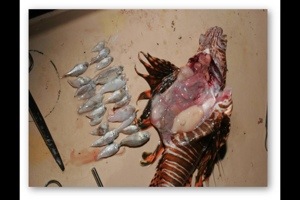
Check out how many fish this lionfish can consume!
Picture courtesy of Joanne Marie De Lourdes via Facebook.
