see what this girl does to that one shark near the end http://www.youtube.com/watch_popup?v=WK2LpUoqX6A&vq=medium
Month: September 2011
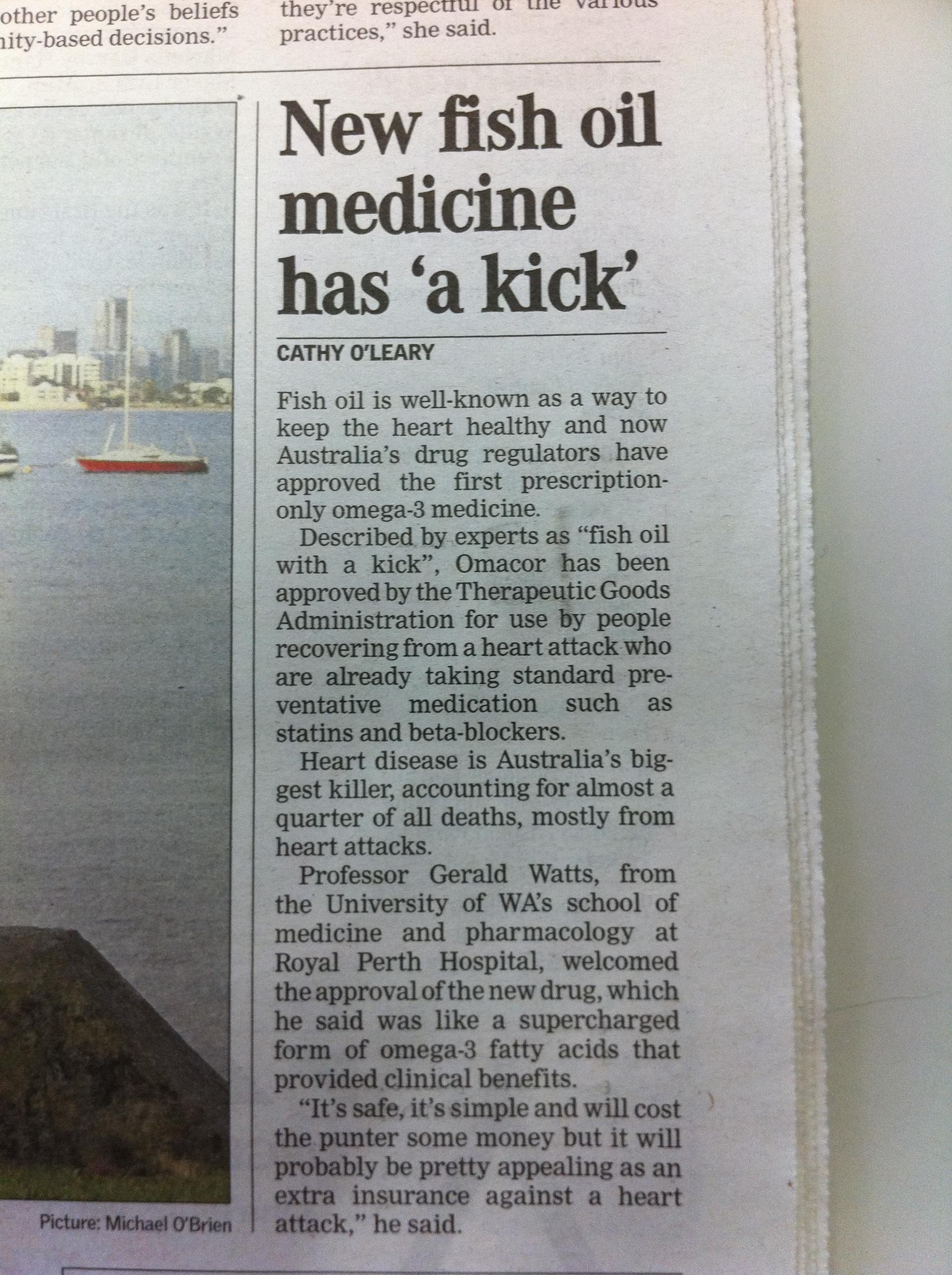
Fish oil is more than for brains and arthritis
Taken from today’s West Australian
A rare new find – A freshwater moray?
Is the elusive Gymnothorax polyuranodon really a freshwater moray?
Article first published online: 25 MAY 2011
DOI: 10.1111/j.1095-8649.2011.02987.x
© 2011 The Authors. Journal of Fish Biology © 2011 The Fisheries Society of the British Isles
Journal of Fish Biology
Volume 79, Issue 1, pages 70–79, July 2011
Keywords:
- Anguilliformes;
- elusive species;
- expert knowledge;
- Muraenidae;
- rarity;
- salinity
Analysis of 36 records of the rarely encountered moray Gymnothorax polyuranodon indicate that juveniles and adults inhabit fresh and mildly brackish habitats (salinity < 5) in streams of the Australian Wet Tropics Eighty-one per cent of these records were from freshwater streams and collectively demonstrate that this species inhabits fresh water throughout all seasons. A survey of fish researchers, each with at least 100 h of field experience in Australia’s Wet Tropics, revealed that 33% of researchers working in fresh waters (nine of 27 researchers) had encountered the species and 15% of researchers with substantial experience working in estuaries (two of 13 researchers) had encountered the species. The species was not sampled or observed in the nearshore marine environment. The only record of an elver of this species was, however, found in an estuary at a salinity of 33·4. This preliminary evidence suggests adult G. polyuranodon occupy freshwater habitats, but further research is required to understand the complete life cycle, including movements, habitat use and reproductive ecology of the species.
Scottish oyster shucker to compete in world championship in Galway!
See article here:
Kamikazi anemone kills fishes
One of my clients rang me in distraught. Soon after installing a wave maker, his magnifica anemone that had made a home for itself and hadn’t moved from the one spot for nearly a year, decided to “walk”. And walk it did, but only briefly until it encountered the powerhead and minced itself in the propeller blades. Within 4 hours, all fish species in the tank started becoming ill and died. The clinical signs they presented include listlessness, respiratory distress and death.
This reminded me of a case in aquacultured fish during my time working as a veterinary fish pathologist in a state veterinary laboratory. Usually, the netting used for aquacultured fish become fouled with aquatic organisms, and they are regularly taken ashore to be pressure cleaned and dried before re-use. But one time, the management thought it would save time and money to pressure clean the nets in-situ. But soon after this was done, high mortalities began to appear. Those fish that were affected were moribund and showed respiratory distress. Microscopic analysis of the organs of the fishes showed widespread, multiple pin-point skin and gill damage as well as severe splenic and liver damage. Such a pattern of damage was similar to previously reported cases of jellyfish stings. In this case of aquacultured fish, it was discovered that one of the “fouling” organisms on the nets included hydrozoans. These are very closely related to jellyfish and have stinging cells known as nematocysts. The pressure cleaning is suspected to have pulverised the hydrozoans, showering the fish with the stingers. Ever since this event, the management has decided not to take short cuts with cleaning their nets.
So, back to this ornamental aquarium fish case. It is suspected that fishes were exposed to toxins within the nematocysts that were released from the “suicidal” anemone, induced by mechanical stimulation/damage. There is no rescuing severely affected fishes. The only things you can do is to remove your fishes from the dangerous waters. Try to catch the fishes out and house them in separate tank. Alternatively, very large water changes would be needed to dilute the dangerous toxins. Chemical filtration and protein skimming may also help.
Sexing goldfish
To follow on from my previous post, sexing goldfish is a little more difficult. There isn’t the colour differences and it will be difficult to distinguish between males and females in those bred for their rotund body shapes.
However, during the breeding season/spring time, male fish will develop little white nodules ~0.5mm in diameter on their operculae (gill covers) and along the anterior rays of their pectoral fins. And of course, you will notice males chasing the females when they are ready to spawn.
Sexing koi
To follow on from my previous post, text books will often tell you that a male koi will be slimmer and have a longer head. Female kois will have a wider, deeper body and a shorter, more feminine head.
Those in the know will also add that during the breeding season, the male fish will be rougher to touch along their flanks and over their operculae (gill covers). The females on the other hand, will have smoother skins.
Your female kois will be roeing up now in preparation for spawning which would occur over the next few months. You might notice males showing more interest in the females and will chase them when they are ready to spawn.
Sexing fish
Sexing fishes are one of the most common things people ask fish keepers. Many would want to purchase a male and a female fish.
So, how do you tell the difference between a male and a female fish? In general, male fishes tend to have longer or more elaborate finnage and more intense colouration. Females tend to be bigger and more rotund in order to carry their eggs. Some species such as the live-bearing guppies, mollies, platies and half-beaks have their anal fins modified from the fan shapes (seen in females) to elongate tubes known as a gonopodium. Sharks and rays have similar long appendages known as claspers.
Grab a bargain

How to use a gravel siphon without getting a gob full of muck
In the past and including myself, we’ve all sucked the bottom of the hose to start the siphon. Those who are less skilled at this will usually get a mouthful of fishy water – YUKS! Be aware that there are several zoonotic pathogens in the water and it is not a good idea to do it this way.
Below are several ways of avoiding tasting the fishy waters:
- Use a syringe at the bottom end of the hose
- Fill the entire tube with aquarium water by submerging the entire length of hosing in the aquarium and allowing the air to escape; and then with a thumb sealing one end of the hose, put that end in the bucket and leave one end in the aquarium
- Scoop water into the hose with the broad end as shown in this video
- Purchase gravel siphons that come with a unidirectional valve so that you can pump the broad end in the water and start the flow.
Sorry that my descriptions aren’t quite clear, but speak to your other fish buddies and I reckon they can possibly figure out what I’m trying to say.